


Longitudinal Cognitive Changes in Genetic Frontotemporal Dementia Within the GENFI Cohort
- PMID: 35483895
- PMCID: PMC9302936
- DOI: 10.1212/WNL.0000000000200384
Longitudinal Cognitive Changes in Genetic Frontotemporal Dementia Within the GENFI Cohort
Abstract
Background and objectives: Disease-modifying therapeutic trials for genetic frontotemporal dementia (FTD) are underway, but sensitive cognitive outcome measures are lacking. The aim of this study was to identify such cognitive tests in early stage FTD by investigating cognitive decline in a large cohort of genetic FTD pathogenic variant carriers and by investigating whether gene-specific differences are moderated by disease stage (asymptomatic, prodromal, and symptomatic).
Methods: C9orf72, GRN, and MAPT pathogenic variant carriers as well as controls underwent a yearly neuropsychological assessment covering 8 cognitive domains as part of the Genetic FTD Initiative, a prospective multicenter cohort study. Pathogenic variant carriers were stratified according to disease stage using the global Clinical Dementia Rating (CDR) plus National Alzheimer's Coordinating Center (NACC) FTLD score (0, 0.5, or ≥1). Linear mixed-effects models were used to investigate differences between genetic groups and disease stages as well as the 3-way interaction between time, genetic group, and disease stage.
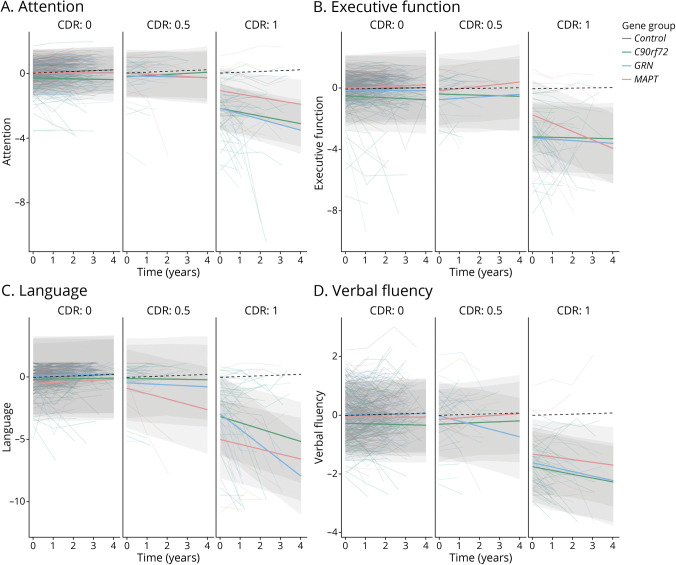
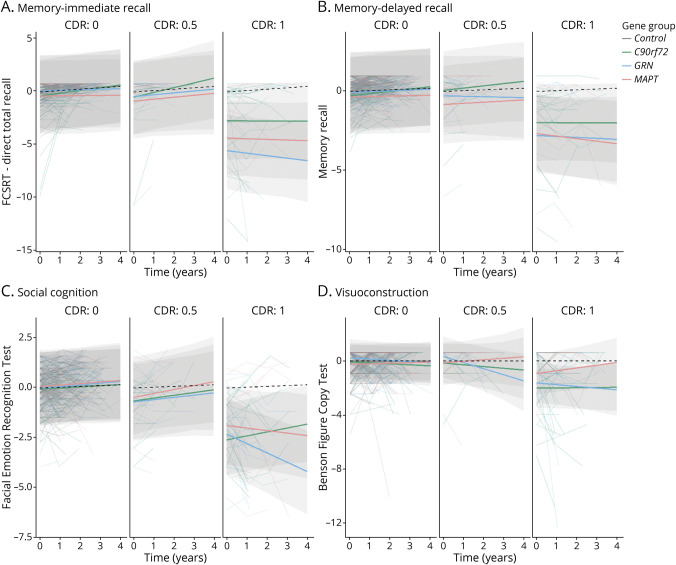
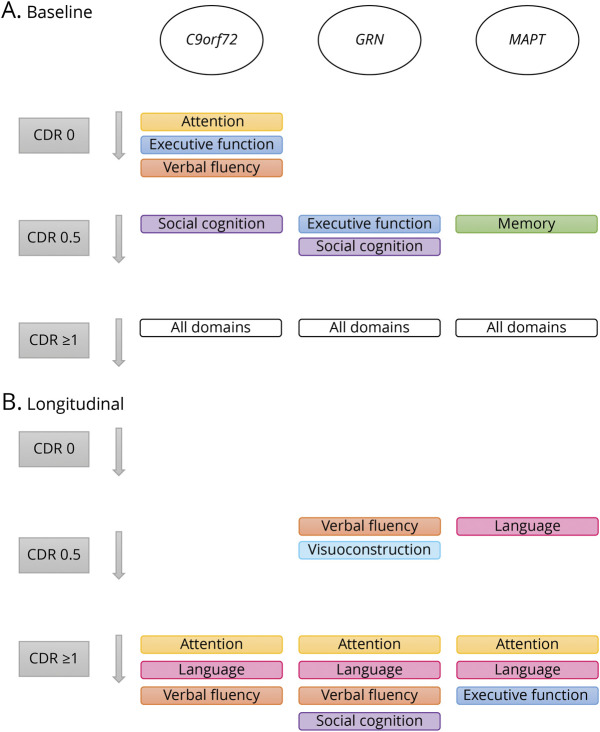
Results: A total of 207 C9orf72, 206 GRN, and 86 MAPT pathogenic variant carriers and 255 controls were included. C9orf72 pathogenic variant carriers performed lower on attention, executive function, and verbal fluency from CDR plus NACC FTLD 0 onwards, with relatively minimal decline over time regardless of the CDR plus NACC FTLD score (i.e., disease progression). The cognitive profile in MAPT pathogenic variant carriers was characterized by lower memory performance at CDR plus NACC FTLD 0.5, with decline over time in language from the CDR plus NACC FTLD 0.5 stage onwards, and executive dysfunction rapidly developing at CDR plus NACC FTLD ≥1. GRN pathogenic variant carriers declined on verbal fluency and visuoconstruction in the CDR plus NACC FTLD 0.5 stage, with progressive decline in other cognitive domains starting at CDR plus NACC FTLD ≥1.
Discussion: We confirmed cognitive decline in the asymptomatic and prodromal stage of genetic FTD. Specifically, tests for attention, executive function, language, and memory showed clear differences between genetic groups and controls at baseline, but the speed of change over time differed depending on genetic group and disease stage. This confirms the value of neuropsychological assessment in tracking clinical onset and progression and could inform clinical trials in selecting sensitive end points for measuring treatment effects as well as characterizing the best time window for starting treatment.
Copyright © 2022 The Author(s). Published by Wolters Kluwer Health, Inc. on behalf of the American Academy of Neurology.
Figures
References
-
- Seelaar H, Rohrer JD, Pijnenburg YA, Fox NC, van Swieten JC. Clinical, genetic and pathological heterogeneity of frontotemporal dementia: a review. J Neurol Neurosurg Psychiatry. 2011;82(5):476-486. - PubMed
-
- Lashley T, Rohrer JD, Mead S, Revesz T. An update on clinical, genetic and pathological aspects of frontotemporal lobar degenerations. Neuropathol Appl Neurobiol. 2015;41(7):858-881. - PubMed
