Meta-Analysis
. 2022 Apr 28;13(1):2337.
doi: 10.1038/s41467-022-29932-y.

Childhood body size directly increases type 1 diabetes risk based on a lifecourse Mendelian randomization approach

Affiliations
Meta-Analysis

Childhood body size directly increases type 1 diabetes risk based on a lifecourse Mendelian randomization approach

Tom G Richardson et al. Nat Commun. .

Abstract

The rising prevalence of childhood obesity has been postulated as an explanation for the increasing rate of individuals diagnosed with type 1 diabetes (T1D). In this study, we use Mendelian randomization (MR) to provide evidence that childhood body size has an effect on T1D risk (OR = 2.05 per change in body size category, 95% CI = 1.20 to 3.50, P = 0.008), which remains after accounting for body size at birth and during adulthood using multivariable MR (OR = 2.32, 95% CI = 1.21 to 4.42, P = 0.013). We validate this direct effect of childhood body size using data from a large-scale T1D meta-analysis based on n = 15,573 cases and n = 158,408 controls (OR = 1.94, 95% CI = 1.21 to 3.12, P = 0.006). We also provide evidence that childhood body size influences risk of asthma, eczema and hypothyroidism, although multivariable MR suggested that these effects are mediated by body size in later life. Our findings support a causal role for higher childhood body size on risk of being diagnosed with T1D, whereas its influence on the other immune-associated diseases is likely explained by a long-term effect of remaining overweight for many years over the lifecourse.


Conflict of interest statement

J.A.T. is a member of the Human Genetics Advisory Board of GSK. T.G.R. is employed part-time by Novo Nordisk outside of this work. The remaining authors declare no competing interests.

Figures

Fig. 1
Fig. 1. Directed acyclic graphs depicting the effects of childhood body size on disease risk.
Schematic representation of the analysis undertaken in this study using Mendelian randomisation (MR). A Using univariable MR to estimate the total effect of genetically predicted childhood body size on type 1 diabetes (T1D) risk without accounting for adulthood body size. B Applying multivariable MR to estimate the direct effect of genetically predicted childhood body size on T1D risk whilst accounting for the effect of adult body size and C using the same approach to estimate the indirect effect of childhood body size of T1D (via adult body size). The highlighted red lines indicate the causal pathway being evaluated in MR to estimate the A total, B direct, and C indirect effects of childhood body size on T1D risk.
Fig. 2
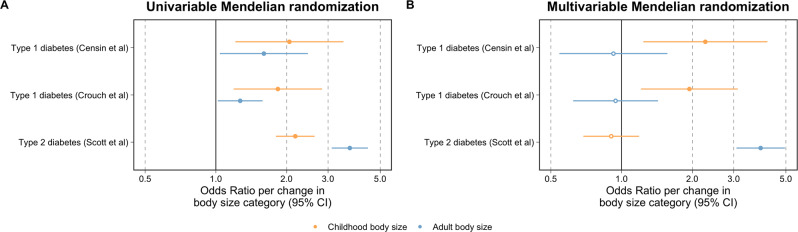
Fig. 2. Forest plots illustrating the total and direct effects of childhood body size on type 1 and type 2 diabetes risk.
A The univariable Mendelian randomisation (MR) estimates between childhood (yellow) and adult (blue) body size (n = 453,169) on risk of type 1 (using estimates from both discovery (n = 14,741) and replication analysis (n = 173,981)) and type 2 diabetes (n = 159,208) and B their corresponding multivariable MR estimates. Odds ratios are per change in body size category. 95% CI 95% confidence interval. Central estimates are illustrated as circles which were filled when confidence intervals did not overlap with the null. The data underlying these figures can be found in Supplementary Data 9, 13 and 16.
Fig. 3
Fig. 3. A forest plot depicting multivariable Mendelian randomisation estimates of childhood body size on type 1 diabetes risk for each study contributing to the meta-analysis.
Multivariable Mendelian randomisation analyses of childhood (yellow) and adult (blue) body size (n = 453,169) on type 1 diabetes risk were undertaken in each contributing study to the large-scale meta-analysis used in this work (n = 173,981). Odds ratios are per change in body size category. 95% CI 95% confidence interval. Central estimates are illustrated as circles which were filled when confidence intervals did not overlap with the null. T1DGC Type 1 Diabetes Genetics Consortium. The data underlying this figure can be found in Supplementary Data 14.
Fig. 4
Fig. 4. Forest plots comparing the univariable and multivariable Mendelian randomisation estimates of childhood body size on type 1 diabetes risk and seven chronic immune disease outcomes.
A The univariable Mendelian randomisation (MR) estimates between childhood (yellow) and adult (blue) body size (n = 453,169) on the risk of chronic immune disease outcomes (see Supplementary Data 1 for sample sizes) and B their corresponding multivariable MR estimates. The type 1 diabetes estimates were based on the analysis using data from Crouch et al. (2021) (n = 173,981). Odds ratios are per change in body size category. 95% CI 95% confidence interval. Central estimates are illustrated as circles which were filled when confidence intervals did not overlap with the null. The data underlying this figure can be found in Supplementary Data 13 and 17. Multiple testing comparisons for estimates in this figure were accounted for by calculating false discovery rates as reported in Supplementary Data 17.

References

    1. García, A. R. et al. Peripheral tolerance to insulin is encoded by mimicry in the microbiome. Preprint at bioRxiv10.1101/2019.12.18.881433 (2019).
    1. Bach JF. The effect of infections on susceptibility to autoimmune and allergic diseases. N. Engl. J. Med. 2002;347:911–920. doi: 10.1056/NEJMra020100. - DOI - PubMed
    1. Filippi CM, von Herrath MG. Viral trigger for type 1 diabetes: pros and cons. Diabetes. 2008;57:2863–2871. doi: 10.2337/db07-1023. - DOI - PMC - PubMed
    1. Vehik K, Dabelea D. The changing epidemiology of type 1 diabetes: why is it going through the roof? Diabetes Metab. Res. Rev. 2011;27:3–13. doi: 10.1002/dmrr.1141. - DOI - PubMed
    1. Ferrara-Cook C, et al. Excess BMI accelerates islet autoimmunity in older children and adolescents. Diabetes Care. 2020;43:580–587. doi: 10.2337/dc19-1167. - DOI - PMC - PubMed

Publication types