


Risk factors for severe COVID-19 differ by age for hospitalized adults
- PMID: 35484176
- PMCID: PMC9050669
- DOI: 10.1038/s41598-022-10344-3
Risk factors for severe COVID-19 differ by age for hospitalized adults
Abstract
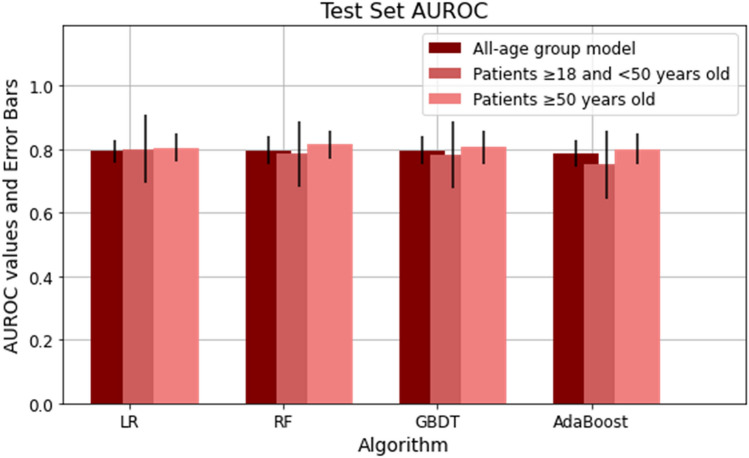
Risk stratification for hospitalized adults with COVID-19 is essential to inform decisions about individual patients and allocation of resources. So far, risk models for severe COVID outcomes have included age but have not been optimized to best serve the needs of either older or younger adults. Models also need to be updated to reflect improvements in COVID-19 treatments. This retrospective study analyzed data from 6906 hospitalized adults with COVID-19 from a community health system across five states in the western United States. Risk models were developed to predict mechanical ventilation illness or death across one to 56 days of hospitalization, using clinical data available within the first hour after either admission with COVID-19 or a first positive SARS-CoV-2 test. For the seven-day interval, models for age ≥ 18 and < 50 years reached AUROC 0.81 (95% CI 0.71-0.91) and models for age ≥ 50 years reached AUROC 0.82 (95% CI 0.77-0.86). Models revealed differences in the statistical significance and relative predictive value of risk factors between older and younger patients including age, BMI, vital signs, and laboratory results. In addition, for hospitalized patients, sex and chronic comorbidities had lower predictive value than vital signs and laboratory results.
© 2022. The Author(s).
Conflict of interest statement
JJH and SM have received grant funding from Pfizer for research unrelated to this work. JDG declared contracted research with Gilead, Lilly, and Regeneron, and fees from Gilead and Lilly for speaking and advisory board. JJH declared grant funding from Pfizer for COVID-19 research unrelated to this study. None of the other authors declare a competing interest with this study.
Figures

References
-
- WHO Coronavirus Disease (COVID-19) Dashboard at https://covid19.who.int. Accessed 10 Dec 2021.
-
- Zhou F, Yu T, Du R, Fan G, Liu Y, Liu Z, Xiang J, Wang Y, Song B, Gu X, Guan L, Wei Y, Li H, Wu X, Xu J, Tu S, Zhang Y, Chen H, Cao B. Clinical course and risk factors for mortality of adult inpatients with COVID-19 in Wuhan, China: A retrospective cohort study. Lancet. 2020;395:1054–1062. doi: 10.1016/S0140-6736(20)30566-3. - DOI - PMC - PubMed
-
- Kim L, Garg S, O’Halloran A, Whitaker M, Pham H, Anderson EJ, Armistead I, Bennett NM, Billing L, Como-Sabetti K, Hill M, Kim S, Monroe ML, Muse A, Reingold AL, Schaffner W, Sutton M, Talbot HK, Torres SM, Yousey-Hindes K, Holstein R, Cummings C, Brammer L, Hall AJ, Fry AM, Langley GE. Risk factors for intensive care unit admission and in-hospital mortality among hospitalized adults identified through the us coronavirus disease 2019 (COVID-19)-associated hospitalization surveillance network (COVID-NET) Clin. Infect. Dis. 2021;72:e206–e214. doi: 10.1093/cid/ciaa1012. - DOI - PMC - PubMed
Publication types
MeSH terms
Grants and funding
LinkOut - more resources
Full Text Sources
Medical
Miscellaneous
