


Identifying pleiotropic variants and candidate genes for fertility and reproduction traits in Holstein cattle via association studies based on imputed whole-genome sequence genotypes
- PMID: 35484513
- PMCID: PMC9052698
- DOI: 10.1186/s12864-022-08555-z
Identifying pleiotropic variants and candidate genes for fertility and reproduction traits in Holstein cattle via association studies based on imputed whole-genome sequence genotypes
Abstract
Background: Genetic progress for fertility and reproduction traits in dairy cattle has been limited due to the low heritability of most indicator traits. Moreover, most of the quantitative trait loci (QTL) and candidate genes associated with these traits remain unknown. In this study, we used 5.6 million imputed DNA sequence variants (single nucleotide polymorphisms, SNPs) for genome-wide association studies (GWAS) of 18 fertility and reproduction traits in Holstein cattle. Aiming to identify pleiotropic variants and increase detection power, multiple-trait analyses were performed using a method to efficiently combine the estimated SNP effects of single-trait GWAS based on a chi-square statistic.
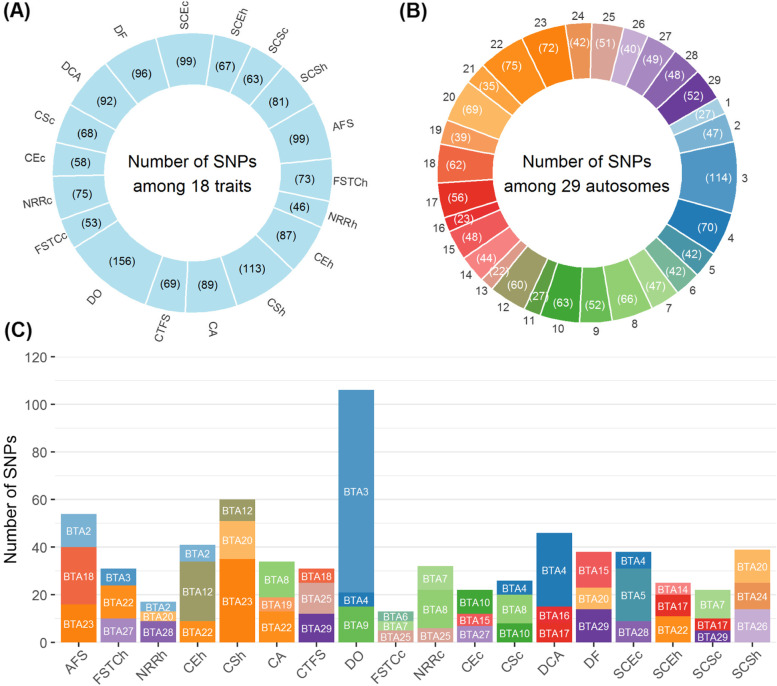
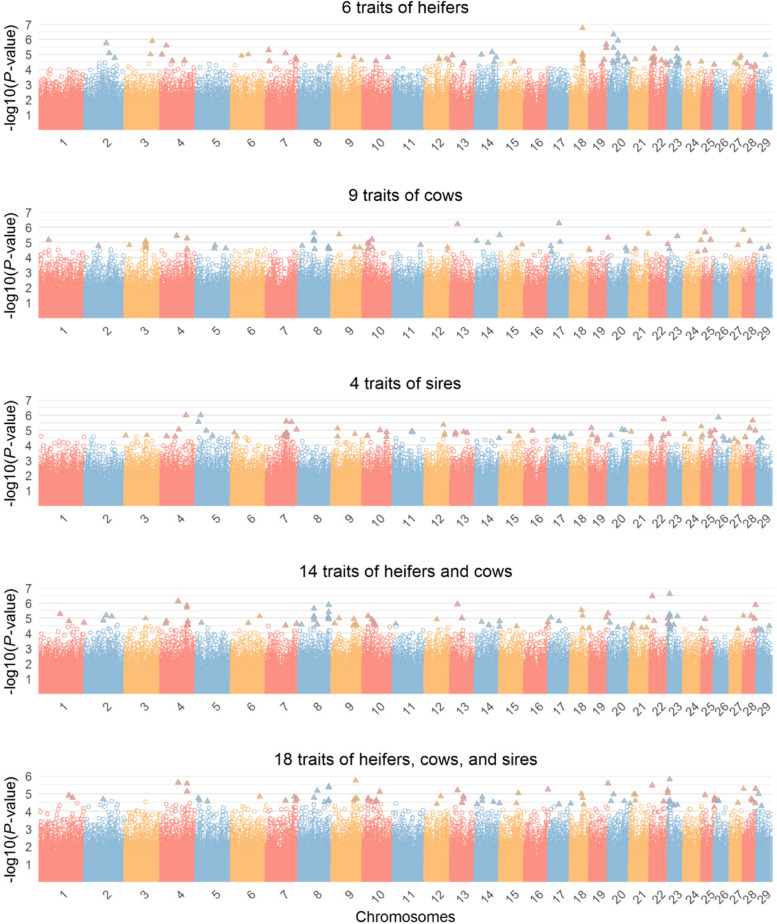
Results: There were 87, 72, and 84 significant SNPs identified for heifer, cow, and sire traits, respectively, which showed a wide and distinct distribution across the genome, suggesting that they have relatively distinct polygenic nature. The biological functions of immune response and fatty acid metabolism were significantly enriched for the 184 and 124 positional candidate genes identified for heifer and cow traits, respectively. No known biological function was significantly enriched for the 147 positional candidate genes found for sire traits. The most important chromosomes that had three or more significant QTL identified are BTA22 and BTA23 for heifer traits, BTA8 and BTA17 for cow traits, and BTA4, BTA7, BTA17, BTA22, BTA25, and BTA28 for sire traits. Several novel and biologically important positional candidate genes were strongly suggested for heifer (SOD2, WTAP, DLEC1, PFKFB4, TRIM27, HECW1, DNAH17, and ADAM3A), cow (ANXA1, PCSK5, SPESP1, and JMJD1C), and sire (ELMO1, CFAP70, SOX30, DGCR8, SEPTIN14, PAPOLB, JMJD1C, and NELL2) traits.
Conclusions: These findings contribute to better understand the underlying biological mechanisms of fertility and reproduction traits measured in heifers, cows, and sires, which may contribute to improve genomic evaluation for these traits in dairy cattle.
Keywords: Cattle breeding; GWAS; Genome-wide association study; QTL; Whole-genome sequence variants.
© 2022. The Author(s).
Conflict of interest statement
The authors declare that they have no competing interests.
Figures
References
-
- Brito LF, Bedere N, Douhard F, Oliveira HR, Arnal M, Peñagaricano F, et al. Invited Review: Genetic selection of high-yielding dairy cattle towards sustainable farming systems in a rapidly-changing world. Animal. 2021:100292. - PubMed
MeSH terms
Substances
LinkOut - more resources
Full Text Sources
Research Materials
Miscellaneous
