. 2022 Jun;9(18):e2104463.
doi: 10.1002/advs.202104463. Epub 2022 Apr 28.

Noninvasive and Individual-Centered Monitoring of Uric Acid for Precaution of Hyperuricemia via Optical Supramolecular Sensing

Affiliations

Noninvasive and Individual-Centered Monitoring of Uric Acid for Precaution of Hyperuricemia via Optical Supramolecular Sensing

Yaping Zhang et al. Adv Sci (Weinh). 2022 Jun.

Abstract

Characterized by an excessively increased uric acid (UA) level in serum, hyperuricemia induces gout and also poses a great threat to renal and cardiovascular systems. It is urgent and meaningful to perform early warning by noninvasive diagnosis, thus conducing to blockage of disease aggravation. Here, guanidinocalix[5]arene (GC5A) is successfully identified from the self-built macrocyclic library to specifically monitor UA from urine by the indicator displacement assay. UA is strongly bound to GC5A at micromolar-level, while simultaneously excluding fluorescein (Fl) from the GC5A·Fl complex in the "switch-on" mode. This method successfully differentiates patients with hyperuricemia from volunteers except for those with kidney dysfunction and targets a volunteer at high risk of hyperuricemia. In order to meet the trend from hospital-centered to individual-centered testing, visual detection of UA is studied through a smartphone equipped with a color-scanning feature, whose adaptability and feasibility are demonstrated in sensing UA from authentic urine, leading to a promising method in family-centered healthcare style. A high-throughput and visual detection method is provided here for alarming hyperuricemic by noninvasive diagnosis.

Keywords: hyperuricemia; indicator displacement assay; noninvasive diagnosis; smartphone; uric acid.


Conflict of interest statement

The authors declare no conflict of interest.

Figures

Scheme 1
Scheme 1
Schematic illustration for identifying UA artificial receptor from macrocyclic library by IDA.
Figure 1
Figure 1
Competitive titration in the GC5A·Fl complex by UA and MD simulation of GC5A·UA. A) Competitive titration in the GC5A·Fl (0.80 × 10−6/1.00 × 10−6 m) reporter pair performed with UA up to 119.88 × 10−6 m at λ ex = 500 nm and λ em = 513 nm (= 3). B) Competitive titration curve acquired according to a 1:1 competitive binding model in HEPES buffer solution (10 × 10−3 m, pH = 7.4) at 25 °C (= 3). C) Interactions and corresponding MEP in the GC5A·UA complex by a 100 ns MD simulation. Electrostatic, hydrogen bonding, and π−cation interactions were respectively colored by red, green, and pink dotted lines, in which C atoms of host and guest were respectively shown in green and cyan.
Figure 2
Figure 2
Specificity and sensitivity for UA sensing. A) Fluorescence responses of the GC5A·Fl (0.80 × 10−6/1.00 × 10−6 m) reporter pair at λ ex = 500 nm and λ em = 513 nm upon addition of UA or endogenous substances in HEPES buffer solution (10 × 10−3 m, pH = 7.4) at 25 °C, whose concentration was 0.40 mg L−1 for BSA and HSA, 5 mg L−1 for IgG, 3 × 10−3 m for Glc, 0.30 × 10−3 m for urea, Cl, K+, Tyr, Arg, Asp, Glu, and AA, and 10 × 10−6 m for UA, Xan, HX, All, Ade, Gua, and Cre, respectively (n = 3). I 0 and I are the fluorescence intensities of the GC5A·Fl complex (0.80 × 10−6/1.00 × 10−6 m) in the absence and presence of the tested analytes, respectively. B) The correlation between fluorescence response and the increased level of UA in the tenfold diluted artificial urine at 25 °C (n = 3). I 0 and I are the fluorescence intensities of the GC5A·Fl complex (8.00 × 10−6/4.00 × 10−6 m) in the absence and presence of the tested analytes, respectively.
Figure 3
Figure 3
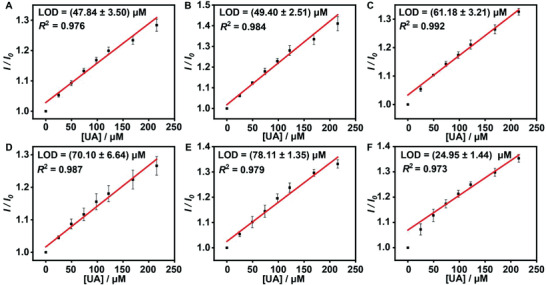
The calibration curves and LOD of UA acquired in the 50‐fold diluted urine from different volunteers (A–F) at 25 °C (n = 3). I 0 and I are the fluorescence intensities of the GC5A·Fl complex (10.00 × 10−6/5.00 × 10−6 m) before and after addition of UA.
Figure 4
Figure 4
Applicability of fluorescence sensing for UA monitoring and UA level in urine from volunteers and patients. A) The determined results of UA in urine from patients and volunteers by fluorescence sensing and HPLC (n = 3). B) A moderately positive correlation (r = 0.798, p < 0.01) of UA level determined by HPLC and fluorescence assay in urine. C) Fluorescence intensity of the GC5A·Fl complex (10.00 × 10−6/5.00 × 10−6 m) at λ ex = 500 nm and λ em = 513 nm exposed to UA in the 50‐fold diluted urine from patients and volunteers (n = 3). D) Statistical analysis by Student's t‐test among the groups of volunteers, hyperuricemia patients, and hyperuricemia patients with kidney disease (***, p < 0.001).
Figure 5
Figure 5
Visual monitoring of UA in HEPES buffer solution and urine from volunteer and hyperuricemia patient by smartphone with the GC5A·Fl reporter pair.

References

    1. Chen Y., Zhao Z., Li Y., Yang Y., Li L., Jiang Y., Lin C., Cao Y., Zhou P., Tian Y., Wu T., Pang J., Phytomedicine 2021, 80, 153374. - PubMed
    1. Lu J., Dalbeth N., Yin H., Li C., Merriman T. R., Wei W.‐H., Nat. Rev. Rheumatol. 2019, 15, 413. - PubMed
    1. Major T. J., Dalbeth N., Stahl E. A., Merriman T. R., Nat. Rev. Rheumatol. 2018, 14, 341. - PubMed
    1. Ichida K., Matsuo H., Takada T., Nakayama A., Murakami K., Shimizu T., Yamanashi Y., Kasuga H., Nakashima H., Nakamura T., Takada Y., Kawamura Y., Inoue H., Okada C., Utsumi Y., Ikebuchi Y., Ito K., Nakamura M., Shinohara Y., Hosoyamada M., Sakurai Y., Shinomiya N., Hosoya T., Suzuki H., Nat. Commun. 2012, 3, 764. - PMC - PubMed
    1. Dalbeth N., Choi H. K., Joosten L. A. B., Khanna P. P., Matsuo H., Perez‐Ruiz F., Stamp L. K., Nat. Rev. Dis. Primers 2019, 5, 69. - PubMed

Publication types

LinkOut - more resources