


Comparing the care experiences of Medicare Advantage beneficiaries with and without Alzheimer's disease and related dementias
- PMID: 35484976
- PMCID: PMC9378465
- DOI: 10.1111/jgs.17817
Comparing the care experiences of Medicare Advantage beneficiaries with and without Alzheimer's disease and related dementias
Abstract
Background: The Medicare Advantage (MA) program is rapidly growing. Limited evidence exists about the care experiences of MA beneficiaries with Alzheimer's Disease and Related Dementia (ADRD). Our objective was to compare care experiences for MA beneficiaries with and without ADRD.
Methods: We examined MA beneficiaries who completed the Medicare Advantage Consumer Assessment of Healthcare Providers and Systems (CAHPS) and used inpatient, nursing home, or home health services in the past 3 years. We classified beneficiaries with ADRD using the presence of diagnosis codes in hospitals, nursing homes, and home health records. Our key measures included overall ratings of care and health plan, and indices of receiving timely care, care coordination, receiving needed care, and customer service. We compared differences between beneficiaries with and without ADRD using regression analysis adjusting for demographic, health, and plan characteristics, and stratifying by proxy response status.
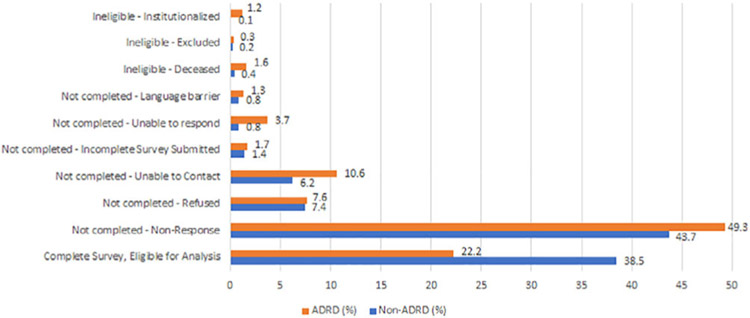
Results: Among beneficiaries sampled by CAHPS, 22.2% with ADRD completed the survey compared to 38.5% without ADRD. Among proxy responses, beneficiaries with ADRD were 4.2 (95% CI: 0.1-8.4) percentage points less likely to report a high score for receiving needed care, and 3.5 percentage points (95% CI: 0.2-6.9) less likely to report a high score for customer service. Among non-proxy responses, those with ADRD were 9.0 (95% CI: 5.5-12.5) percentage points less likely to report a high score for needed care, and 8.5 (95% CI: 5.4-11.5) percentage points less likely to report a high score for customer service.
Conclusions: ADRD respondents to the CAHPS were more likely to be excluded from CAHPS performance measures because they did not meet eligibility requirements and rates of non-response were higher. Among responders with or without a proxy, MA enrollees with an ADRD diagnosis reported worse care experiences in receiving needed care and in customer service than those without an ADRD diagnosis.
Keywords: ADRD; Alzheimer's; CAHPS; Medicare Advantage.
© 2022 The American Geriatrics Society.
Conflict of interest statement
CONFLICT OF INTEREST
Vincent Mor chairs the Scientific Advisory Board of naviHealth, a post-acute care convener. All other authors have no conflicts of interest to disclose.
Figures
References
-
- Black CM, Mehta V, Dubin B, Khandker RK, Ambegaonkar BM, Marsico M. Health care use among newly diagnosed Alzheimer's (AD) patients in a U.S. commercial Medicare Advantage insurance plan. Alzheim Dement J Alzheimers Assoc. 2017;13(7):P859. doi: 10.1016/j.jalz.2017.06.1216 - DOI
Publication types
MeSH terms
Grants and funding
LinkOut - more resources
Full Text Sources
Medical
Miscellaneous
