


Respiratory tract infections in Norwegian primary care 2006-2015: a registry-based study
- PMID: 35485789
- PMCID: PMC9397465
- DOI: 10.1080/02813432.2022.2069711
Respiratory tract infections in Norwegian primary care 2006-2015: a registry-based study
Erratum in
-
Correction.Scand J Prim Health Care. 2023 Dec;41(4):516. doi: 10.1080/02813432.2023.2250170. Epub 2023 Sep 4. Scand J Prim Health Care. 2023. PMID: 37665574 Free PMC article. No abstract available.
Abstract
Objective: Examine characteristics and time trends of respiratory tract infection (RTI) consultations in Norwegian primary care and compare consultations in daytime general practice and out-of-hours (OOH) services.
Design: Registry-based study using reimbursement claims data.
Setting: All in-person primary care consultations during 2006-2015.
Patients: All patients visiting primary care during the study period.
Main outcome measures: The main outcome variable was RTI consultations. Differences regarding service type (general practice or OOH services) and changes over time were investigated. We report associations with patient age and sex, season, point-of-care C-reactive protein (CRP) test use, and sickness certificate issuing.
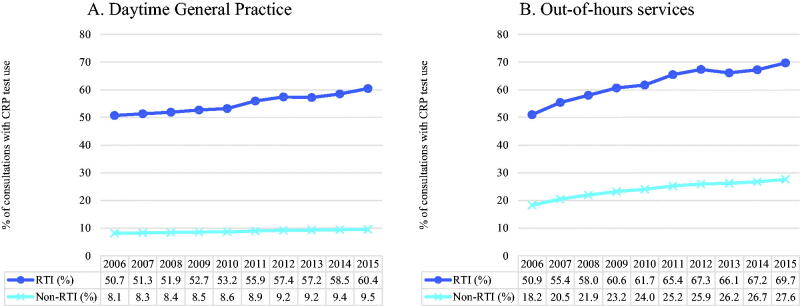
Results: RTI consultations (n = 16 304 777) represented 11.6% of all consultations (N = 140 199 637) in primary care over the ten-year period. The annual number of RTI consultations per 1000 inhabitants decreased from 335 to 314, while the number of consultations for any reason increased. Of RTI consultations, 83.2% occurred in general practice. OOH services had a higher proportion of RTI consultations (21.4%) compared with general practice (10.6%). Young children (0-4 years) represented 18.9% of all patients in RTI consultations. CRP testing was used in 56.2% of RTI consultations, and use increased over time. Sickness certificates were issued in 31.9% of RTI consultations with patients of working age (20-67 years).
Conclusion: Most RTI consultations occurred in general practice, although the proportion was higher in OOH services. Laboratory testing and/or issuing of sickness certificates were part of most consultations. This could be an important reason for seeking health care. Key PointsPatients with a respiratory tract infection (RTI) are mostly managed in primary care, where they represent much of the workload.Most consultations for RTIs took place in daytime general practice, but out-of-hours services had a higher proportion of RTI consultations.RTIs were the dominating reason for encounter among young children both in out-of-hours services and daytime general practice.CRP tests were used in over half of RTI consultations, and their use expanded over time.
Keywords: Data analysis; epidemiology; general practice; health services research; primary health care; respiratory tract infections.
Conflict of interest statement
The study was approved by the Regional Committee for Medical and Health Research Ethics, approval ID 2018/1541.
The authors have no conflicts of interest in the publication of this research paper.
Figures
References
-
- Putri WCWS, Muscatello DJ, Stockwell MS, et al. Economic burden of seasonal influenza in the United States. Vaccine. 2018;36(27):3960–3966. - PubMed
-
- Grimsmo A, Hagman E, Falko E, et al. Patients, diagnoses and processes in general practice in the nordic countries. An attempt to make data from computerised medical records available for comparable statistics. Scand J Prim Health Care. 2001;19:76–82. - PubMed
-
- Wandell P, Carlsson AC, Wettermark B, et al. Most common diseases diagnosed in primary care in Stockholm, Sweden, in 2011. Fam Pract. 2013;30(5):506–513. - PubMed
-
- Dekker ARJ, Verheij TJM, van der Velden AW.. Antibiotic management of children with infectious diseases in dutch primary care. Fam Pract. 2017;34(2):169–174. - PubMed
MeSH terms
Substances
LinkOut - more resources
Full Text Sources
Research Materials
Miscellaneous
