


The Architecture of a Feasibility Query Portal for Distributed COVID-19 Fast Healthcare Interoperability Resources (FHIR) Patient Data Repositories: Design and Implementation Study
- PMID: 35486893
- PMCID: PMC9135115
- DOI: 10.2196/36709
The Architecture of a Feasibility Query Portal for Distributed COVID-19 Fast Healthcare Interoperability Resources (FHIR) Patient Data Repositories: Design and Implementation Study
Abstract
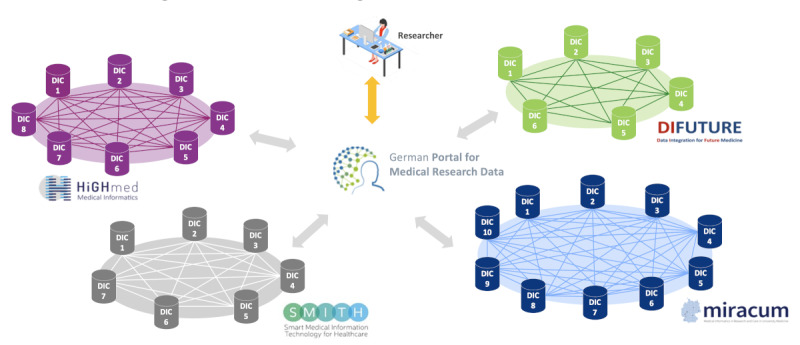
Background: An essential step in any medical research project after identifying the research question is to determine if there are sufficient patients available for a study and where to find them. Pursuing digital feasibility queries on available patient data registries has proven to be an excellent way of reusing existing real-world data sources. To support multicentric research, these feasibility queries should be designed and implemented to run across multiple sites and securely access local data. Working across hospitals usually involves working with different data formats and vocabularies. Recently, the Fast Healthcare Interoperability Resources (FHIR) standard was developed by Health Level Seven to address this concern and describe patient data in a standardized format. The Medical Informatics Initiative in Germany has committed to this standard and created data integration centers, which convert existing data into the FHIR format at each hospital. This partially solves the interoperability problem; however, a distributed feasibility query platform for the FHIR standard is still missing.
Objective: This study described the design and implementation of the components involved in creating a cross-hospital feasibility query platform for researchers based on FHIR resources. This effort was part of a large COVID-19 data exchange platform and was designed to be scalable for a broad range of patient data.
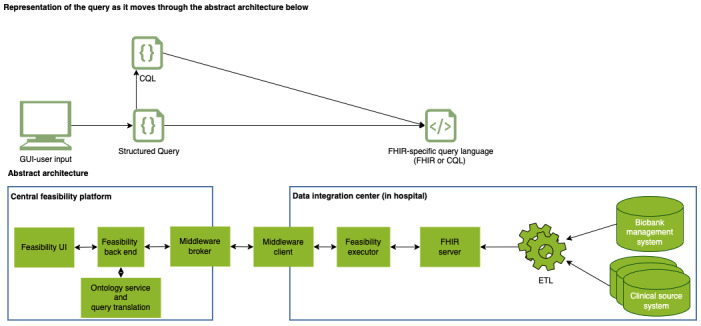
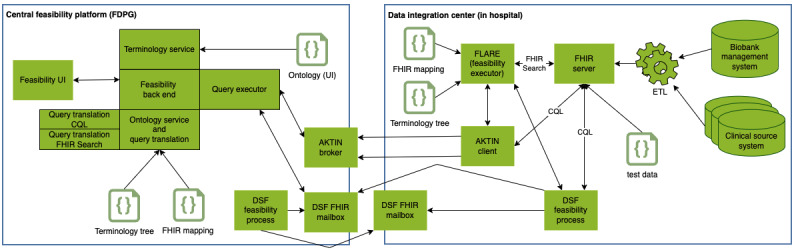
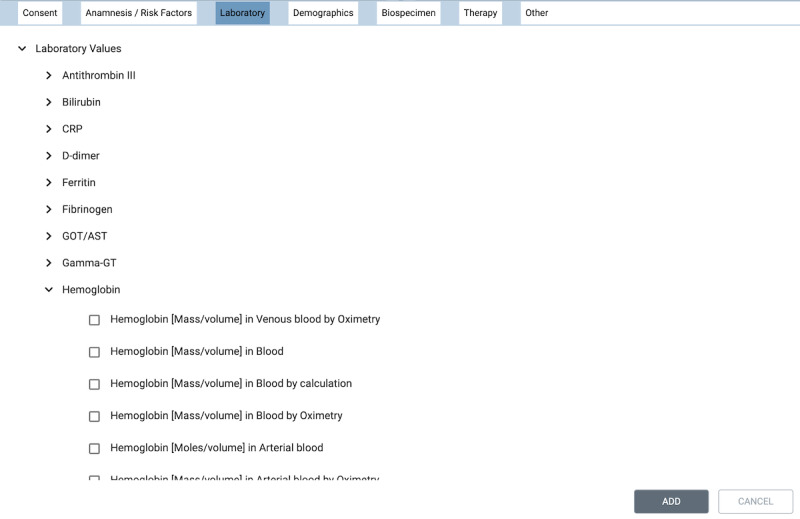
Methods: We analyzed and designed the abstract components necessary for a distributed feasibility query. This included a user interface for creating the query, backend with an ontology and terminology service, middleware for query distribution, and FHIR feasibility query execution service.
Results: We implemented the components described in the Methods section. The resulting solution was distributed to 33 German university hospitals. The functionality of the comprehensive network infrastructure was demonstrated using a test data set based on the German Corona Consensus Data Set. A performance test using specifically created synthetic data revealed the applicability of our solution to data sets containing millions of FHIR resources. The solution can be easily deployed across hospitals and supports feasibility queries, combining multiple inclusion and exclusion criteria using standard Health Level Seven query languages such as Clinical Quality Language and FHIR Search. Developing a platform based on multiple microservices allowed us to create an extendable platform and support multiple Health Level Seven query languages and middleware components to allow integration with future directions of the Medical Informatics Initiative.
Conclusions: We designed and implemented a feasibility platform for distributed feasibility queries, which works directly on FHIR-formatted data and distributed it across 33 university hospitals in Germany. We showed that developing a feasibility platform directly on the FHIR standard is feasible.
Keywords: COVID-19; CQL; FHIR; FHIR Search; Fast Healthcare Interoperability Resources; HL7 FHIR; consensus data set; distributed analysis; feasibility study; federated feasibility queries; health data; medical informatics; pandemic; patient data; query.
©Julian Gruendner, Noemi Deppenwiese, Michael Folz, Thomas Köhler, Björn Kroll, Hans-Ulrich Prokosch, Lorenz Rosenau, Mathias Rühle, Marc-Anton Scheidl, Christina Schüttler, Brita Sedlmayr, Alexander Twrdik, Alexander Kiel, Raphael W Majeed. Originally published in JMIR Medical Informatics (https://medinform.jmir.org), 25.05.2022.
Conflict of interest statement
Conflicts of Interest: None declared.
Figures
References
-
- Azzopardi-Muscat N, Kluge HH, Asma S, Novillo-Ortiz D. A call to strengthen data in response to COVID-19 and beyond. J Am Med Inform Assoc. 2021 Mar 01;28(3):638–9. doi: 10.1093/jamia/ocaa308. http://europepmc.org/abstract/MED/33275146 6020261 - DOI - PMC - PubMed
-
- Khan MS, Dar O, Erondu NA, Rahman-Shepherd A, Hollmann L, Ihekweazu C, Ukandu O, Agogo E, Ikram A, Rathore TR, Okereke E, Squires N. Using critical information to strengthen pandemic preparedness: the role of national public health agencies. BMJ Glob Health. 2020 Sep;5(9):e002830. doi: 10.1136/bmjgh-2020-002830. https://gh.bmj.com/lookup/pmidlookup?view=long&pmid=32994228 bmjgh-2020-002830 - DOI - PMC - PubMed
-
- Prasser F, Kohlbacher O, Mansmann U, Bauer B, Kuhn KA. Data Integration for Future Medicine (DIFUTURE) Methods Inf Med. 2018 Jul;57(S 01):e57–65. doi: 10.3414/ME17-02-0022. http://www.thieme-connect.com/DOI/DOI?10.3414/ME17-02-0022 - DOI - PMC - PubMed
-
- Haarbrandt B, Schreiweis B, Rey S, Sax U, Scheithauer S, Rienhoff O, Knaup-Gregori P, Bavendiek U, Dieterich C, Brors B, Kraus I, Thoms CM, Jäger D, Ellenrieder V, Bergh B, Yahyapour R, Eils R, Consortium H, Marschollek M. HiGHmed - an open platform approach to enhance care and research across institutional boundaries. Methods Inf Med. 2018 Jul;57(S 01):e66–81. doi: 10.3414/ME18-02-0002. http://www.thieme-connect.com/DOI/DOI?10.3414/ME18-02-0002 - DOI - PMC - PubMed
-
- Prokosch HU, Acker T, Bernarding J, Binder H, Boeker M, Boerries M, Daumke P, Ganslandt T, Hesser J, Höning G, Neumaier M, Marquardt K, Renz H, Rothkötter HJ, Schade-Brittinger C, Schmücker P, Schüttler J, Sedlmayr M, Serve H, Sohrabi K, Storf H. MIRACUM: Medical Informatics in Research and Care in University Medicine. Methods Inf Med. 2018 Jul;57(S 01):e82–91. doi: 10.3414/ME17-02-0025. http://www.thieme-connect.com/DOI/DOI?10.3414/ME17-02-0025 - DOI - PMC - PubMed
LinkOut - more resources
Full Text Sources
