


Sexually Transmitted Infections in Pregnant People With Human Immunodeficiency Virus: Temporal Trends, Demographic Correlates, and Association With Preterm Birth
- PMID: 35486952
- PMCID: PMC10200300
- DOI: 10.1093/cid/ciac321
Sexually Transmitted Infections in Pregnant People With Human Immunodeficiency Virus: Temporal Trends, Demographic Correlates, and Association With Preterm Birth
Abstract
Background: We describe trends in prevalence and identify factors associated with Chlamydia trachomatis (CT), Neisseria gonorrhoeae (NG), syphilis, and Trichomonas vaginalis (TV) diagnosed in pregnancy among US people with human immunodeficiency virus (PWH) and evaluate associations of sexually transmitted infections (STIs) with preterm birth (PTB).
Methods: We included pregnant PWH enrolled in the Surveillance Monitoring for ART Toxicities dynamic cohort of the Pediatric HIV/AIDS Cohort Study network who delivered between 2010 and 2019. Multivariable log-binomial or Poisson generalized estimating equation models were used to estimate the association of calendar year with each STI, controlling for confounders; the association of demographic and clinical factors with each STI; and the association of each STI with PTB.
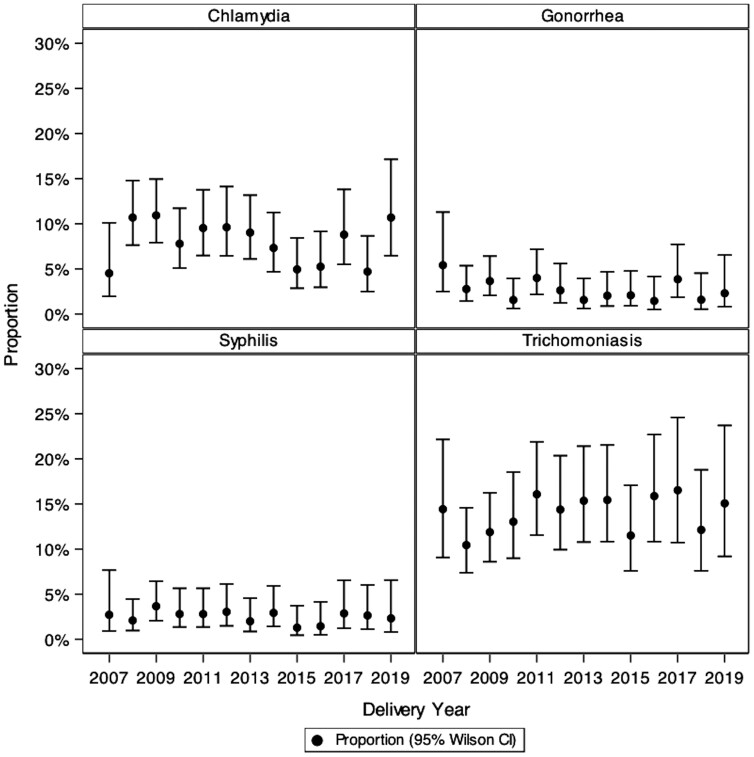
Results: The sample included 2241 pregnancies among 1821 PWH. Median age at delivery was 29.2 years; 71% of participants identified as Black or African American. STI prevalence was: CT 7.7%, NG 2.3%, syphilis 2.4%, and TV 14.5%; 30% had unknown TV status. There were no temporal changes in STI prevalence. Younger age and initial HIV viral load ≥400 copies/mL were associated with increased risk of CT, NG, and TV. Recreational substance use was a risk factor for NG, syphilis, and TV. No STI was associated with PTB.
Conclusions: Unlike nationwide trends, no changes in STI prevalence during the study period were observed. The large proportion with unknown TV status underscores the need for increased adherence to screening guidelines. STIs diagnosed during pregnancy in PWH were not associated with risk of PTB.
Keywords: HIV; pregnancy; preterm birth; sexually transmitted infections.
© The Author(s) 2022. Published by Oxford University Press on behalf of the Infectious Diseases Society of America. All rights reserved. For permissions, please e-mail: journals.permissions@oup.com.
Conflict of interest statement
Potential conflicts of interest. K. M. P. reports funding paid to the institution from the National Institutes of Health, outside the submitted work. E. G. C. reports payment for expert testimony from Brown & James, P.C. (paid to self) and stock or stock options from AbbVie (to spouse). L. Y. reports grant to institution from the National Institute of Diabetes and Digestive and Kidney Diseases, the National Heart, Lung, and Blood Institute, and Friends of Prentice, outside the submitted work. All other authors report no potential conflicts of interest. All authors have submitted the ICMJE Form for Disclosure of Potential Conflicts of Interest. Conflicts that the editors consider relevant to the content of the manuscript have been disclosed.
Figures
References
-
- Centers for Disease Control and Prevention . Sexually transmitted disease surveillance 2019. 2021. Available at: https://www.cdc.gov/std/statistics/2019/default.htm. Accessed 6 December 2021.
-
- Centers for Disease Control and Prevention . STDs and pregnancy—CDC fact sheet. Available at: www.cdc.gov/std/pregnancy/stdfact-pregnancy.htm. Accessed 8 May 2022.
-
- Andrews WW, Goldenberg RL, Mercer B, et al. The Preterm Prediction Study: association of second-trimester genitourinary chlamydia infection with subsequent spontaneous preterm birth. Am J Obstet Gynecol 2000; 183:662–8. - PubMed
