


National trend in heart failure hospitalization and outcome under public health insurance system in Thailand 2008-2013
- PMID: 35488204
- PMCID: PMC9052701
- DOI: 10.1186/s12872-022-02629-2
National trend in heart failure hospitalization and outcome under public health insurance system in Thailand 2008-2013
Abstract
Background: There are limited data on the burden, characteristics, and outcomes of hospitalized heart failure (HF) patients in Thailand. The aim of this study was to investigate national trend in HF hospitalization rate, in-hospital and 1-year mortality rate, and rehospitalization rate in Thailand.
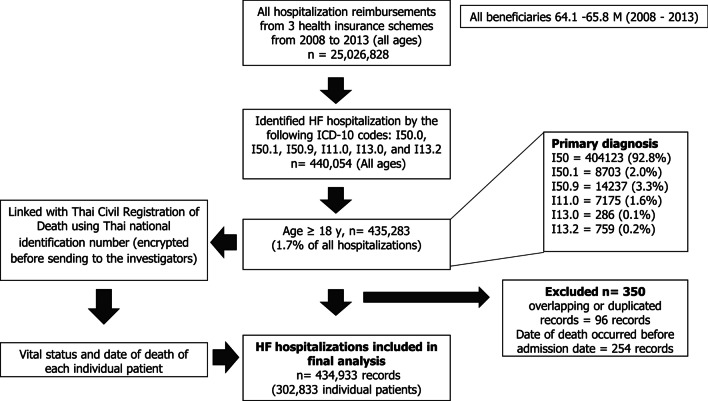
Methods: We analyzed the claims data of hospitalized patients obtained from the three major Thailand public health reimbursement systems between 2008 and 2013. Patients aged ≥ 18 years with a principal diagnosis of HF by the International Classification of Diseases, Tenth Revision, Thai modification were included. Comorbidities were identified by secondary diagnosis codes. The annual rate of HF hospitalization was calculated per 100,000 beneficiaries. Records of subsequent hospitalization of discharged patients were retrieved. For 1-year mortality rate, vital status of each patient was obtained from Thai Civil Registration of Death database. All outcomes were tested for linear trends across calendar years.
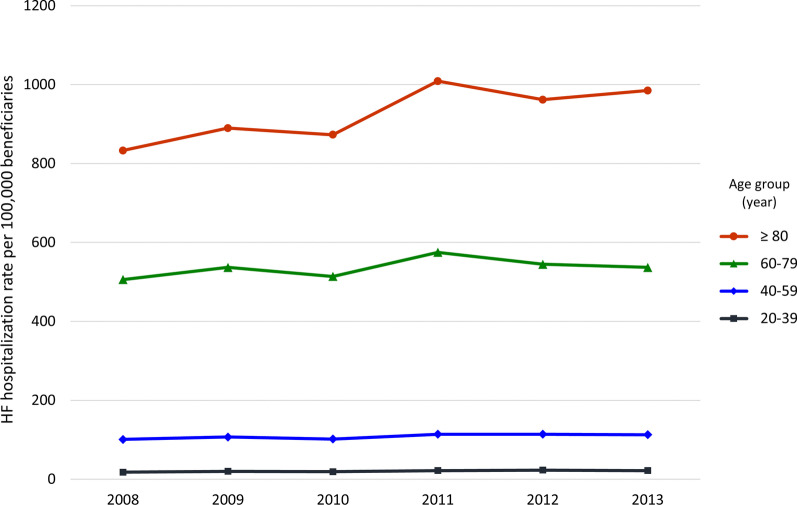
Results: Between 2008 and 2013, 434,933 HF hospitalizations were identified. The mean age was 65.3 years (SD 14.6), and 58.1% were female. The HF hospitalization rate increased from 138 in 2008 to 168 per 100,000 beneficiaries in 2013 (P for trend < 0.001). Nearly half (47.4%) had had a prior HF admission within 1 year. A small proportion of patients (7.4%) received echocardiography during hospitalization. The median length of hospital stay was 3 days. In-hospital mortality declined from 4.4 to 3.8% (P for trend < 0.001). The overall 30-day and 1-year rehospitalization rates were 34 and 73%, respectively, without significant trends over the study period. Most common cause of 30-day rehospitalization was HF (42%). One-year mortality decreased from 31.8% in 2008 to 28.5% in 2012 (P for trend < 0.001).
Conclusion: Between 2008 and 2013, HF hospitalization rate in Thailand increased. The in-hospital and 1-year mortality rates decreased slightly. However, the rehospitalization rate remained high mainly due to recurrent HF hospitalization.
Keywords: Heart failure; Hospitalization; National trend; Thailand.
© 2022. The Author(s).
Conflict of interest statement
I declare that the authors have no competing interests that might be perceived to influence the result and/or discussion reported in this paper.
Figures
References
-
- Jencks SF, Williams MV, Coleman EA. Rehospitalizations among patients in the Medicare fee-for-service program. N Engl J Med. 2009;360(14):1418–1428. - PubMed
-
- Bhatia RS, Tu JV, Lee DS, Austin PC, Fang J, Haouzi A, et al. Outcome of heart failure with preserved ejection fraction in a population-based study. N Engl J Med. 2006;355(3):260–269. - PubMed
-
- Atherton JJ, Hayward CS, Wan Ahmad WA, Kwok B, Jorge J, Hernandez AF, et al. Patient characteristics from a regional multicenter database of acute decompensated heart failure in Asia Pacific (ADHERE International-Asia Pacific) J Cardiac Fail. 2012;18(1):82–88. - PubMed
Publication types
MeSH terms
LinkOut - more resources
Full Text Sources
Medical
Research Materials
Miscellaneous
