


Engaging with EPIO, a digital pain self-management program: a qualitative study
- PMID: 35488295
- PMCID: PMC9052507
- DOI: 10.1186/s12913-022-07963-x
Engaging with EPIO, a digital pain self-management program: a qualitative study
Abstract
Background: Chronic pain conditions entail significant personal and societal burdens and improved outreach of evidence-based pain self-management programs are needed. Digital cognitive-behavioral self-management interventions have shown promise. However, evidence is still scarce and several challenges with such interventions for chronic pain exist. Exploring patients' experiences and engagement with digital interventions may be an essential step towards developing meaningful digital self-management interventions for those living with chronic pain.
Objectives: This study aimed to gain insight into the experiences of people with chronic pain when engaging with EPIO, an application (app)-based cognitive-behavioral pain self-management intervention program.
Methods: Participants (N = 50) living with chronic pain received access to the EPIO intervention in a feasibility pilot-study for 3 months. During this time, all participants received a follow-up phone call at 2-3 weeks, and a subsample (n = 15) also participated in individual semi-structured interviews after 3 months. A qualitative design was used and thematic analysis was employed aiming to capture participants' experiences when engaging with the EPIO intervention program.
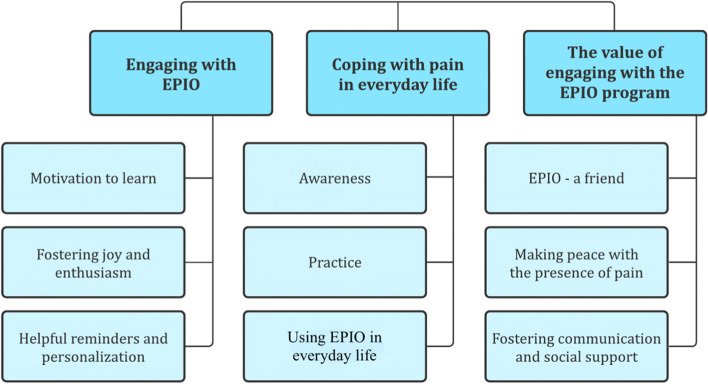
Results: Findings identifying program-related experiences and engagement were organized into three main topics, each with three sub-themes: (1) Engaging with EPIO; motivation to learn, fostering joy and enthusiasm, and helpful reminders and personalization, (2) Coping with pain in everyday life; awareness, practice and using EPIO in everyday life, and (3) The value of engaging with the EPIO program; EPIO - a friend, making peace with the presence of pain, and fostering communication and social support.
Conclusions: This qualitative study explored participants' experiences and engagement with EPIO, a digital self-management intervention program for people living with chronic pain. Findings identified valued aspects related to motivation for engagement, and showed how such a program may be incorporated into daily life, and encourage a sense of acceptance, social support and relatedness. The findings highlight vital components for facilitating digital program engagement and use in support of self-management for people living with chronic pain.
Trial registration: ClinicalTrials.gov NCT03705104 .
Keywords: Application (app); Chronic pain; Digital; EPIO; Engagement; Qualitative study; Self-management; eHealth.
© 2022. The Author(s).
Conflict of interest statement
The authors declare that they have no competing interests.
Figures
References
-
- Beck AT. Cognitive therapy and the emotional disorders. Oxford, England: International Universities Press; 1976.
MeSH terms
Associated data
LinkOut - more resources
Full Text Sources
Medical
Miscellaneous
