


The Postpartum Specific Anxiety Scale: Confirmatory factor analyses and relationships with birth experience
- PMID: 35488935
- PMCID: PMC9055017
- DOI: 10.1007/s00737-022-01233-9
The Postpartum Specific Anxiety Scale: Confirmatory factor analyses and relationships with birth experience
Abstract
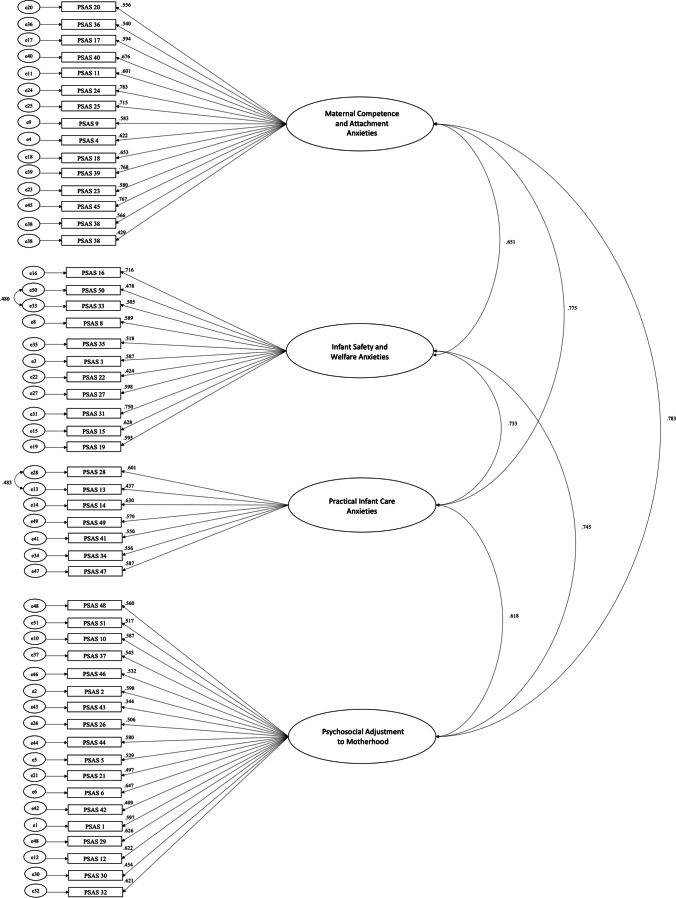
The Postpartum Specific Anxiety Scale [PSAS] was developed and validated as a research tool with a four-factor structure; with predictive validity corroborated in studies examining infant-feeding and maternal bonding outcomes. The PSAS has not been examined in relation to birth experiences. We aimed to confirm the PSAS four-factor structure and examine these domains of anxiety in relation to subjective and objective birth experiences. Postpartum mothers (≤ 12-months; N = 500) completed the PSAS alongside measures of subjective birth satisfaction and objective obstetric interventions/complications. Confirmatory factor analyses [CFA] tested eight models, theoretically derived from the preceding exploratory work. Structural equation modelling [SEM] tested associations between each PSAS factor and birth experience variables in the best-fitting model. An identical 51-item four-factor model fits the data well. SEM analyses revealed associations between lower perceptions of quality of intrapartum care and increased maternal competence and attachment anxieties, practical infant care anxieties, and infant safety and welfare anxieties. High subjective stress and negative emotional response to labour were associated with increased psychosocial adjustment to motherhood anxieties. Specific associations were found between neonatal care unit admission and practical infant care anxieties; and infant asphyxia and infant safety and welfare anxieties. Findings confirm construct and convergent validity of the four-factor PSAS and its use in measuring postpartum anxiety. Unique associations were also identified, indicating specific subjective and objective experiences occurring during birth may elicit a differential anxiety response, in that they are related to specific forms of postpartum anxiety which occur during the first postpartum year.
Keywords: Birth experience; Birth satisfaction; Child-bearing specific measures of mood; Maternal anxiety; Psychometrics.
© 2022. The Author(s).
Conflict of interest statement
Sergio A. Silverio (King’s College London) is currently supported by the National Institute for Health Research Applied Research Collaboration South London [NIHR ARC South London] at King’s College Hospital NHS Foundation Trust. The views expressed are those of the authors and not necessarily those of the NIHR or the Department of Health and Social Care.
References
-
- Azzopardi D, Strohm B, Marlow N, Brocklehurst P, Deierl A, Eddama O, Goodwin J, Halliday HL, Juszczak E, Kapellou O, Levene M, Linsell L, Omar O, Thoresen M, Tusor N, Whitelaw A, Edwards AD, for the TOBY Study Group Effects of hypothermia for perinatal asphyxia on childhood outcomes. N Engl J Med. 2014;371(2):140–149. doi: 10.1056/NEJMoa1315788. - DOI - PubMed
-
- Baptie G (2021) Birth Trauma: A mixed-methods investigation [Unpublished doctoral thesis]. University of Plymouth
-
- Bauer A, Parsonage M, Knapp M, Lemmi V, Adelaja B (2014) The costs of perinatal mental health problems. London School of Economics and Political Science and Centre for Mental Health
MeSH terms
LinkOut - more resources
Full Text Sources
Medical
