Effects of early-life poverty on health and human capital in children and adolescents: analyses of national surveys and birth cohort studies in LMICs
- PMID: 35489358
- PMCID: PMC9061872
- DOI: 10.1016/S0140-6736(21)02716-1
Effects of early-life poverty on health and human capital in children and adolescents: analyses of national surveys and birth cohort studies in LMICs
Abstract
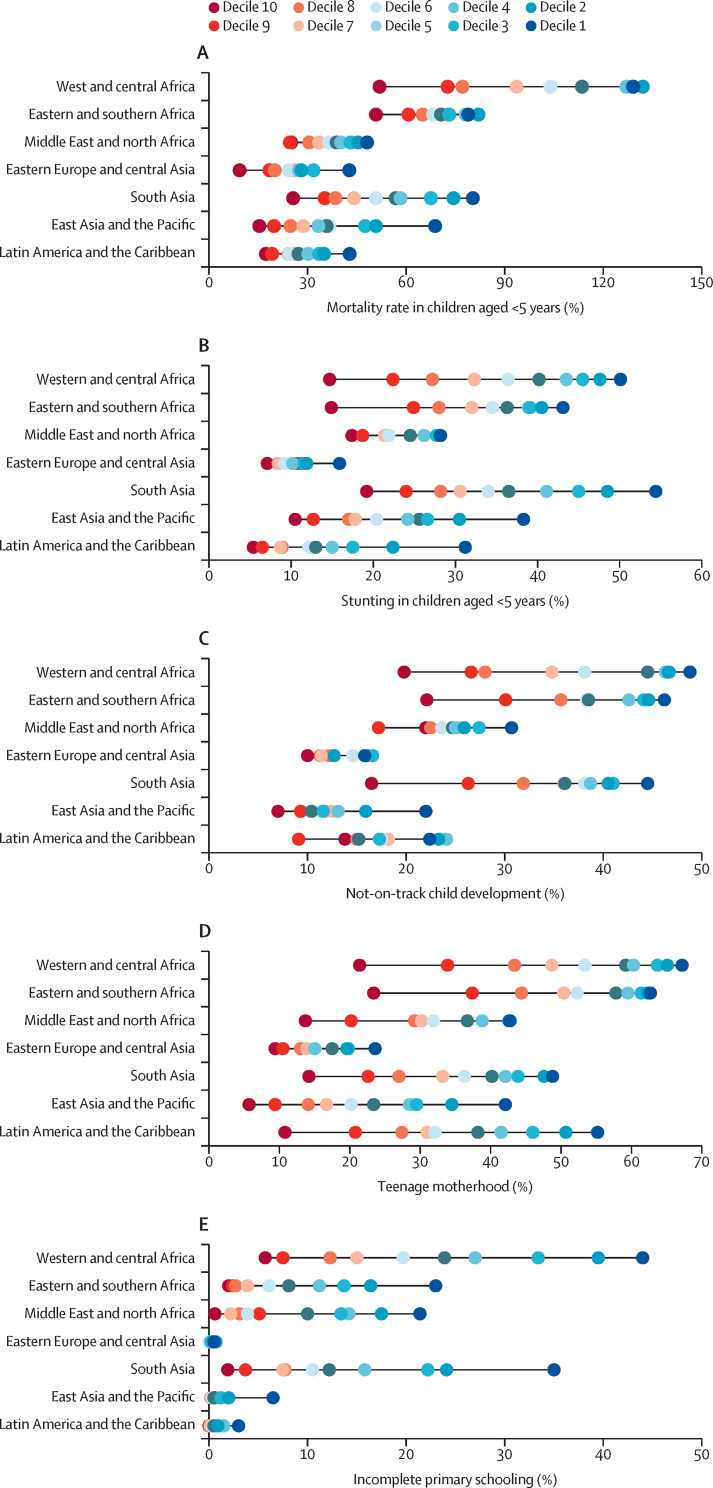
The survival and nutrition of children and, to a lesser extent, adolescents have improved substantially in the past two decades. Improvements have been linked to the delivery of effective biomedical, behavioural, and environmental interventions; however, large disparities exist between and within countries. Using data from 95 national surveys in low-income and middle-income countries (LMICs), we analyse how strongly the health, nutrition, and cognitive development of children and adolescents are related to early-life poverty. Additionally, using data from six large, long-running birth cohorts in LMICs, we show how early-life poverty can have a lasting effect on health and human capital throughout the life course. We emphasise the importance of implementing multisectoral anti-poverty policies and programmes to complement specific health and nutrition interventions delivered at an individual level, particularly at a time when COVID-19 continues to disrupt economic, health, and educational gains achieved in the recent past.
Copyright © 2022 Elsevier Ltd. All rights reserved.
Conflict of interest statement
Declaration of interests REB serves on the Board of Vitamin Angels, a non-profit charitable organisation supporting maternal and child nutrition services in LMICs. AS and ADS report grants from Bill and Melinda Gates Foundation. AS reports grants from the Wellcome Trust. ZAB reports grants from the International Development Research Centre (reproductive, maternal, newborn, child, and adolescent health in conflict settings: case studies to inform implementation of interventions) and Countdown to 2030–UNICEF. All other authors declare no competing interests.
Figures


References
-
- Sen A. Oxford University Press; Oxford, UK: 1999. Development as Freedom.
-
- World Bank Inequality and shared prosperity. 2019. https://www.worldbank.org/en/topic/isp/overview
-
- Wadhwa D. The World Bank; Washington, DC: 2018. The number of extremely poor people continues to rise in sub-Saharan Africa.
-
- Hasell J. Is income inequality rising around the world? Nov 23, 2018. https://www.weforum.org/agenda/2018/11/is-income-inequality-rising-aroun...
-
- UN . United Nations; New York, NY: 2015. 2030 Agenda for Sustainable Development.
Publication types
MeSH terms
Grants and funding
LinkOut - more resources
Full Text Sources
Medical
Miscellaneous