Review
. 2022 Jun:185:114311.
doi: 10.1016/j.addr.2022.114311. Epub 2022 Apr 27.

Laser ablation: Heating up the anti-tumor response in the intracranial compartment

Affiliations
Review

Laser ablation: Heating up the anti-tumor response in the intracranial compartment

Emily C Lerner et al. Adv Drug Deliv Rev. 2022 Jun.

Abstract

Immunotherapies, such as immune checkpoint inhibition (ICI), have had limited success in treating intracranial malignancies. These failures are due partly to the restrictive blood-brain-barrier (BBB), the profound tumor-dependent induction of local and systemic immunosuppression, and immune evasion exhibited by these tumors. Therefore, novel approaches must be explored that aim to overcome these stringent barriers. LITT is an emerging treatment for brain tumors that utilizes thermal ablation to kill tumor cells. LITT provides an additional therapeutic benefit by synergizing with ICI and systemic chemotherapies to strengthen the anti-tumor immune response. This synergistic relationship involves transient disruption of the BBB and local augmentation of immune function, culminating in increased CNS drug penetrance and improved anti-tumor immunity. In this review, we will provide an overview of the challenges facing immunotherapy for brain tumors, and discuss how LITT may synergize with the endogenous anti-tumor response to improve the efficacy of ICI.

Keywords: Anti-tumor immunity; Blood brain barrier; Brain metastases; Checkpoint blockade; Checkpoint inhibition; Glioblastoma; Glioma; Hyperthermia; Immunotherapy; Intracranial tumors; LITT laser interstitial thermal therapy.


Conflict of interest statement

Declaration of Competing Interest The authors declare that they have no known competing financial interests or personal relationships that could have appeared to influence the work reported in this paper.

Figures

Fig 1.
Fig 1.
The LITT catheter is inserted into the core of the tumor using MRI guidance. Once the laser is turned on, the temperature of the surrounding tissue increases as light energy converts to heat energy. The amount of heat generated by LITT is a function of both time and distance. As distance increases, temperature decreases resulting in the formation of three histologically distinct ablation zones. In zone 1, temperatures exceed 46°C , causing irreversible damage to cells and rapid necrosis. Temperatures in zone 2 range from 41-45°C causing initially reversible damage that becomes irreversible as ablation time increases. In zone 3, temperatures are within the physiologic fever range and lead to inflammatory changes.
Fig 2
Fig 2
During laser ablation, the core of the tumor reaches temperatures above 46 C and local cells rapidly incur irreversible damage and necrose. Necrotic tumor cells spill intracellular components including DNA, RNA, and HSPs into the TME. Following ablation, these intracellular components serve as inflammatory signals leading to the recruitment and activation of NK cells to the tumor site, and dendritic cell maturation and migration to the tumor, and stimulate APCs to secrete inflammatory cytokines and chemokines ultimately propagating the inflammatory response in the area surrounding the ablation site. Additionally, necrotic tumor cells release antigens into the TME which are picked up by APCs and trafficked to the cervical lymph nodes where they are presented to tumor specific T cells. These tumor specific T cells then become activated, undergo clonal expansion, and traffic to the tumor site ultimately resulting in an antigen specific anti-tumor response.
Fig 3
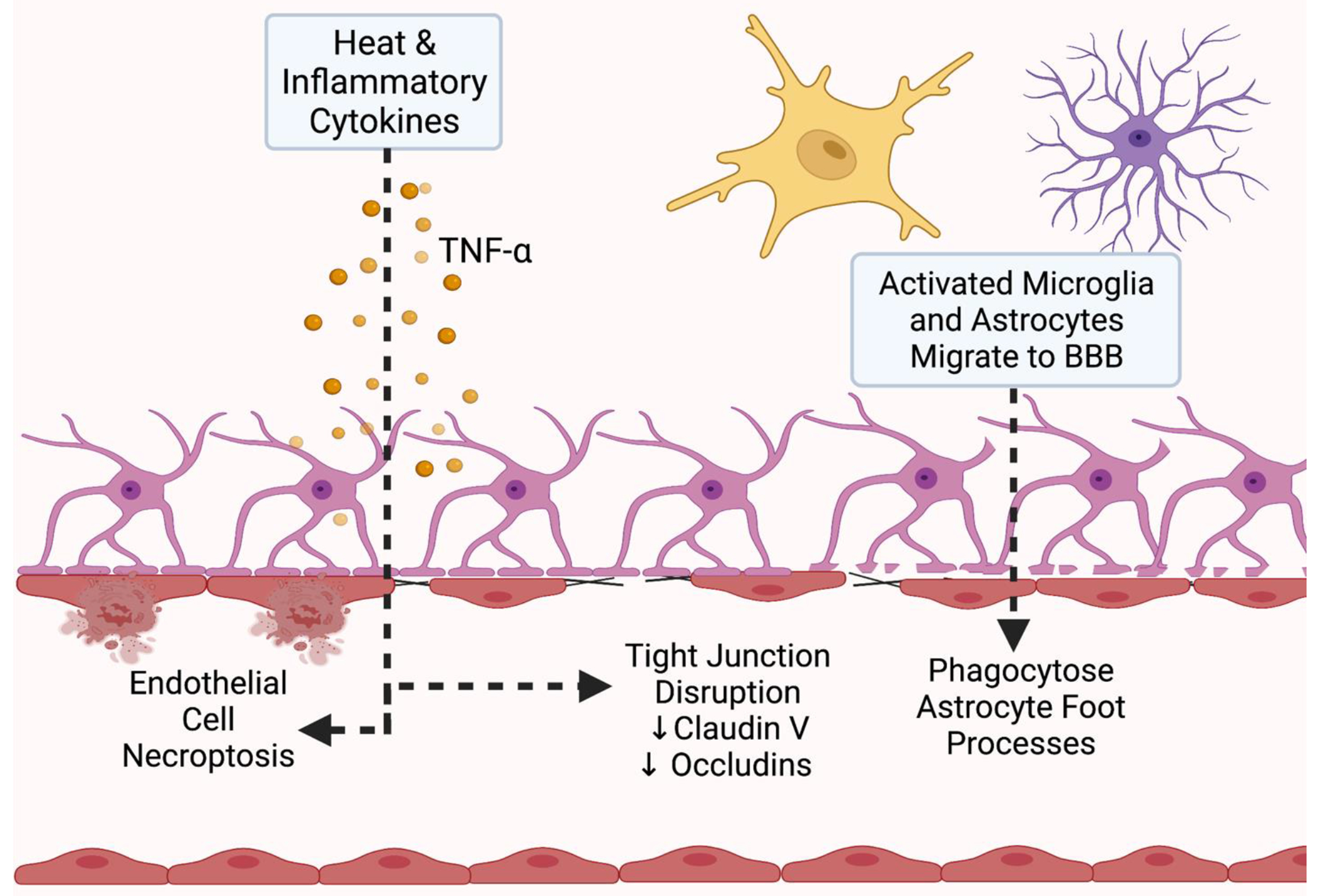
Fig 3
Tissue heating from LITT directly affects the permeability of the blood brain barrier by disrupting gap junctions and increasing endothelial cell endocytosis. The inflammatory response following LITT also creates a transient disruption in BBB permeability as cytokines including TNF-a disrupt the BBB by directly induce endothelial necroptosis and decreasing the expression of junctional proteins claudin V and occludin. Inflammation at the BBB also leads to the recruitment of activated microglia and astrocytes which further disrupt the BBB integrity through phagocytosis of BBB-associated astrocyte foot processes.

References

    1. Vaddepally RK, et al., Review of Indications of FDA-Approved Immune Checkpoint Inhibitors per NCCN Guidelines with the Level of Evidence. Cancers (Basel), 2020. 12(3). - PMC - PubMed
    1. Robert C, A decade of immune-checkpoint inhibitors in cancer therapy. Nature Communications, 2020. 11(1): p. 3801. - PMC - PubMed
    1. Schreiber RD, Old LJ, and Smyth MJ, Cancer Immunoediting: Integrating Immunity’s Roles in Cancer Suppression and Promotion. Science, 2011. 331(6024): p. 1565–1570. - PubMed
    1. Dunn GP, et al., Cancer immunoediting: from immunosurveillance to tumor escape. Nature Immunology, 2002. 3(11): p. 991–998. - PubMed
    1. Dunn GP, Fecci PE, and Curry WT, Cancer immunoediting in malignant glioma. Neurosurgery, 2012. 71(2): p. 201–22; discussion 222-3. - PubMed