. 2022 Aug;25(8):1268-1280.
doi: 10.1016/j.jval.2022.03.016. Epub 2022 Apr 28.

Emerging Therapies for COVID-19: The Value of Information From More Clinical Trials

Affiliations

Emerging Therapies for COVID-19: The Value of Information From More Clinical Trials

Stijntje W Dijk et al. Value Health. 2022 Aug.

Abstract

Objectives: The COVID-19 pandemic necessitates time-sensitive policy and implementation decisions regarding new therapies in the face of uncertainty. This study aimed to quantify consequences of approving therapies or pursuing further research: immediate approval, use only in research, approval with research (eg, emergency use authorization), or reject.

Methods: Using a cohort state-transition model for hospitalized patients with COVID-19, we estimated quality-adjusted life-years (QALYs) and costs associated with the following interventions: hydroxychloroquine, remdesivir, casirivimab-imdevimab, dexamethasone, baricitinib-remdesivir, tocilizumab, lopinavir-ritonavir, interferon beta-1a, and usual care. We used the model outcomes to conduct cost-effectiveness and value of information analyses from a US healthcare perspective and a lifetime horizon.

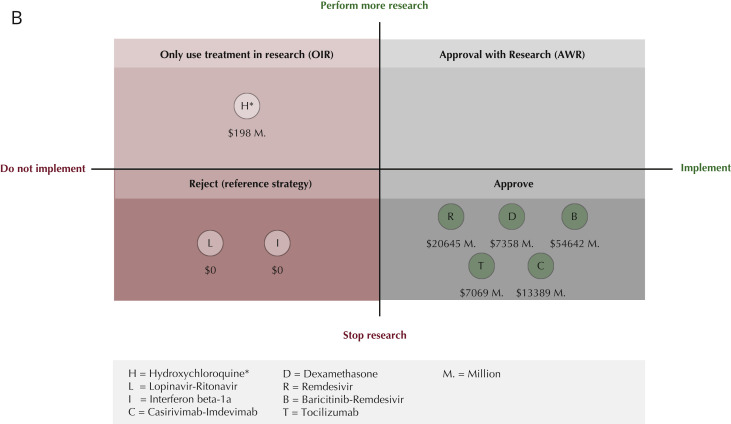
Results: Assuming a $100 000-per-QALY willingness-to-pay threshold, only remdesivir, casirivimab-imdevimab, dexamethasone, baricitinib-remdesivir, and tocilizumab were (cost-) effective (incremental net health benefit 0.252, 0.164, 0.545, 0.668, and 0.524 QALYs and incremental net monetary benefit $25 249, $16 375, $54 526, $66 826, and $52 378). Our value of information analyses suggest that most value can be obtained if these 5 therapies are approved for immediate use rather than requiring additional randomized controlled trials (RCTs) (net value $20.6 billion, $13.4 billion, $7.4 billion, $54.6 billion, and $7.1 billion), hydroxychloroquine (net value $198 million) is only used in further RCTs if seeking to demonstrate decremental cost-effectiveness and otherwise rejected, and interferon beta-1a and lopinavir-ritonavir are rejected (ie, neither approved nor additional RCTs).

Conclusions: Estimating the real-time value of collecting additional evidence during the pandemic can inform policy makers and clinicians about the optimal moment to implement therapies and whether to perform further research.

Keywords: COVID-19; cost-benefit analysis; decision support techniques; drug approval.


Figures

Figure 1
Figure 1
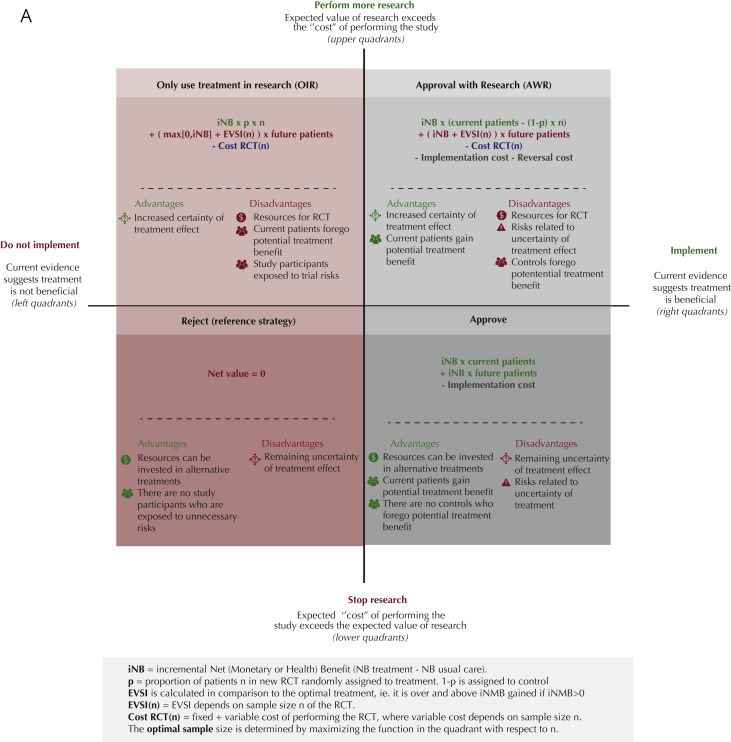
Trade-off between implementation of promising COVID-19 treatments and conducting further research. (A) Net value equations and description of trade-offs. Demonstrates the equations used to quantify the net value for the overall strategy options, compared to reject as default strategy. These equations take iNB, EVSI, RCT cost, and number of patients (current and future) into account. iNB may be expressed in monetary units (NMB) or health units (NHB). One could also consider irrecoverable costs for the implementation of a new treatment or the possible reversal of implementation. However, in our analysis implementation and reversal costs are assumed negligible and therefor, shown in gray. The figure additionally shows the advantages and disadvantages of the corresponding implementation and research strategy. These quadrants are based on whether the drug’s current evidence suggests benefit versus standard care or placebo (the right quadrants) or not (left quadrants). Within these right and left quadrants, the upper and lower quadrants indicate whether the value of doing additional research to reduce the uncertainty in benefit exceeds the “cost” of performing additional research expressed economically or (as quality-adjusted) life years lost) in the upper quadrants or not in the lower quadrants. (B) Net value results for optimal strategy. The net value results for the currently existing evidence and its uncertainty for eight drugs are calculated and each drug is placed in the resulting optimal health policy quadrant. Other factors, in particular ethical issues, also need to be considered to decide whether a strategy is desirable. For our study this is particularly true for Hyrdroxychloroquine. H∗ = Hydroxychloroquine: OIR has the highest net value if further research would demonstrate decremental cost-effectiveness (that is, saving costs but with loss of quality-adjusted life years). The ethics of investigating such decremental cost-effectiveness should be considered. If not justifiable, then hydroxychloroquine would move to the Reject category, where the net value would be 0.
Figure 1
Figure 1
Trade-off between implementation of promising COVID-19 treatments and conducting further research. (A) Net value equations and description of trade-offs. Demonstrates the equations used to quantify the net value for the overall strategy options, compared to reject as default strategy. These equations take iNB, EVSI, RCT cost, and number of patients (current and future) into account. iNB may be expressed in monetary units (NMB) or health units (NHB). One could also consider irrecoverable costs for the implementation of a new treatment or the possible reversal of implementation. However, in our analysis implementation and reversal costs are assumed negligible and therefor, shown in gray. The figure additionally shows the advantages and disadvantages of the corresponding implementation and research strategy. These quadrants are based on whether the drug’s current evidence suggests benefit versus standard care or placebo (the right quadrants) or not (left quadrants). Within these right and left quadrants, the upper and lower quadrants indicate whether the value of doing additional research to reduce the uncertainty in benefit exceeds the “cost” of performing additional research expressed economically or (as quality-adjusted) life years lost) in the upper quadrants or not in the lower quadrants. (B) Net value results for optimal strategy. The net value results for the currently existing evidence and its uncertainty for eight drugs are calculated and each drug is placed in the resulting optimal health policy quadrant. Other factors, in particular ethical issues, also need to be considered to decide whether a strategy is desirable. For our study this is particularly true for Hyrdroxychloroquine. H∗ = Hydroxychloroquine: OIR has the highest net value if further research would demonstrate decremental cost-effectiveness (that is, saving costs but with loss of quality-adjusted life years). The ethics of investigating such decremental cost-effectiveness should be considered. If not justifiable, then hydroxychloroquine would move to the Reject category, where the net value would be 0.
Figure 2
Figure 2
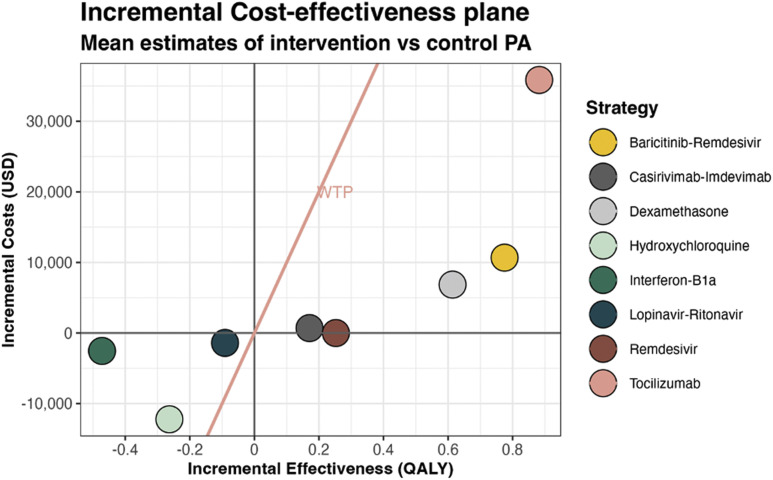
Incremental cost-effectiveness plane for mean estimates per individual resulting from the PA. Incremental costs in USD and effects are calculated and shown as the treatment group versus the control group within the respective trial, and not in comparison with the other treatments projected. The right side of the WTP threshold line represents cost-effectiveness. PA indicates probabilistic analysis; USD, US dollar; WTP, willingness to pay.

References

    1. Coronavirus (COVID-19) hospitalizations. Our World in Data. https://ourworldindata.org/covid-hospitalizations
    1. COVID-19 data repository by the Center for Systems Science and Engineering (CSSE) at johns Hopkins University Johns Hopkins University. https://github.com/CSSEGISandData/COVID-19
    1. Van Nguyen T Van, Ferrand G., Cohen-Boulakia S., et al. The COVID-NMA initiative: a living mapping and living systematic review of Covid-19 trials RCT studies on preventive measures and treatments for COVID-19. COVID-NMA consortium. https://covid-nma.com/dataviz/
    1. Claxton K., Palmer S., Longworth L., et al. A comprehensive algorithm for approval of health technologies with, without, or only in research: the key principles for informing coverage decisions. Value Health. 2016;19(6):885–891. - PubMed
    1. Mullard A. Flooded by the torrent: the COVID-19 drug pipeline. Lancet. 2020;395(10232):1245–1246. - PMC - PubMed

Publication types