


In Vitro Activity of Ceftolozane-Tazobactam, Imipenem-Relebactam, Ceftazidime-Avibactam, and Comparators against Pseudomonas aeruginosa Isolates Collected in United States Hospitals According to Results from the SMART Surveillance Program, 2018 to 2020
- PMID: 35491836
- PMCID: PMC9112925
- DOI: 10.1128/aac.00189-22
In Vitro Activity of Ceftolozane-Tazobactam, Imipenem-Relebactam, Ceftazidime-Avibactam, and Comparators against Pseudomonas aeruginosa Isolates Collected in United States Hospitals According to Results from the SMART Surveillance Program, 2018 to 2020
Abstract
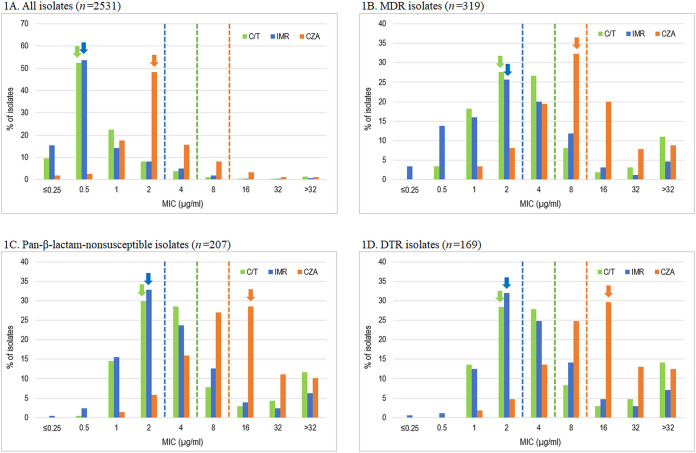
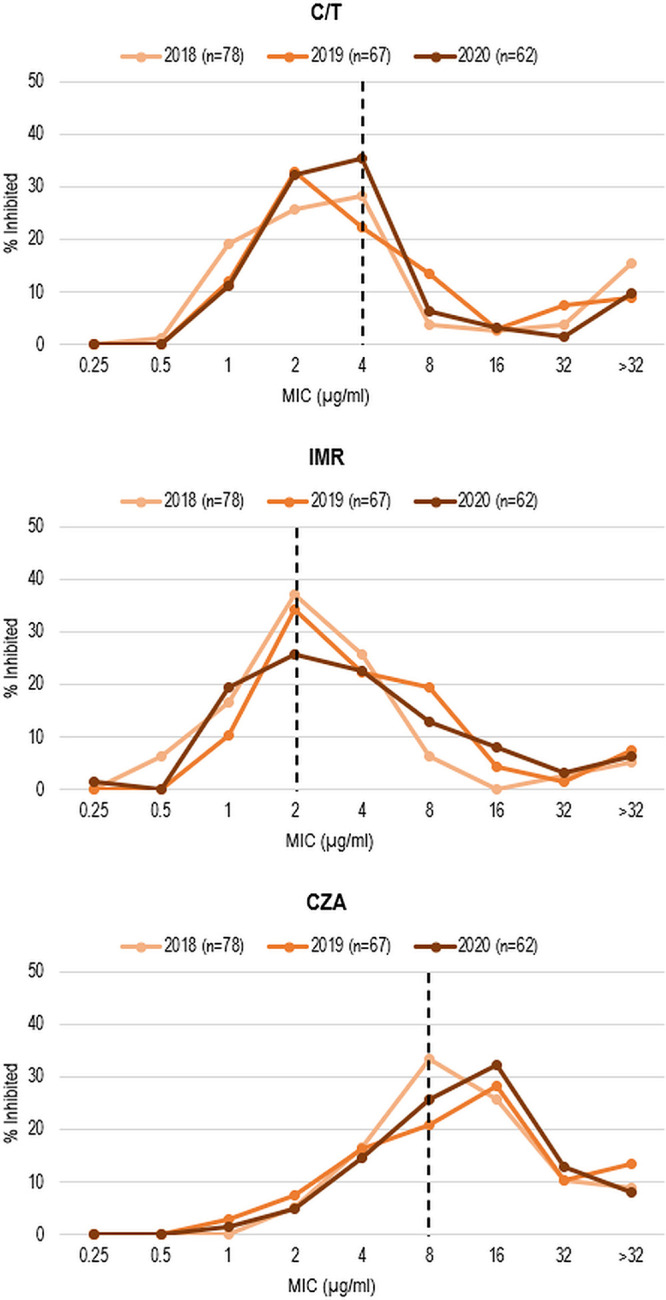
Ceftolozane-tazobactam (C/T), imipenem-relebactam (IMR), and ceftazidime-avibactam (CZA) were tested against 2,531 P. aeruginosa strains isolated from patients in the United States from 2018 to 2020 as part of the SMART (Study for Monitoring Antimicrobial Resistance Trends) surveillance program. MICs were determined by CLSI broth microdilution and interpreted using CLSI M100 (2021) breakpoints. Imipenem-, IMR-, or C/T-nonsusceptible isolates were screened for β-lactamase genes: 96.4% of all isolates and ≥70% of multidrug-resistant (MDR), pan-β-lactam-nonsusceptible, and difficult-to-treat resistance (DTR) isolates were C/T-susceptible; 52.2% of C/T-nonsusceptible isolates remained susceptible to IMR compared to 38.9% for CZA; and 1.7% of isolates tested were nonsusceptible to both C/T and IMR versus 2.2% of isolates with a C/T-nonsusceptible and CZA-resistant phenotype (a difference of 12 isolates). C/T and IMR modal MICs for pan-β-lactam-nonsusceptible isolates remained at or below their respective susceptible MIC breakpoints from 2018 to 2020, while the modal MIC for CZA increased 2-fold from 2018 to 2019 and exceeded the CZA-susceptible MIC breakpoint in both 2019 and 2020. Only six of 802 molecularly characterized isolates carried a metallo-β-lactamase, and two isolates carried a GES carbapenemase. Most P. aeruginosa isolates were C/T-susceptible, including many with MDR, pan-β-lactam-nonsusceptible, DTR, CZA-resistant, and IMR-nonsusceptible phenotypes. While C/T was the most active antipseudomonal agent, IMR demonstrated greater activity than CZA against isolates nonsusceptible to C/T.
Keywords: Pseudomonas aeruginosa; SMART; United States; ceftazidime-avibactam; ceftolozane-tazobactam; imipenem-relebactam; surveillance.
Conflict of interest statement
The authors declare a conflict of interest. S.H.L. and D.F.S. work for IHMA, which receives funding from Merck Sharp & Dohme Corp., a subsidiary of Merck & Co., Inc., Kenilworth, New Jersey, USA for the SMART surveillance program. J.A.K. is a consultant to IHMA, and an employee of Shared Health Manitoba and the University of Manitoba. C.A.D., D.W.H., M.T.W., K.Y., F.S., and M.R.M. are employees of Merck Sharp & Dohme Corp., a subsidiary of Merck & Co., Inc., Kenilworth, New Jersey, USA, and own stock in Merck & Co., Inc., Kenilworth, New Jersey, USA. The IHMA authors do not have personal financial interests in the sponsor of this manuscript (Merck Sharp & Dohme Corp., a subsidiary of Merck & Co., Inc., Kenilworth, New Jersey, USA).
Figures
References
-
- Tamma PD, Aitken SL, Bonomo RA, Mathers AJ, van Duin D, Clancy CJ. 2021. Infectious Diseases Society of America guidance on the treatment of extended-spectrum β-lactamase producing Enterobacterales (ESBL-E), carbapenem-resistant Enterobacterales (CRE), and Pseudomonas aeruginosa with difficult-to-treat resistance (DTR-P aeruginosa). Clin Infect Dis 72:e169–e183. doi: 10.1093/cid/ciaa1478. - DOI - PubMed
-
- Sader HS, Flamm RK, Carvalhaes CG, Castanheira M. 2020. Comparison of ceftazidime-avibactam and ceftolozane-tazobactam in vitro activities when tested against Gram-negative bacteria isolated from patients hospitalized with pneumonia in United States medical centers (2017–2018). Diagn Microbiol Infect Dis 96:114833. doi: 10.1016/j.diagmicrobio.2019.05.005. - DOI - PubMed
-
- Sader HS, Huband MD, Castanheira M, Flamm RK. 2017. Pseudomonas aeruginosa antimicrobial susceptibility results from four years (2012 to 2015) of the International Network for Optimal Resistance Monitoring Program in the United States. Antimicrob Agents Chemother 61:e02252-16. doi: 10.1128/AAC.02252-16. - DOI - PMC - PubMed
Publication types
MeSH terms
Substances
LinkOut - more resources
Full Text Sources
