. 2022 Mar 15;4(1):113-123.
doi: 10.1016/j.jaccao.2022.01.102. eCollection 2022 Mar.

Does Cardiovascular Mortality Overtake Cancer Mortality During Cancer Survivorship?: An English Retrospective Cohort Study

Affiliations

Does Cardiovascular Mortality Overtake Cancer Mortality During Cancer Survivorship?: An English Retrospective Cohort Study

Helen Strongman et al. JACC CardioOncol. .

Abstract

Background: Cancer survivors have a higher risk for developing cardiovascular diseases than the general population.

Objectives: The aim of this study was to investigate whether cardiovascular mortality overtakes cancer-specific mortality during cancer survivorship and, if so, at what point cardiovascular disease becomes the dominant cause of death.

Methods: This cohort study used linked English electronic health records, including death registration data. The study population included 104,028 adults ≥40 years of age whose first cancer diagnosis was for 1 of 9 common cancers and who were alive and followed up at least 1 year after diagnosis. Age-stratified mortality rates were estimated from cardiovascular disease or cancer by predicting from Poisson models incorporating categorical age at diagnosis and time since diagnosis. Where cardiovascular disease mortality overtook cancer mortality, the crossover point was estimated using interpolation.

Results: Mortality from cardiovascular causes overtook mortality due to the primary cancer at 2 to 11 years after cancer diagnosis in survivors of all 9 cancer types ≥80 years of age at diagnosis and after 5 to 17 years in survivors of 7 cancer types 60 to 79 years of age at diagnosis. Cardiovascular mortality overtook all cancer mortality for 6 and 2 cancer sites in the ≥80-year and 60- to 79-year age groups, respectively, over a longer time period. Cardiovascular mortality did not overtake cancer mortality during the observation period in patients aged 40 to 59 years, except among survivors of uterine cancer.

Conclusions: In older survivors of 9 common cancers, cardiovascular mortality becomes dominant over mortality from the primary cancer, though not always over total cancer mortality, as time passes since cancer diagnosis.

Keywords: CPRD GOLD, Clinical Practice Research Datalink primary care data in England; beyond cancer; cancer survivors; electronic health records.


Conflict of interest statement

This work was supported by the Wellcome Trust and the Royal Society (grants 107731/Z/15/Z and 220283/Z/20/Z). Dr Lyon is supported by the Fondation Leducq Network of Excellence in Cardio-Oncology. Dr Lyon has received grants and personal fees from Servier and Pfizer and personal fees from Novartis, Roche, Takeda, Boehringer Ingelheim, Amgen, Clinigen Group, Ferring Pharmaceuticals, Eli Lily, Bristol Myers Squibb, and Eisai, outside the submitted work. Dr Bhaskaran has received grants from the Wellcome Trust and the Royal Society during the conduct of the study; and has received grants from the Medical Research Council, the British Heart Foundation, and Diabetes UK, outside the submitted work. Dr Smeeth has received grants from the Wellcome Trust, the Medical Research Council, the National Institute for Health Research, GlaxoSmithKline, the British Heart Foundation, and Diabetes UK, outside the submitted work; and is a trustee of the British Heart Foundation. Dr Stanway has received personal fees from Roche, Novartis, Eli Lilly, and Clinigen, outside the submitted work. Dr dos-Santos-Silva has received grants from Susan G. Komen and the National Cancer Institute, outside the submitted work. Dr Matthews has received grants from Forte, outside the submitted work. All other authors have reported that they have no relationships relevant to the contents of this paper to disclose.

Figures
None
Graphical abstract
Figure 1
Figure 1
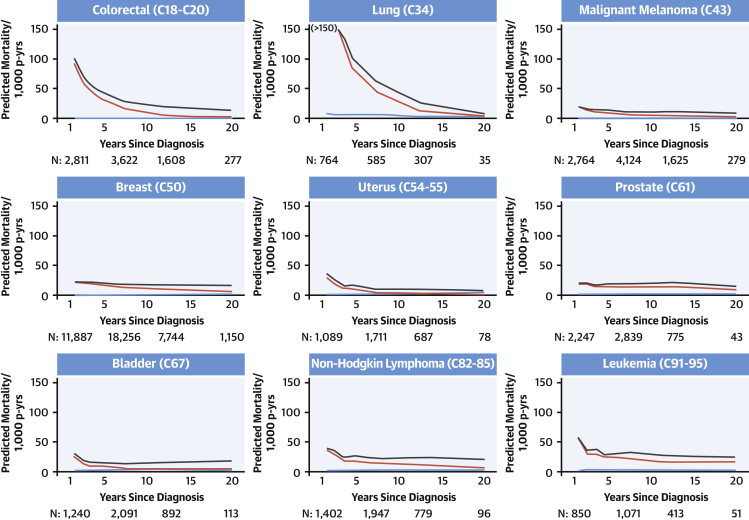
Predicted Cause-Specific Mortality in Cancer Survivors 40 to 59 Years of Age at Diagnosis Predicted cause-specific mortality per 1,000 person-years (p-yrs) by time since diagnosis in cancer survivors 40 to 59 years of age at diagnosis. Predicted mortality was calculated using Poisson models incorporating categorical age at diagnosis and time since diagnosis. Cardiovascular mortality did not overtake cancer mortality during the observation period, except among survivors of uterine cancer. Blue line = cardiovascular disease mortality; red line = primary malignancy mortality; black line = all malignancy mortality. Ordering of cancer sites is by International Classification of Diseases code of the cancer site. Predicted mortality is predicted at the midpoint of each category of time since diagnosis. The number of people (N) contributing to the analysis at 1.5, 7.5, 12.5, and 20 years is provided. Graphs are truncated at the earliest time since diagnosis group where the width of the CI exceeds 50 to 1,000 patient-years.
Figure 2
Figure 2
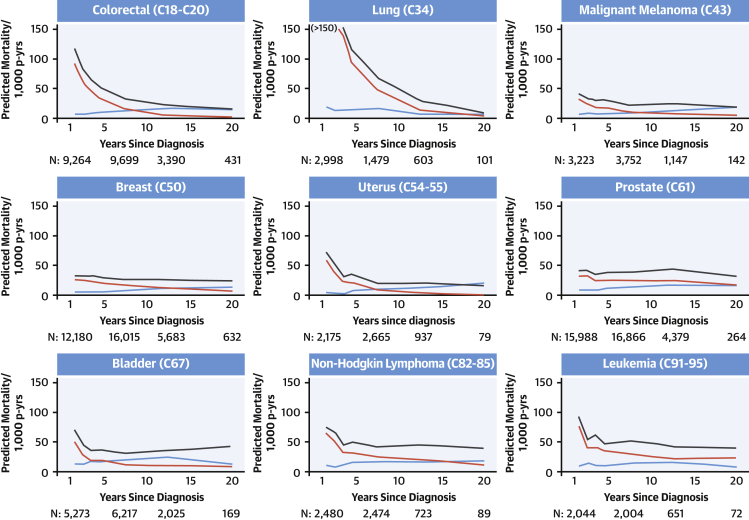
Predicted Cause-Specific Mortality in Cancer Survivors 60 to 79 Years of Age at Diagnosis Predicted cause-specific mortality per 1,000 person-years (p-yrs) by time since diagnosis in cancer survivors 60 to 79 years of age at diagnosis. Predicted mortality was calculated using Poisson models incorporating categorical age at diagnosis and time since diagnosis. Mortality from cardiovascular causes overtook mortality due to the primary cancer in survivors of 7 of 9 cancer types. Cardiovascular mortality overtook all cancer mortality for malignant melanoma and uterine cancer over a longer time period. Blue line = cardiovascular disease mortality; red line = primary malignancy mortality; black line = all malignancy mortality. Ordering of cancer sites is by International Classification of Diseases code of the cancer site. Predicted mortality is predicted at the midpoint of each category of time since diagnosis. The number of people (N) contributing to the analysis at 1.5, 7.5, 12.5, and 20 years is provided. Graphs are truncated at the earliest time since diagnosis group where the width of the CI exceeds 50 to 1,000 patient-years.
Figure 3
Figure 3
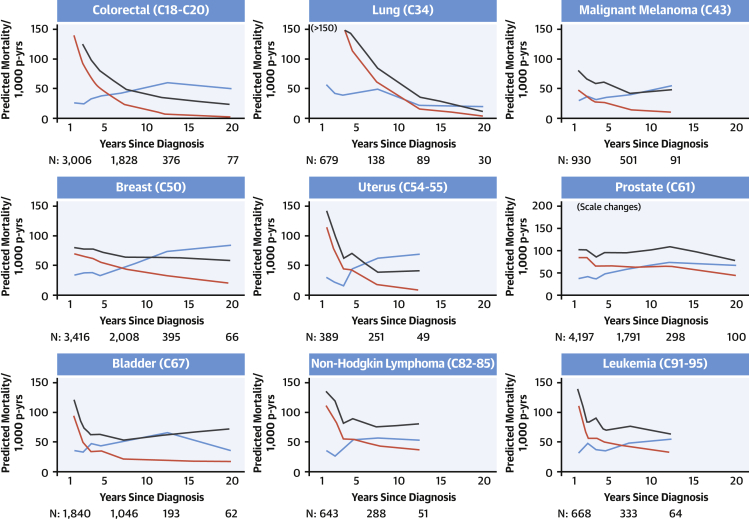
Predicted Cause-Specific Mortality in Cancer Survivors ≥80 Years of Age at Diagnosis Predicted cause-specific mortality per 1,000 person-years (p-yrs) by time since diagnosis in cancer survivors ≥80 years of age at diagnosis. Predicted mortality was calculated using Poisson models incorporating categorical age at diagnosis and time since diagnosis. Mortality from cardiovascular causes overtook mortality due to the primary cancer in survivors of all 9 cancer types. Cardiovascular mortality overtook all cancer mortality for 6 cancer types over a longer time period. Blue line = cardiovascular disease mortality; red line = primary malignancy mortality; black line = all malignancy mortality. Ordering of cancer sites is by International Classification of Diseases code of the cancer site. Predicted mortality is predicted at the midpoint of each category of time since diagnosis. The number of people (N) contributing to the analysis at 1.5, 7.5, 12.5, and 20 years is provided. Graphs are truncated at the earliest time since diagnosis group where the width of the CI exceeds 50 to 1,000 patient-years.
Central Illustration
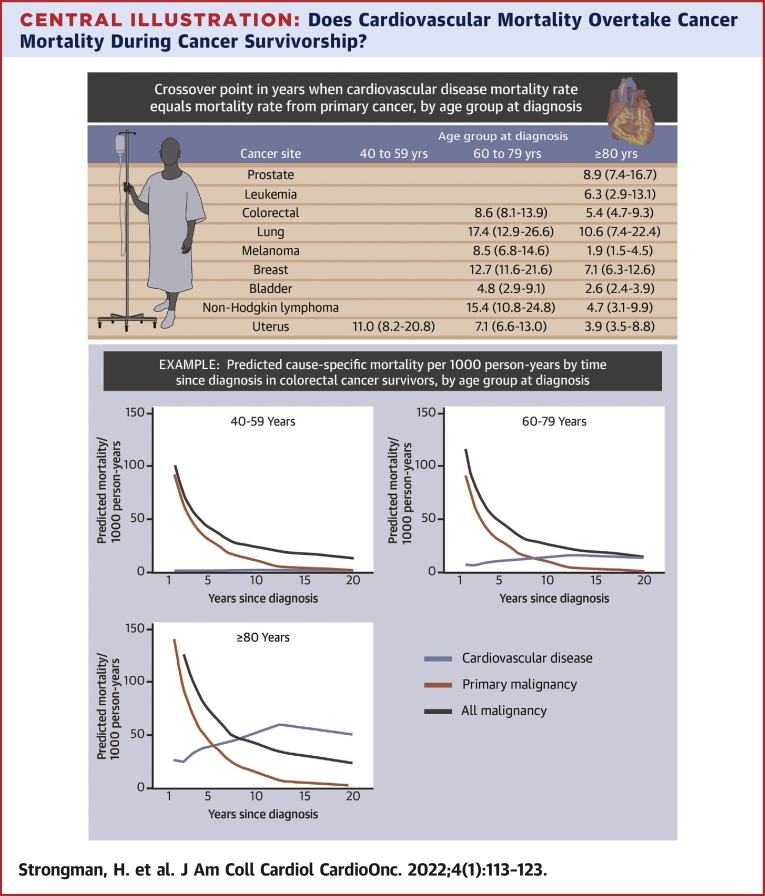
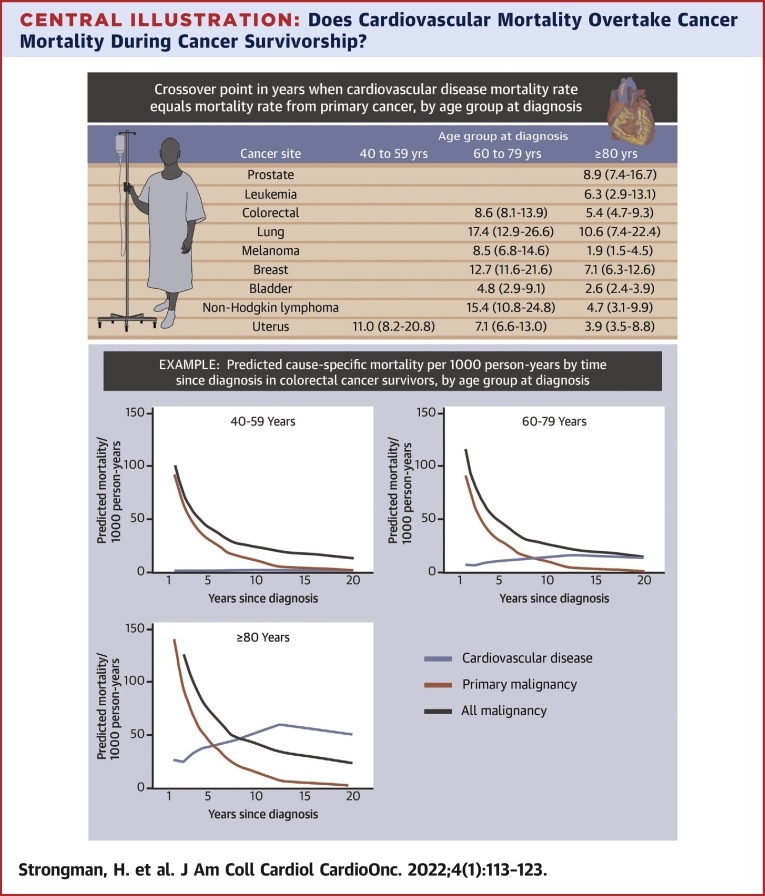
Does Cardiovascular Mortality Overtake Cancer Mortality During Cancer Survivorship? Tabulated crossover point (years, 95% CIs) at which the predicted cardiovascular disease mortality rate equals the predicted mortality rate from primary cancer for the 9 most common cancers, by age group at diagnosis. Predicted cardiovascular and cancer mortality rates over time were calculated using Poisson models including categorical age at diagnosis and time since diagnosis, and crossover points were calculated by interpolating between points at either side of the intersection; 95% CIs were estimated by taking the 2.5th and 97.5th percentile estimates from 200 bootstrap repetitions. Crossover points are not provided if the cardiovascular mortality rate did not equal the mortality rate from cancer within 20 years. An illustrative example is provided for colorectal cancer. In older survivors of 9 common cancers, cardiovascular mortality becomes dominant over mortality from the primary cancer as time passes since cancer diagnosis.

References

    1. University of Washington Institute for Health Metrics and Evaluation GBD Compare: Viz Hub. https://www.thelancet.com/lancet/visualisations/gbd-compare Accessed September 24, 2021.
    1. Cancer Research UK Cancer statistics for the UK. https://www.cancerresearchuk.org/health-professional/cancer-statistics-f... Accessed March 7, 2019.
    1. Strongman H., Gadd S., Matthews A., et al. Medium and long-term risks of specific cardiovascular diseases in survivors of 20 adult cancers: a population-based cohort study using multiple linked UK electronic health records databases. Lancet. 2019;394(10203):1041–1054. - PMC - PubMed
    1. Ye Y., Otahal P., Marwick T.H., Wills K.E., Neil A.L., Venn A.J. Cardiovascular and other competing causes of death among patients with cancer from 2006 to 2015: an Australian population-based study. Cancer. 2019;125(3):442–452. - PubMed
    1. Sturgeon K.M., Deng L., Bluethmann S.M., et al. A population-based study of cardiovascular disease mortality risk in US cancer patients. Eur Heart J. 2019;40(48):3889–3897. - PMC - PubMed

LinkOut - more resources