Meta-Analysis
. 2022 Mar 15;3(3):100542.
doi: 10.1016/j.xcrm.2022.100542.

A multi-level investigation of the genetic relationship between endometriosis and ovarian cancer histotypes

Affiliations
Meta-Analysis

A multi-level investigation of the genetic relationship between endometriosis and ovarian cancer histotypes

Sally Mortlock et al. Cell Rep Med. .

Abstract

Endometriosis is associated with increased risk of epithelial ovarian cancers (EOCs). Using data from large endometriosis and EOC genome-wide association meta-analyses, we estimate the genetic correlation and evaluate the causal relationship between genetic liability to endometriosis and EOC histotypes, and identify shared susceptibility loci. We estimate a significant genetic correlation (rg) between endometriosis and clear cell (rg = 0.71), endometrioid (rg = 0.48), and high-grade serous (rg = 0.19) ovarian cancer, associations supported by Mendelian randomization analyses. Bivariate meta-analysis identified 28 loci associated with both endometriosis and EOC, including 19 with evidence for a shared underlying association signal. Differences in the shared risk suggest different underlying pathways may contribute to the relationship between endometriosis and the different histotypes. Functional annotation using transcriptomic and epigenomic profiles of relevant tissues/cells highlights several target genes. This comprehensive analysis reveals profound genetic overlap between endometriosis and EOC histotypes with valuable genomic targets for understanding the biological mechanisms linking the diseases.

Keywords: Mendelian randomization; endometriosis; epithelial ovarian cancer; genetic association; genetic correlation; genetic risk; histotype; meta-analysis.


Conflict of interest statement

M.L.F. reports other support from Nuscan Diagnostics outside the scope of the submitted work. C.W. reports research funding support from Merck, is a member of the Immunogen advisory board (1/2022), and has been a member of the Genentech advisory board (8/2020). The remaining authors declare no competing interests.

Figures
None
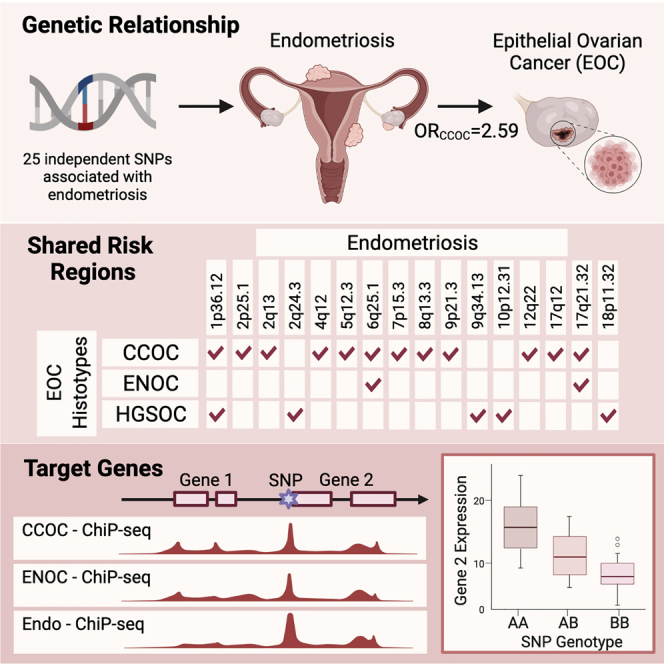
Graphical abstract
Figure 1
Figure 1
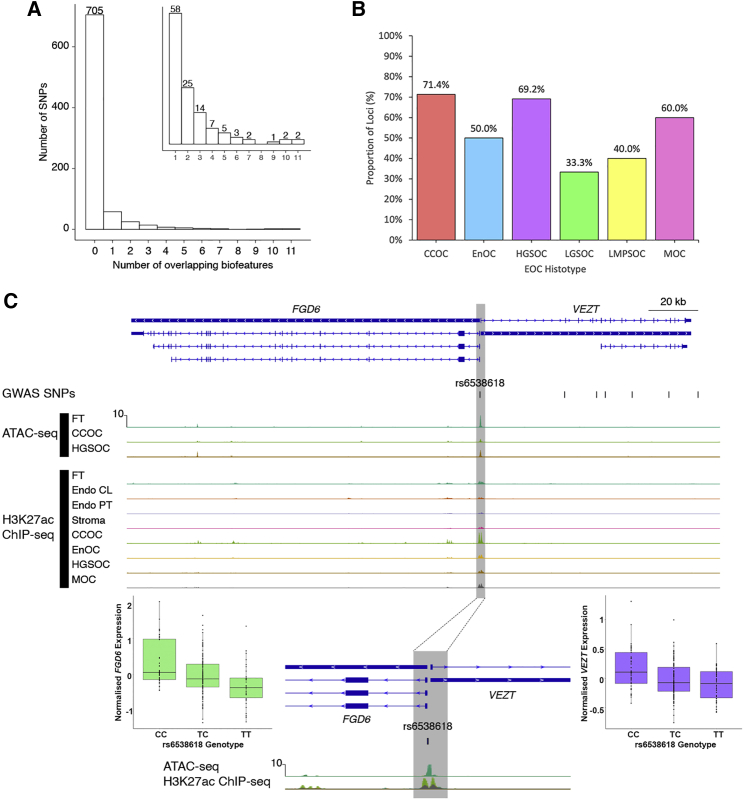
Functional annotation of SNPs associated with risk of endometriosis and epithelial ovarian cancer (A) Histogram of number of non-redundant SNPs for all epithelial ovarian cancer (EOC) histological subtypes that overlap n biofeatures. Inset: histogram of number of non-redundant SNPs for all histological subtypes that overlap at least one biofeature. (B) Proportion of loci shared between endometriosis and each EOC histotype containing SNPs that overlap at least one biofeature. (C) A promoter SNP at the VEZT/FGD6 locus overlaps 10 biofeatures and intersects with an active open region of chromatin that lies in a bidirectional promoter associated with these two genes. Biofeatures are shown as peaks on the ATAC-seq and H3K27ac ChIP-seq tracks for primary tissues and cell lines. Endo, endometriosis; FT, fallopian tube; Stroma, endometriosis-associated stroma; CCOC, clear cell ovarian cancer; CL, cell lines; ENOC, endometrioid ovarian cancer; HGSOC, high-grade serous ovarian cancer; MOC, mucinous ovarian cancer; PT, primary tissues. Specimens are primary tissues unless otherwise indicated. The gray shaded area highlights peaks overlapping rs6538618. Boxplots show the association between rs6538618 genotypes and expression of VEZT and FGD6 in endometrium.

References

    1. Treloar S., Hadfield R., Montgomery G., Lambert A., Wicks J., Barlow D.H., O’Connor D.T., Kennedy S. The international endogene study: a collection of families for genetic research in endometriosis. Fertil. Sterility. 2002;78:679–685. doi: 10.1016/S0015-0282(02)03341-1. - DOI - PubMed
    1. Giudice L.C. Clinical practice: endometriosis. New Engl. J. Med. 2010;362:2389–2398. doi: 10.1056/NEJMcp1000274. - DOI - PMC - PubMed
    1. Rowlands I.J., Abbott J.A., Montgomery G.W., Hockey R., Rogers P., Mishra G.D. Prevalence and incidence of endometriosis in Australian women: a data linkage cohort study. BJOG: Int. J. Obstet. Gynaecol. 2021;128:657–665. doi: 10.1111/1471-0528.16447. - DOI - PubMed
    1. American Society for Reproductive M. Revised American society for reproductive medicine classification of endometriosis: 1996. Fertil. Steril. 1997;67:817–821. doi: 10.1016/S0015-0282(97)81391-X. - DOI - PubMed
    1. Kok V.C., Tsai H.-J., Su C.-F., Lee C.-K. The risks for ovarian, endometrial, breast, colorectal, and other cancers in women with newly diagnosed endometriosis or adenomyosis: a population-based study. Int. J. Gynecol. Cancer. 2015;25:968. doi: 10.1097/IGC.0000000000000454. - DOI - PubMed

Publication types

MeSH terms