


Mechanically tough and highly stretchable poly(acrylic acid) hydrogel cross-linked by 2D graphene oxide
- PMID: 35492941
- PMCID: PMC9050439
- DOI: 10.1039/d0ra00678e
Mechanically tough and highly stretchable poly(acrylic acid) hydrogel cross-linked by 2D graphene oxide
Abstract
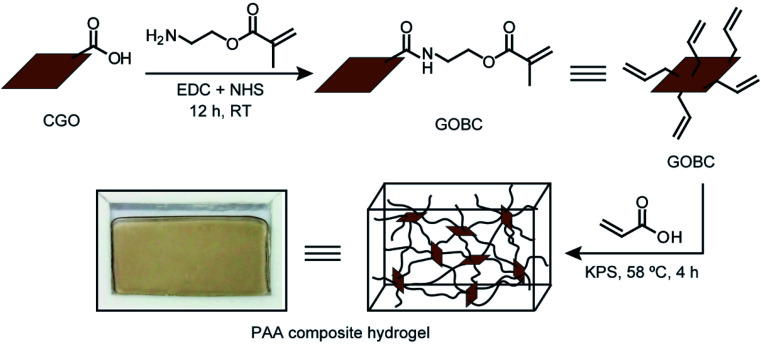
The mechanical performances of hydrogels are greatly influenced by the functionality of cross-linkers and their covalent and non-covalent interactions with the polymer chains. Conventional chemical cross-linkers fail to meet the demand of large toughness and high extensibility for their immediate applications as artificial tissues like ligaments, blood vessels, and cardiac muscles in human or animal bodies. Herein, we synthesized a new graphene oxide-based two-dimensional (2D) cross-linker (GOBC) and exploited the functionality of the cross-linker for the enhancement of toughness and stretchability of a poly(acrylic acid) (PAA) hydrogel. The 2D nanosheets of GO were modified in such a way that they could provide multifunctional sites for both physical and chemical bonding with the polymer chains. Carboxylic acid groups at the surfaces of the GO sheets were coupled with the acrylate functional groups for covalent cross-linking, while the other oxygen-containing functional groups are responsible for physical cross-linking with polymers. The GOBC had been successfully incorporated into the PAA hydrogel and the mechanical properties of the GOBC cross-linked PAA hydrogel (PAA-GOBC) were investigated at various compositions of cross-linker. Seven times enhancement in both toughness and elongation at break has been achieved without compromising on the modulus for the as-synthesized PAA-GOBC compared to the conventional N,N'-methylenebis(acrylamide) (MBA) cross-linked PAA hydrogel. This facile and efficient way of GO modification is expected to lead the development of a high-performance nanocomposite for cutting-edge applications in biomedical engineering.
This journal is © The Royal Society of Chemistry.
Conflict of interest statement
There are no conflicts to declare.
Figures
References
-
- Peppas N. A. Hilt J. Z. Khademhosseini A. Langer R. Adv. Mater. 2006;18:1345–1360. doi: 10.1002/adma.200501612. - DOI
LinkOut - more resources
Full Text Sources
