Review
. 2022 May;23(5):363.
doi: 10.3892/etm.2022.11290. Epub 2022 Apr 1.

Long COVID and neuropsychiatric manifestations (Review)

Affiliations
Review

Long COVID and neuropsychiatric manifestations (Review)

Vasiliki Efstathiou et al. Exp Ther Med. 2022 May.

Abstract

There is accumulating evidence in the literature indicating that a number of patients with coronavirus disease 2019 (COVID-19) may experience a range of neuropsychiatric symptoms, persisting or even presenting following the resolution of acute COVID-19. Among the neuropsychiatric manifestations more frequently associated with 'long COVID' are depression, anxiety, post-traumatic stress disorder, sleep disturbances, fatigue and cognitive deficits, that can potentially be debilitating and negatively affect patients' wellbeing, albeit in the majority of cases symptoms tend to improve over time. Despite variations in results obtained from studies using different methodological approaches to define 'long COVID' syndrome, the most widely accepted factors associated with a higher risk of developing neuropsychiatric manifestations include the severity of foregoing COVID-19, the female sex, the presence of comorbidities, a history of mental health disease and an elevation in the levels of inflammatory markers, albeit further research is required to establish causal associations. To date, the pathophysiological mechanisms implicated in neuropsychiatric manifestations of 'long COVID' remain only partially elucidated, while the role of the indirect effects of the COVID-19 pandemic, such as social isolation and uncertainty concerning social, financial and health recovery post-COVID, have also been highlighted. Given the alarming effects of 'long-COVID', interdisciplinary cooperation for the early identification of patients who are at a high risk of persistent neuropsychiatric presentations, beyond COVID-19 recovery, is crucial to ensure that appropriate integrated physical and mental health support is provided, with the aim of mitigating the risks of long-term disability at a societal and individual level.

Keywords: COVID-19; COVID-19 survivors; long COVID; neuropsychiatric sequalae; post-COVID syndrome; severe acute respiratory syndrome coronavirus 2.


Conflict of interest statement

DAS is the Editor-in-Chief for the journal, but has no personal involvement in the reviewing process, or any influence in terms of adjudicating on the final decision, for this article. The other authors declare that they have no competing interests.

Figures
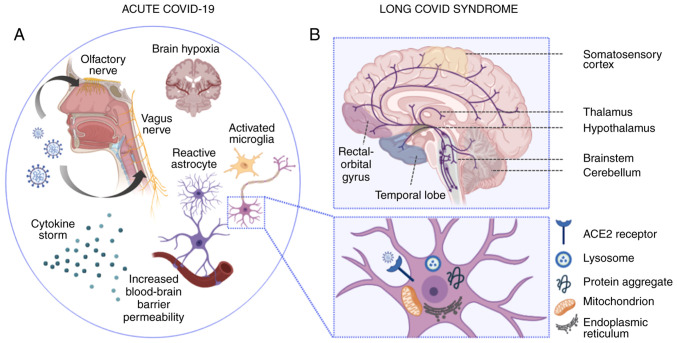
Figure 1
Figure 1
Pathophysiological mechanisms implicated in acute and ‘long-COVID’ neuropsychiatric sequelae. (A) In acute COVID-19 infection, SARS-CoV-2 enters the CNS via hematogenous transmission or retrograde transport along the axons of the olfactory (94-97) and vagus nerve (100). Vagus nerve affection may lead to autonomic dysregulation, impaired cerebral autoregulation and subsequent brain hypoxia (100). Moreover, the SARS-CoV-2-induced cytokine storm results in impaired blood-brain barrier function and increased blood-brain barrier permeability. The latter induces the transmigration of virus-infected leukocytes into the CNS, the activation of microglial cells and astrocytes, which in turn trigger apoptotic cascades and demyelination, respectively. At the neuronal level (illustrated in the magnified inset), SARS-CoV-2 cell entry is mainly facilitated by the ACE2 receptor, located on the surface of neuronal cells. Intracellular inflammatory responses in the setting of acute SARS-CoV-2 infection induce lysosomal, mitochondrial and endoplasmic reticulum dysfunction, while protein misfolding and intracellular accumulation of protein aggregates may induce long-lasting neurodegenerative cascades (132). (B) In ‘long-COVID’ syndrome, neuropsychiatric deficits have been mainly associated with ongoing inflammatory, metabolic and degenerative processes, which have been linked to ‘ACE2-rich’ brain areas, extending from the somatosensory cortex to the rectal/orbital gyrus, the temporal lobe, the thalamus and hypothalamus, and further, to brainstem and cerebellar regions (133). Serotoninergic pathways are depicted in purple. Apart from serotoninergic pathways, further neurotransmitter imbalances (not illustrated), including acetylcholine, dopamine and histamine have been found to be linked to lingering neuropsychiatric symptoms noted in patients with ‘long-COVID’ (134). The image was created using BioRender (https://biorender.com). CNS, central nervous system; SARS-CoV-2, severe acute respiratory syndrome coronavirus 2; ACE2, angiotensin-converting enzyme 2.

References

    1. Sohrabi C, Alsafi Z, O'Neill N, Khan M, Kerwan A, Al-Jabir A, Iosifidis C, Agha R. World Health Organization declares global emergency: A review of the 2019 novel coronavirus (COVID-19) Int J Surg. 2020;76:71–76. doi: 10.1016/j.ijsu.2020.02.034. - DOI - PMC - PubMed
    1. Leaune E, Samuel M, Oh H, Poulet E, Brunelin J. Suicidal behaviors and ideation during emerging viral disease outbreaks before the COVID-19 pandemic: A systematic rapid review. Prev Med. 2020;141(106264) doi: 10.1016/j.ypmed.2020.106264. - DOI - PMC - PubMed
    1. Kahil K, Cheaito MA, El Hayek R, Nofal M, El Halabi S, Kudva KG, Pereira-Sanchez V, El Hayek S. Suicide during COVID-19 and other major international respiratory outbreaks: A systematic review. Asian J Psychiatr. 2021;56(102509) doi: 10.1016/j.ajp.2020.102509. - DOI - PMC - PubMed
    1. Zoumpourlis V, Goulielmaki M, Rizos E, Baliou S, Spandidos DA. [Comment] The COVID-19 pandemic as a scientific and social challenge in the 21st century. Mol Med Rep. 2020;22:3035–3048. doi: 10.3892/mmr.2020.11393. - DOI - PMC - PubMed
    1. Efstathiou V, Stefanou MI, Siafakas N, Makris M, Tsivgoulis G, Zoumpourlis V, Spandidos DA, Smyrnis N, Rizos E. Suicidality and COVID-19: Suicidal ideation, suicidal behaviors and completed suicides amidst the COVID-19 pandemic (Review) Exp Ther Med. 2022;23(107) doi: 10.3892/etm.2021.11030. - DOI - PMC - PubMed