. 2022 Apr 13:13:859331.
doi: 10.3389/fimmu.2022.859331. eCollection 2022.

CCDC88A Post-Transcriptionally Regulates VEGF via miR-101 and Subsequently Regulates Hepatocellular Carcinoma

Affiliations

CCDC88A Post-Transcriptionally Regulates VEGF via miR-101 and Subsequently Regulates Hepatocellular Carcinoma

Qiongying Hu et al. Front Immunol. .

Retraction in

Abstract

Background: miR-101 is one of the most abundantly expressed microRNA (miRNA) and exerst a critical role in hepatocellular carcinoma (HCC) by targeting to 3' -untranslated region (UTR) of Girders of actin filaments (CCDC88A) and Vascular endothelial growth factor (VEGF) mRNA, but the underlying molecular mechanism remains to be elucidated. This study aimed to investigate the potential role of CCDC88A on malignancies and stemness by regulating VEGF via miR-101 in HCC.

Methods: Gene Expression Profiling Interactive Analysis (GEPIA) was employed to analyze the relevance of CCDC88A expression with prognosis in HCC. Tissue slides were performed to confirm the protein level of CCDC88A in HCC. Correlation between CCDC88A and VEGF was transcriptionally and post-transcriptionally detected, followed by evaluation of malignancies.

Results: By employing Immunohistochemistry, we found CCDC88A protein was upregulated in HCC tissues, which is closely correlated to poor prognosis and survival rate. Employment of GEPIA revealed the positive correlation between CCDC88A and VEGF in HCC, but not in liver tissue. Silencing of CCDC88A in Huh-7 and SK-HEP-1 cells significantly decreased proliferation, cell cycle phases, migration, invasion, colony formation, and tumor formation. Introduction of miR-101 mimics specifically targeting CCDC88A and VEGF decreased protein levels of both CCDC88A and VEGFA. Notably, inhibition of miR-101 reversed the correlation between CCDC88A and VEGFA protein levels, indicating that CCDC88A and VEGF may exert as a miR-101 sponge. The addition of SKLB1002, a VEGFR2 inhibitor inhibited malignant behaviors, which was further inhibited by the introduction of miR-101 mimics, indicating that CCDC88A regulates malignant behaviors partially via regulating VEGF. Moreover, CCDC88A also promotes the stemness of cancer stem-like cells derived from HCC cells depending on VEGF modification.

Conclusion: Taken together, our findings suggested that the miR-101/CCDC88A/VEGF axis could be a potential therapeutic target of HCC treatment.

Keywords: Girders of actin filaments (CCDC88A); cancer stem-like cells (CSCs); hepatocellular carcinoma (HCC); malignant behavior; microRNA-101; vascular endothelial growth factor (VEGF).


Conflict of interest statement

The authors declare that the research was conducted in the absence of any commercial or financial relationships that could be construed as a potential conflict of interest.

Figures

Figure 1
Figure 1
Expression of CCDC88A in human cancers determined by GEPIA database. (A) The expression profile of CCDC88A in three major human cancers, including Liver hepatocellular carcinoma (LIHC), colorectal adenocarcinoma (COAD), and lung adenocarcinoma (LUAD). Overall survival analysis and disease-free survival analysis of CCDC88A in LIHC (B), COAD (C), and LUAD (D) were determined by employing GEPIA database.
Figure 2
Figure 2
CCDC88A was positively correlated with VEGFA in LIHC. To analyze the correlation between CCDC88A and VEGFA, the GEPIA database was employed and the scatter plots show Pearson’s correlation of CCDC88A expression with expression of VEGFA. (A) The correlation between CCDC88A and VEGFA in LIHC, COAD, and LUAD was analyzed. (B) The correlation between CCDC88A and VEGFB or VEGFC in LIHC was analyzed.
Figure 3
Figure 3
Immunohistochemical staining of CCDC88A in serious LIHC and non-tumor adjacent tissues. Four pairs of LIHC tissues were Immunohistochemically analyzed. Images were taken under amplification of 2, 10, and 40, respectively.
Figure 4
Figure 4
CCDC88A is positively correlated with VEGFA and regulates cell proliferation. (A) RT-qPCR was performed to detect the mRNA level of CCDC88A in cancer cell lines, including Huh-7, SK-HEP-1, HCT-116, Caco-2, A549, and H1299, compared with HepRG. *P < 0.05, vs. HepRG group. (B) Western blot was performed to detect CCDC88A protein in all these cell lines. After transfecting shRNA target to CCDC88A mRNA (shCCDC88A), compared to scrambled shRNA (shScrambled), CCDC88A mRNA was detected in both Huh-7 and SK-HEP-1 cells (C), and protein level was measured by performing western blot (D) *P < 0.05, vs. shScrambled group. (E) 48 h after shCCDC88A transfection, cell cycle phase distribution was measured by performing PI staining followed by flow cytometric analysis. *P < 0.05, vs. shScrambled group.
Figure 5
Figure 5
Knockdown of CCDC88A inhibits malignant behaviors in Huh-7 and SK-HEP-1 cells. After 48-h transfection, malignant behaviors of Huh-7 and SK-HEP-1 cells were detected, including cell viability (A), migration (B), invasion (C), colony formation (D), and tumor formation in soft agar (E). *P < 0.05, vs. shScrambled group.
Figure 6
Figure 6
CCDC88A knockdown decreased tumor formation in nude mice. (A) 30 days after injection, grafting tumors were obtained and the tumor size of each mouse was measured every five days. N=4 for each group. *P < 0.05, vs. shScrambled group; **P < 0.01, vs. shScrambled group. (B) Body weight of each mouse was measured every five days. (C) H&E staining in each grafting tumor was imaged.
Figure 7
Figure 7
CCDC88A may protect VEGFA from miR-101 posttranscriptionally. (A) After transfection of miR-101, miR-4448 or miR-150-5p mimics for 48 h, respectively, miR-101, miR-4448, or miR-150-5p RNA levels were detected by performing RT-qPCR. (B) After transfection of miR-101, miR-4448 or miR-150-5p mimics for 48 h, respectively, protein levels of CCDC88A and VEGFA were detected by performing western blot. *P < 0.05, vs. NC group. (C) miR-4448 or miR-150-5p was co-transfected into Huh-7 and SK-HEP-1 cells together with different concentrations of anti-miR-101 antagonist (25, 50, or 100 nM), and protein levels of CCDC88A and VEGFA were detected by performing western blot. *P < 0.05, vs. NC group.
Figure 8
Figure 8
CCDC88A regulates cell proliferation partially via regulating VEGFA. (A, B) After the addition of SKLB1002, a VEGFR2 inhibitor, transfected miR-101 mimics further blocked the cell cycle at G1/G0. *P < 0.05, vs. mock group; *P < 0.05, vs. SKLB1002/NC mimics group. (C) western blot was performed to detect p-CHK2 and p21 protein levels. *P < 0.05, vs. SKLB1002/NC mimics group.
Figure 9
Figure 9
CCDC88A regulates malignant behaviors in Huh-7 and SK-HEP-1 cells partially via regulating VEGFA. After the addition of SKLB1002, a VEGFR2 inhibitor, transfected miR-101 mimics further inhibited malignant behaviors including migration (A), invasion (B), and colony formation (C).
Figure 10
Figure 10
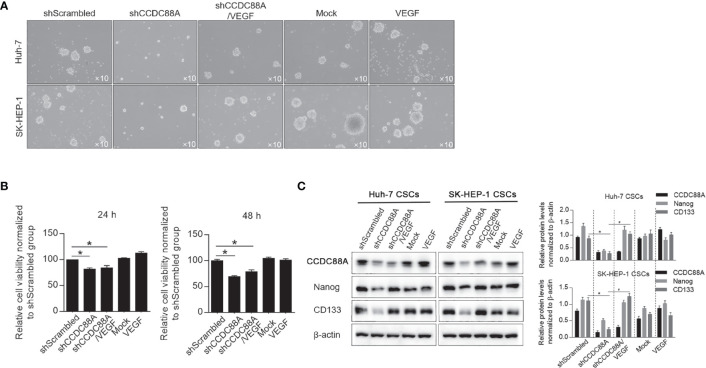
CCDC88A regulates stemness of CSCs via modifying VEGF. (A) After CCDC88A silencing with or without VEGF addition, sphere formation of Huh-7 and SK-HEP-1 in serum-free medium was collected. (B) After CCDC88A silencing with or without VEGF addition, cell viability was measured by performing CCK-8. *P<0.05, vs. shScrambled group. (C) After CCDC88A silencing with or without VEGF addition, expression of Nanog and CD133 were semi-quantitatively analyzed by western blot.

References

    1. Hartke J, Johnson M, Ghabril M. The Diagnosis and Treatment of Hepatocellular Carcinoma. Semin Diagn Pathol (2017) 34(2):153–9. doi: 10.1053/j.semdp.2016.12.011 - DOI - PubMed
    1. Torre LA, Bray F, Siegel RL, Ferlay J, Lortet-Tieulent J, Jemal A. Global Cancer Statistics, 2012. CA Cancer J Clin (2015) 65(2):87–108. doi: 10.3322/caac.21262 - DOI - PubMed
    1. El-Serag HB, Rudolph KL. Hepatocellular Carcinoma: Epidemiology and Molecular Carcinogenesis. Gastroenterology (2007) 132(7):2557–76. doi: 10.1053/j.gastro.2007.04.061 - DOI - PubMed
    1. El-Serag HB, Marrero JA, Rudolph L, Reddy KR. Diagnosis and Treatment of Hepatocellular Carcinoma. Gastroenterology (2008) 134(6):1752–63. doi: 10.1053/j.gastro.2008.02.090 - DOI - PubMed
    1. Bouzat C, Lasala M, Nielsen BE, Corradi J, Esandi MDC. Molecular Function of α7 Nicotinic Receptors as Drug Targets. J Physiol (2018) 596(10):1847–61. doi: 10.1113/JP275101 - DOI - PMC - PubMed

Publication types

MeSH terms