


The organisational response of a hospital critical care service to the COVID-19 pandemic: The Groote Schuur Hospital experience
- PMID: 35493978
- PMCID: PMC9045501
- DOI: 10.7196/SAJCC.2021.v37i2.503
The organisational response of a hospital critical care service to the COVID-19 pandemic: The Groote Schuur Hospital experience
Abstract
Background: There are limited data about the coronavirus disease-19 (COVID-19)-related organisational responses and the challenges of expanding a critical care service in a resource-limited setting.
Objectives: To describe the ICU organisational response to the pandemic and the main outcomes of the intensive care service of a large state teaching hospital in South Africa.
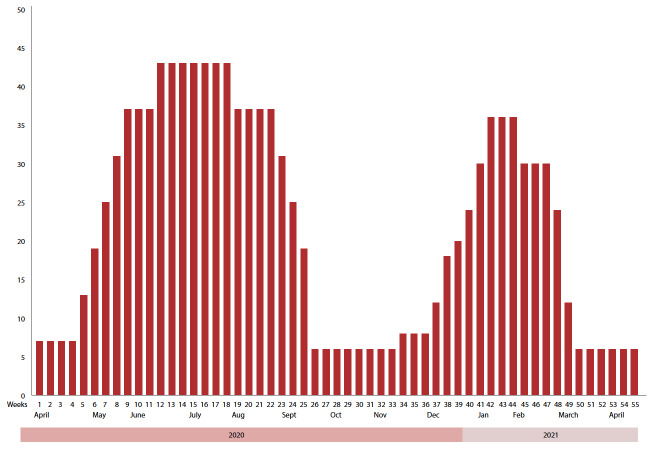
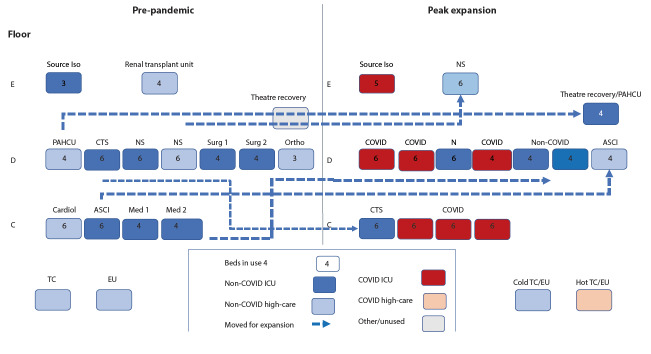
Methods: Data were extracted from administrative records and a prospective patient database with ethical approval. An ICU expansion plan was developed, and resource constraints identified. A triage tool was distributed to referring wards and hospitals. Intensive care was reserved for patients who required invasive mechanical ventilation (IMV). The total number of ICU beds was increased from 25 to 54 at peak periods, with additional non-COVID ICU capacity required during the second wave. The availability of nursing staff was the main factor limiting expansion. A ward-based high flow nasal oxygen (HFNO) service reduced the need for ICU admission of patients who failed conventional oxygen therapy. A team was established to intubate and transfer patients requiring ICU admission but was only available for the first wave.
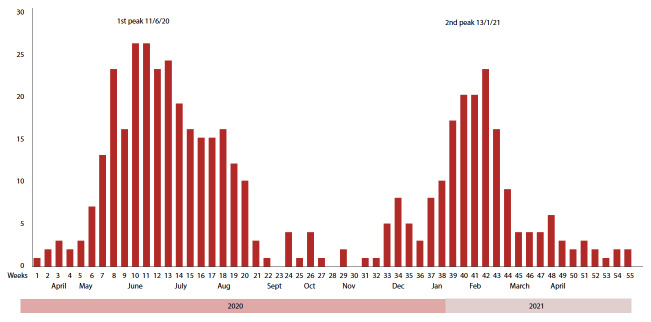
Results: We admitted 461 COVID-19 patients to the ICU over a 13-month period from 5 April 2020 to 5 May 2021 spanning two waves of admissions. The median age was 50 years and duration of ICU stay was 9 days. More than a third of the patients (35%; n=161) survived to hospital discharge.
Conclusion: Pre-planning, leadership, teamwork, flexibility and good communication were essential elements for an effective response. A shortage of nurses was the main constraint on ICU expansion. HFNO may have reduced the requirement for ICU admission, but patients intubated after failing HFNO had a poor prognosis.
Contributions of the study: We describe the organisational requirements to successfully expand critical care facilities and strategies to reduce the need for invasive mechanical ventilation in COVID-19 pneumonia. We also present the intensive care outcomes of these patients in a resource-constrained environment.
Keywords: COVID-19; intensive care; organisation; triage.
Conflict of interest statement
Conflicts of interest: None.
Figures

References
-
- Allocation of scarce critical care resources during the COVID-19 public health emergency in South Africa, 05 May 2020, Version 3. Critical Care Society of Southern Africa. 2020. https://criticalcare.org.za/wp-content/uploads/2020/06/V3-2020-May-05-Al... Accessed 21 April 2021. - PubMed
-
- Cloete K. Circular H83/2020. Western Cape: Department of Health; 2020. COVID Critical Care Triage and Decision Tool.https://www.westerncape.gov.za/assets/departments/health/org/for-healthc... Accessed 28 May 2021.
-
- Palprac. Palliative care in South Africa during the COVID-19 pandemic is crucial. Palprac. https://palprac.org/for-healthcare-providers/palliativecarecovid-19/ Accessed 12 May 2021.
-
- Cloete K. Circular H156/2020. Western Cape: Department of Health; 2020. Referral, allocation and administrative process to transfer and governance of patients from the public sector to the private sector.https://www.westerncape.gov.za/assets/h1562020_covid-19_referral_allocat... Accessed 28 May 2021.
LinkOut - more resources
Full Text Sources
Research Materials
Miscellaneous