. 2020 Jan 13;10(4):2303-2312.
doi: 10.1039/c9ra07803g. eCollection 2020 Jan 8.

R-VAPOL-phosphoric acid based 1H and 13C-NMR for sensing of chiral amines and acids

Affiliations

R-VAPOL-phosphoric acid based 1H and 13C-NMR for sensing of chiral amines and acids

Durga Prasad et al. RSC Adv. .

Abstract

Enantiomers have significant importance in pharmaceuticals, biology and modern chemistry and therefore distinguishing and quantifying the enantiomeric forms is of utmost importance. Herein, we propose diphenyl-3,3'-biphenanthryl-4,4'-diyl phosphate (R-VAPOL-PA) as a promising chiral solvating agent to discriminate amines and acids of poly-functional groups such as chiral amines, amino alcohols and hydroxy acids. The methodological approach involves using the nature of hydrogen bonds and ion pairs as a mode of weak interactions to form diastereomers where the probe is associated with enantiomers. The resulting diastereomer difference in the NMR spectrum enables the chiral discrimination with a complete baseline peak separation and an accurate enantiomeric excess (ee) analysis. We also carried out density functional theory (DFT) calculations to understand the complex formation to explain enantiodiscrimination by analysing the formation and stability of different chiral complexes. The binding energy differences between enantiomeric forms revealed by DFT calculations are qualitatively in agreement with the diastereomer difference in the NMR spectrum and unequivocally establishes the suggested experimental protocol of R-VAPOL-PA-based enantiomeric discrimination.


Conflict of interest statement

There are no conflicts to declare.

Figures
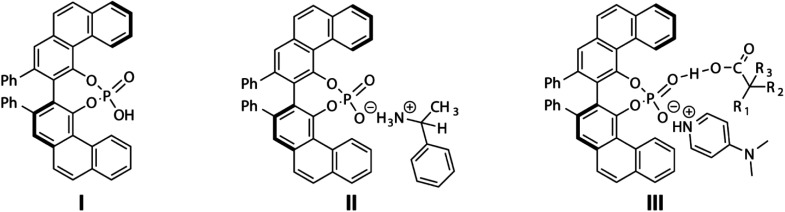
Fig. 1
Fig. 1. 2D representation of the structure of R-VAPOL-PA (I), mode of interactions between R-VAPOL-PA and chiral amines (II) (for example molecule 1) and ternary ion-pair complex with chiral acids and third component 4-dimethylaminopyridine (III).
Fig. 2
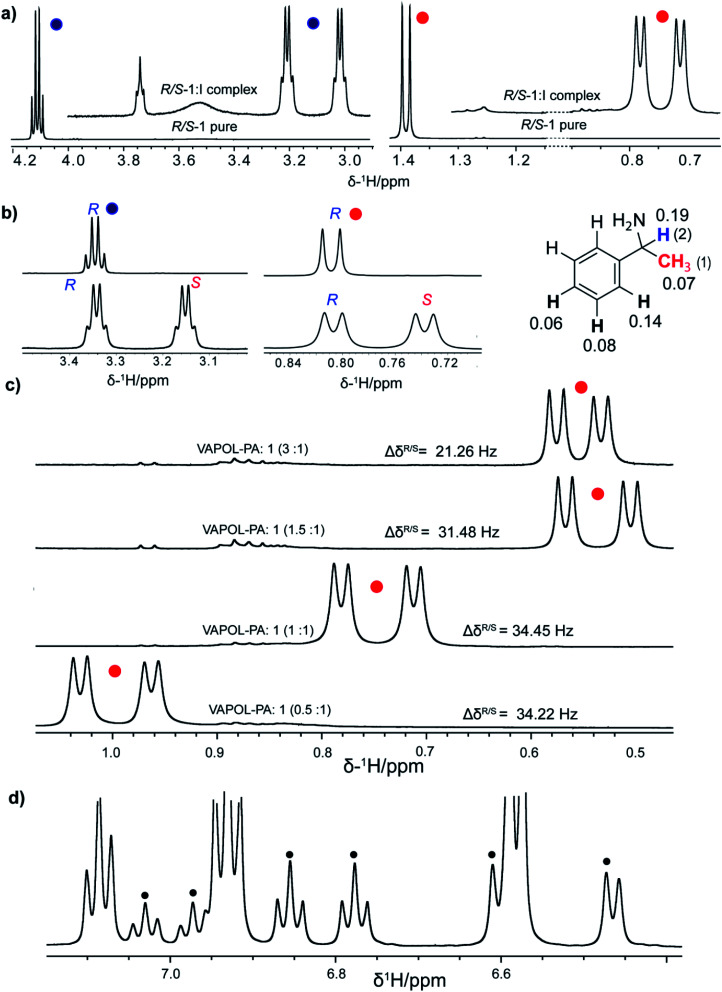
Fig. 2. (a) 1H-NMR spectrum of racemic molecule 1 in CDCl3 with and without 1 equivalent of R-VAPOL-PA showing only alpha proton and methyl proton respectively (b) 1H-NMR stack plot of R and R/S molecule 1 with 1 equivalent of R-VAPOL-PA along with the chemical structure in the schematic shows the chemical shift difference in ppm (ΔδR/S) observed at the respective proton sites. (c) Effect of concentration of CSA (R-VAPOL-PA) on the chemical shift difference of molecule 1 in the solvent CDCl3. (d) 1H-NMR spectrum of R/S molecule 1 showing discriminate aromatic protons with R-VAPOL-PA as CSA. All the spectra were recorded at 500 MHz magnetic field. The black circles indicate the peaks corresponding to both isomers.
Fig. 3
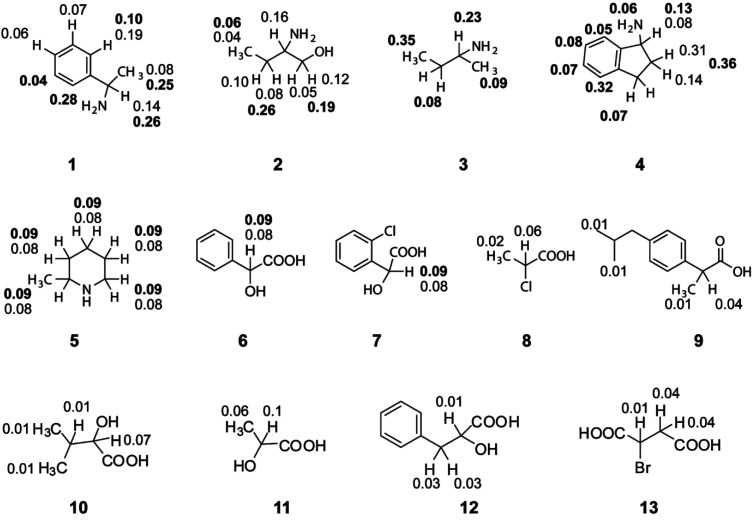
Fig. 3. Measured ΔδR/S values of discriminated protons and carbons for polyfunctional chiral molecules. ΔδR/S displayed in light and bold fonts corresponds to 1H and 13C-NMR, respectively.
Fig. 4
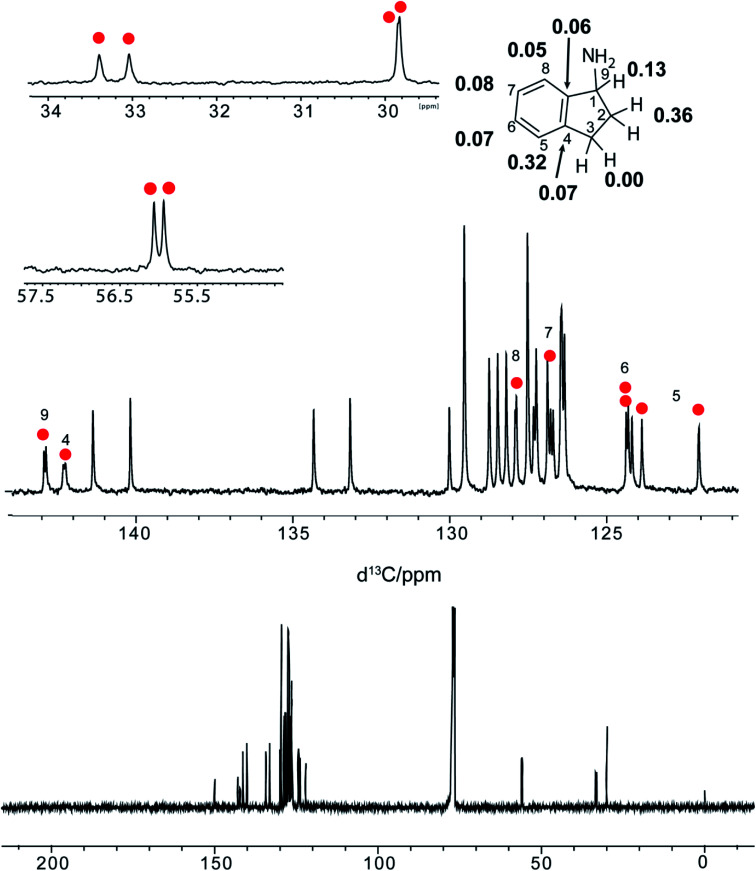
Fig. 4. 13C{1H}-NMR spectra of racemic 1-aminoindane (molecule 4, 1 equivalent) in CDCl3 with 1 equivalent of R-VAPOL-PA added. The red closed circles indicate the peaks corresponding to each isomer and the chemical structure in the schematic shows the chemical shift difference in ppm (ΔδR/S) at the respective carbon sites.
Fig. 5
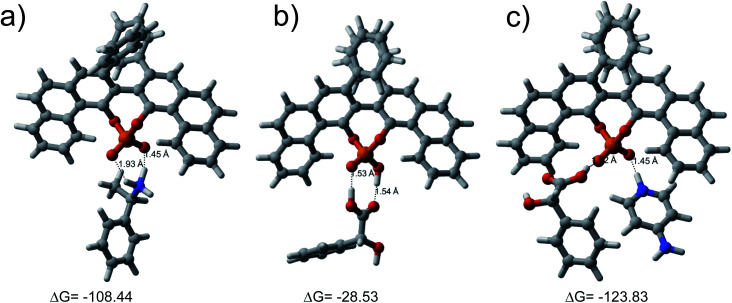
Fig. 5. The DFT optimized geometries of (a) R-VAPOL-PA-1, (b) R-VAPOL-PA-6 and (c) R-VAPOL-PA-6-DMAP complexes. The calculated binding energies (in kcal mol−1) and OH distance (in Å) in hydrogen bonds obtained for the respective complexes were also mentioned.
Fig. 6
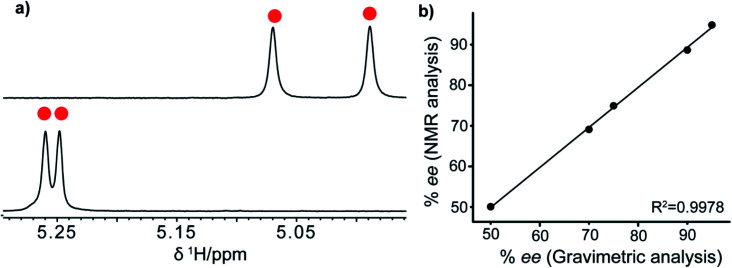
Fig. 6. (a) 1H-NMR spectrum of mandelic acid (molecule 6): R-VAPOL-PA with (upper spectrum) and without DMAP (lower spectrum) showing only alpha proton and (b) plot between NMR and gravimetric analyses in determining the ee for molecule 1 (see Table 2 for details).
Fig. 7
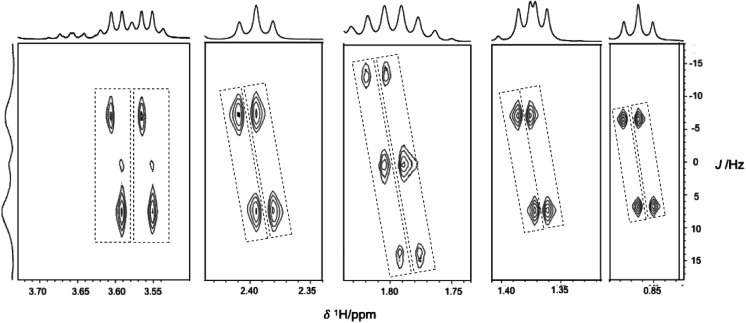
Fig. 7. 2D 1H J-resolved spectrum NMR spectra of racemic 9 (1 equivalent) in CDCl3 with 2 equivalents of R-VAPOL-PA and DMAP were added.

References

    1. Prabhu U. R. Chaudhari S. R. Suryaprakash N. Chem. Phys. Lett. 2010;500:334. doi: 10.1016/j.cplett.2010.10.019. - DOI
    2. Naqi H. A. Woodman T. J. Husbands S. M. Blagbrough I. S. Anal. Methods. 2019;11:3090. doi: 10.1039/C9AY00814D. - DOI
    1. Ardej-Jakubisiak M. Kawęcki R. Tetrahedron: Asymmetry. 2008;19:2645. doi: 10.1016/j.tetasy.2008.11.023. - DOI
    1. Nguyen L. A. He H. Pham-Huy C. Int. J. Biol. Sci. 2006;2:85. - PMC - PubMed
    1. Sanganyado E. Lu Z. Fu Q. Schlenk D. Gan J. Water Res. 2017;124:527. doi: 10.1016/j.watres.2017.08.003. - DOI - PubMed
    1. Hong L. Sun W. Yang D. Li G. Wang R. Chem. Rev. 2016;116:4006. doi: 10.1021/acs.chemrev.5b00676. - DOI - PubMed