


Efficacy and Safety of Omalizumab Treatment Over a 16-Year Follow-Up: When a Clinical Trial Meets Real-Life
- PMID: 35495876
- PMCID: PMC9039243
- DOI: 10.2147/JAA.S363398
Efficacy and Safety of Omalizumab Treatment Over a 16-Year Follow-Up: When a Clinical Trial Meets Real-Life
Abstract
Purpose: Treatment of severe asthma has made great strides thanks to rapid progress in understanding immune response and inflammatory pathways. This led to the advent of the first biologic for severe allergic asthma (SAA), omalizumab. Although the long-term efficacy and safety of omalizumab has been confirmed, increasingly longer follow-up data can further reinforce this evidence and potentially provide new ones, for example on any loss of efficacy or the appearance of unexpected side effects. This study reports omalizumab treatment-related outcomes after 16 years of follow-up.
Patients and methods: In this real-life retrospective study, an extension of a previous 9-year follow-up study on patients initially recruited in a clinical trial, we enrolled 8 adult patients with SAA followed-up from November 2005 to December 2021. Study subjects were selected based on omalizumab eligibility criteria.
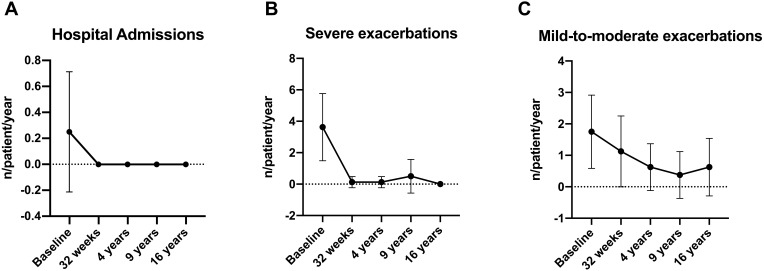
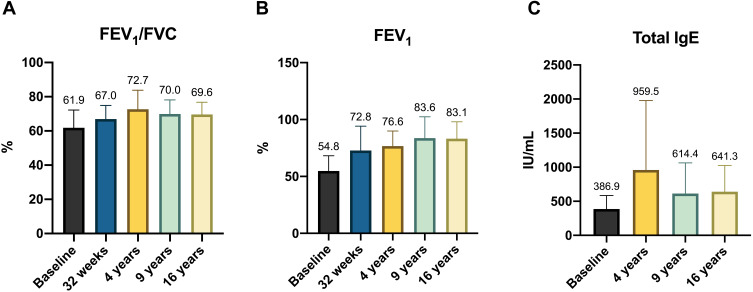
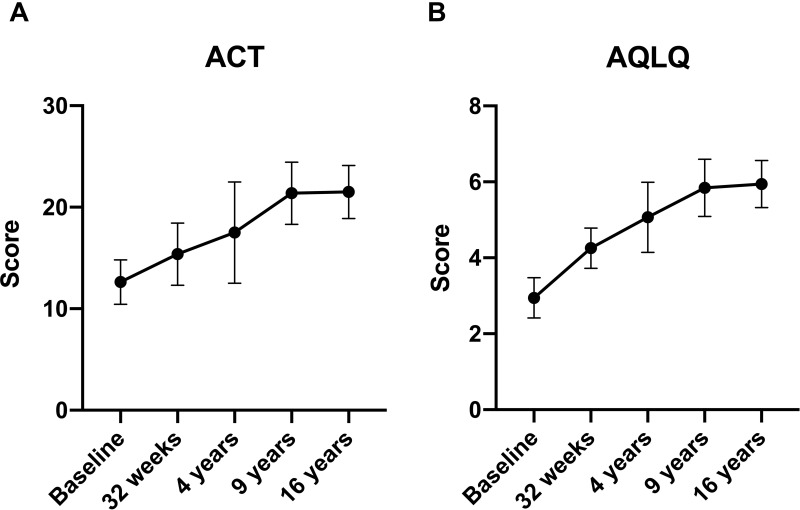
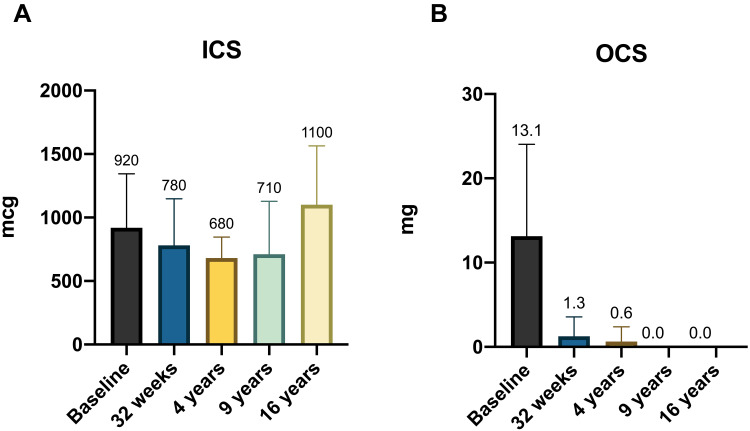
Results: Exacerbation rate significantly decreased from 3.6 ± 2.1 events in year before index date to 0.1 ± 0.4 after 32 weeks of treatment (p < 0.0001). Mean annual number of mild-to-moderate exacerbations at 16 years was 0.88 compared with 1.8 in the year before the index date and 1.1 at 32 weeks. No hospitalizations were documented during the 16-year follow-up compared to 0.3 hospitalizations/patient in the year before the index date. Respiratory function also progressively and significantly improved. Regarding patient-reported outcomes (PROs), The AQLQ and ACT significantly improved from baseline throughout the follow-up, particularly up to 9 years of follow-up. During the study, an overall reduction in doses of asthma medications was observed, with a significant OCS-sparing effect.
Conclusion: Our study, the longest clinical follow-up on patients treated with anti-IgE, confirms and amplifies the results of the studies carried out so far, as they are maintained over a very long interval of time without drops in efficacy without any type of side effect.
Keywords: biologics; exacerbations; omalizumab; oral corticosteroids; severe allergic asthma; side effects.
© 2022 Menzella et al.
Conflict of interest statement
Francesco Menzella has received research grants from AstraZeneca, Novartis, and Sanofi; lecture fees and advisory board fees from AstraZeneca, Boehringer Ingelheim, Chiesi, GSK, Mundipharma, Novartis, and Sanofi. Marco Contoli reports grants and/or personal fees from GlaxoSmithKline, Chiesi, AstraZeneca, Alk Abello, and Boehringer Ingelheim, outside the submitted work. The other authors have no conflicts of interest to declare in this work.
Figures
References
-
- First biologic for allergy-related asthma. FDA Consum. 2003: 5. - PubMed
LinkOut - more resources
Full Text Sources
Miscellaneous
