


Dataset on optimizing ambulance deployment and redeployment in Fez-Meknes region, Morocco
- PMID: 35496483
- PMCID: PMC9046610
- DOI: 10.1016/j.dib.2022.108178
Dataset on optimizing ambulance deployment and redeployment in Fez-Meknes region, Morocco
Abstract
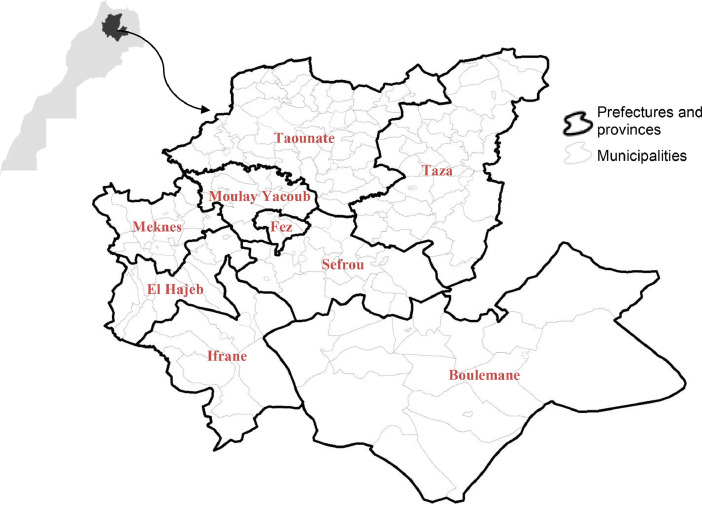
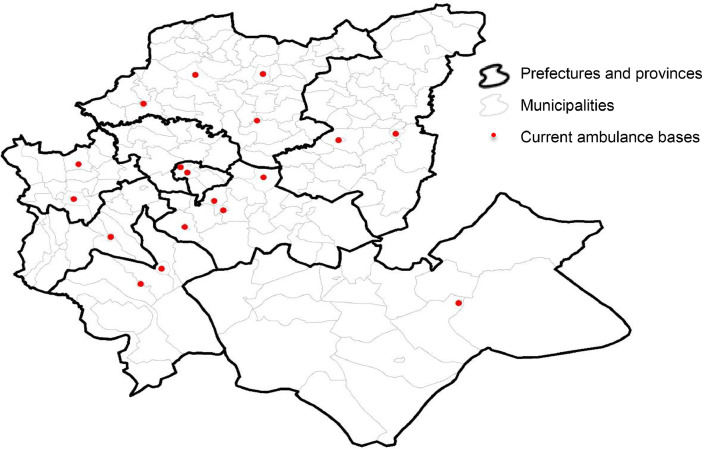
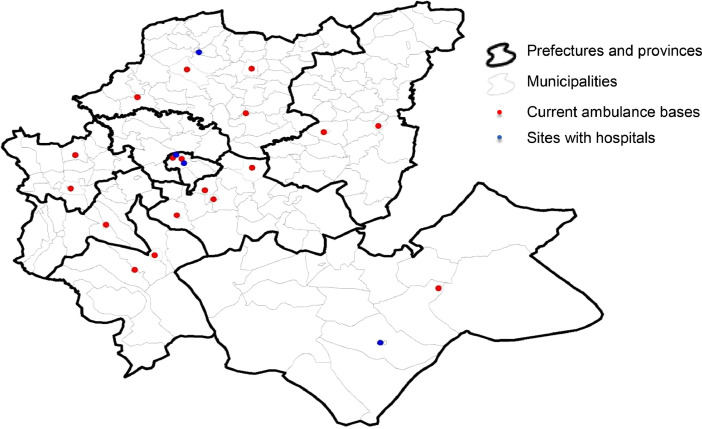
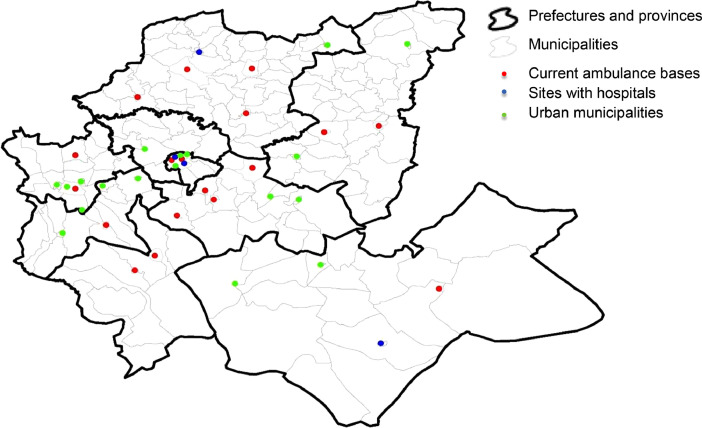
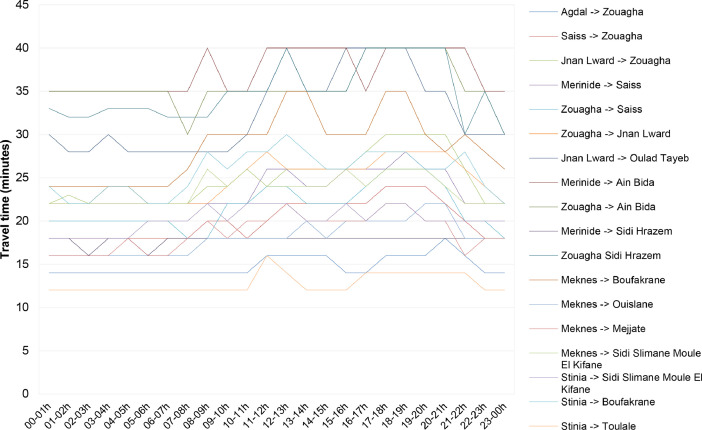
Emergency Medical Services (EMS) are crucial for saving patients' life, attenuating disabilities, and improving patients' satisfaction. Optimal deployment and redeployment of ambulances over a territory reduce response times for serving emergencies. Thus, rapid interventions and transport to a hospital are guaranteed. Optimizing ambulance deployment and redeployment is achieved by conceptualizing and formulating mathematical programming models and simulation models. Mathematical models maximize the proportion of the population that can be reached by ambulance in a response time less than a threshold value. In contrast, simulation models assess a given ambulance deployment and redeployment configuration. The application of mathematical and simulation models require data related to demand areas (geographic territories), demand value at each demand area, locations of potential sites for ambulance bases, X and Y geographic coordinates of demand areas and potential sites, travel times between potential sites and demand areas, etc. All these data are essential in deciding which potential sites to choose for locating ambulance bases and how many ambulances to allocate to each base per period. Beside elaborating and constructing ambulance deployment and redeployment models, researchers in Operations Research (OR) are challenged when collecting data for executing, testing, and proving the performance of their proposed models. This paper provides data about medical transport in Morocco's Fez-Meknes region, which can be accessed at https://zenodo.org/record/6416058. They were collected from the field, estimated based on the population size, and obtained by computer programs. The dataset includes 199 demand areas and their respective demand value per ambulance type and per period, the travel times between 18, 22, 40 potential sites and the 199 demand areas per period, and the travel times between the potential sites. Also, the dataset comprises the minimum number b of ambulances required by each demand area for α-reliable coverage, which was computed using a MATLAB program. The number b of ambulances required by each demand area is mandatory to apply reliability models such as the MALP and the Q-MALP models. These data would be used by the research community interested in EMS, especially pre-hospital emergency issues addressed by deploying mathematical programming and simulation tools.
Keywords: Ambulance location; Data; Emergency medical services; Integer programming; Medical transport; Modeling; Morocco; Simulation.
© 2022 The Author(s). Published by Elsevier Inc.
Conflict of interest statement
The authors declare that they have no known competing financial interests or personal relationships that could have appeared to influence the work reported in this paper.
Figures
References
-
- Y. Frichi, F. Jawab, L. Aboueljinane, Dataset on ambulance deployment and redeployment, Zenodo. (2022). https://zenodo.org/record/6416058. - PMC - PubMed
-
- Y. Frichi, MATLAB codes for computing the minimum number of ambulances for α-reliable coverage, Zenodo. (2022). https://zenodo.org/record/6413103.
-
- Frichi Y., Jawab F., Aboueljinane L., Boutahari S. Development and comparison of two new multi-period queueing reliability models using discrete-event simulation and a simulation-optimization approach. Comput. Ind. Eng. 2022;168 doi: 10.1016/j.cie.2022.108068. - DOI
-
- Coelho O., Alexandrino F., Barreto B. SAMU ambulance positioning using MALP model. Braz. J. Oper. Prod. Manag. 2017;14:508–518. doi: 10.14488/bjopm.2017.v14.n4.a7. - DOI
-
- Frichi Y., Jawab F., Boutahari S. Proceedings of the IEEE 13th International Colloquium of Logistics and Supply Chain Management. IEEE, Fez, Maroc; 2020. Diagnosis of the main issues of extra-hospital medical patient transportation: case of Morocco. LOGISTIQUA 2020. - DOI
LinkOut - more resources
Full Text Sources
