


Electronic cigarette use among adults in 14 countries: A cross-sectional study
- PMID: 35497060
- PMCID: PMC9046112
- DOI: 10.1016/j.eclinm.2022.101401
Electronic cigarette use among adults in 14 countries: A cross-sectional study
Abstract
Background: The tobacco product landscape continues to change. No recent data for electronic cigarette (e-cigarette) use have been reported for multiple countries based on nationally representative surveys. We examined prevalence of e-cigarette use and variations by sociodemographic characteristics in 14 countries using Global Adult Tobacco Survey (GATS) data between Jan 1, 2015, and Dec 31, 2018.
Methods: GATS is a nationally representative household survey of tobacco use among adults aged ≥15 years. The analytic sample size ranged from 4347 in Senegal to 74,037 in India. Prevalence of current e-cigarette use was stratified by sociodemographic subgroups. Age-standardized prevalence was estimated according to world 2000-2025 standard population. Significant differences in adjusted prevalence across sociodemographic subgroup was determined by p value for marginal effect contrast in multivariable logistic regression models.
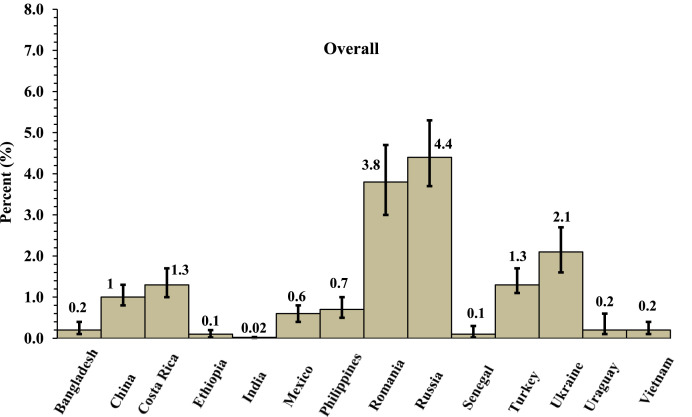
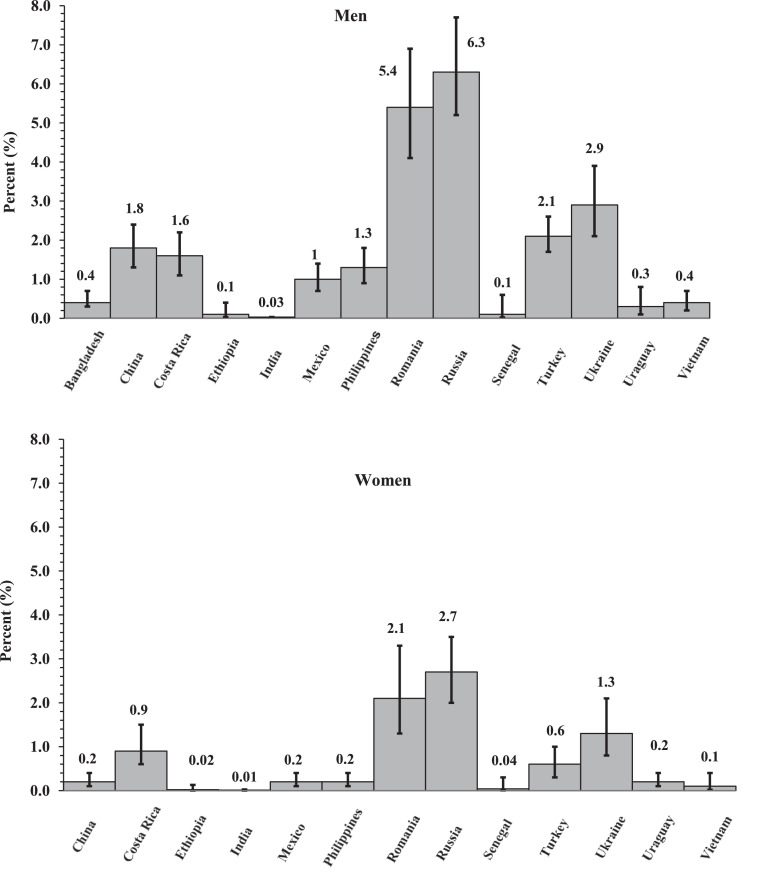
Findings: More than 50% of adults in Russia, Romania, and Ukraine and additionally more than 30% of adults in China, Costa Rica, Uruguay, Mexico, and Philippines were aware of e-cigarettes. Crude prevalence of current e-cigarette use ranged from 0.02% (95% CI 0.01%-0.04%) in India to 3.5% (2.9%-4.2%) in Russia. Prevalence was <1% in nine countries. Approximately 18.3 million adults currently used e-cigarettes across the 14 countries. Men had a significantly higher prevalence of current e-cigarette use than women in eight countries. Additionally, higher adjusted prevalence was observed in some countries among young adults aged 15‒24 years, urban residents, and adults with higher education levels and higher wealth index.
Interpretation: The study provides needed baseline data on e-cigarette awareness and use. Continued surveillance is essential to inform interventions and policies to prevent initiation and enhance cessation support.
Funding: None.
Keywords: Adults; Country; E-cigarettes; Electronic cigarettes; Global; Prevalence.
Conflict of interest statement
We declare no competing interests.
Figures
References
-
- World Health Organization . World Health Organization; Geneva, Switzerland: 2021. Tobacco key facts.https://www.who.int/news-room/fact-sheets/detail/tobacco Available at.
-
- U.S. National Cancer Institute and World Health Organization . U.S. Department of Health and Human Services, National Institutes of Health, National Cancer Institute; and Geneva, CH: World Health Organization; Bethesda, MD: 2016. The economics of tobacco and tobacco control. National Cancer Institute tobacco control monograph 21.https://cancercontrol.cancer.gov/sites/default/files/2020-08/m21_complet... Available at.
-
- U.S. Department of Health and Human Services . U.S. Department of Health and Human Services, Public Health Service, Office of the Surgeon General; Rockville, MD: 2016. E-cigarette use among youth and young adults: A report of the Surgeon General.https://www.cdc.gov/tobacco/data_statistics/sgr/e-cigarettes/pdfs/2016_s... Available at.
-
- Centers for Disease Control and Prevention (CDC). Electronic Cigarettes. Atlanta, GA: U.S. Centers for Disease Control and Prevention. Available at: https://www.cdc.gov/tobacco/basic_information/e-cigarettes/index.htm.
LinkOut - more resources
Full Text Sources
Research Materials
