


Mechanochemical generation of singlet oxygen
- PMID: 35497229
- PMCID: PMC9050071
- DOI: 10.1039/d0ra00831a
Mechanochemical generation of singlet oxygen
Abstract
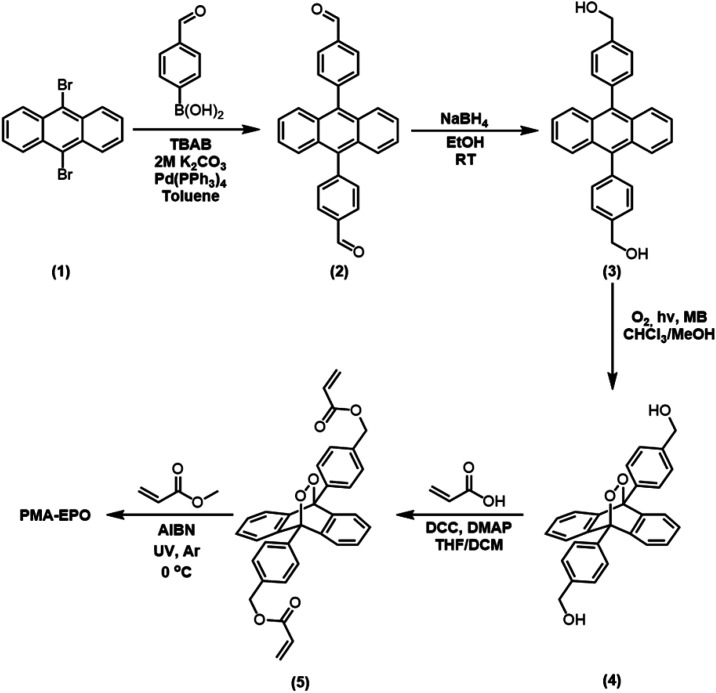
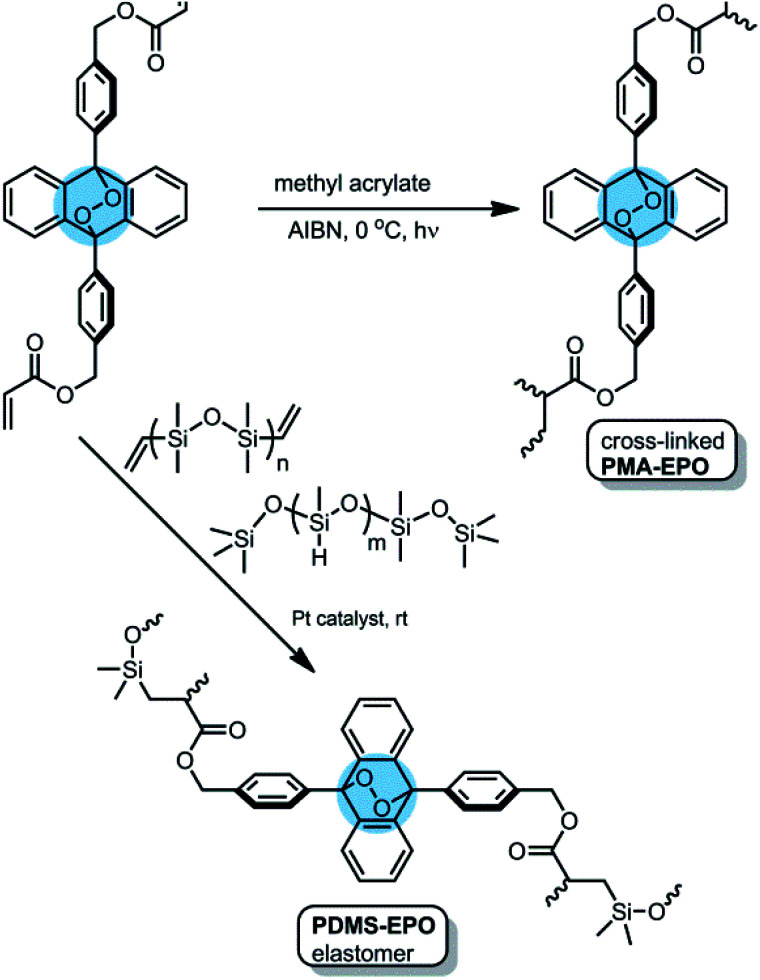
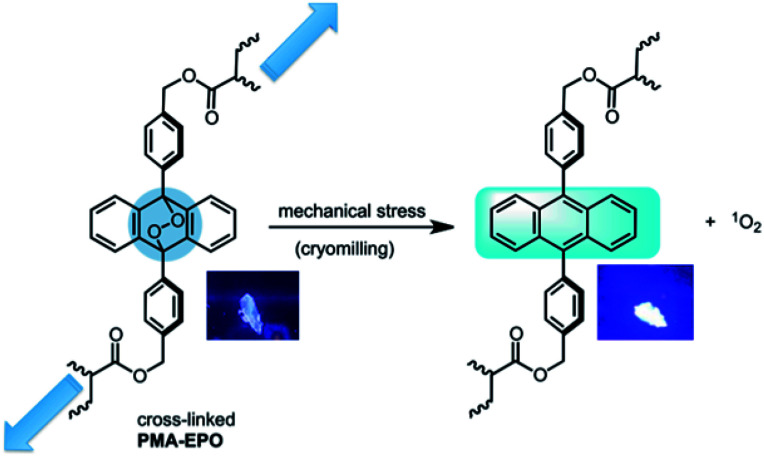
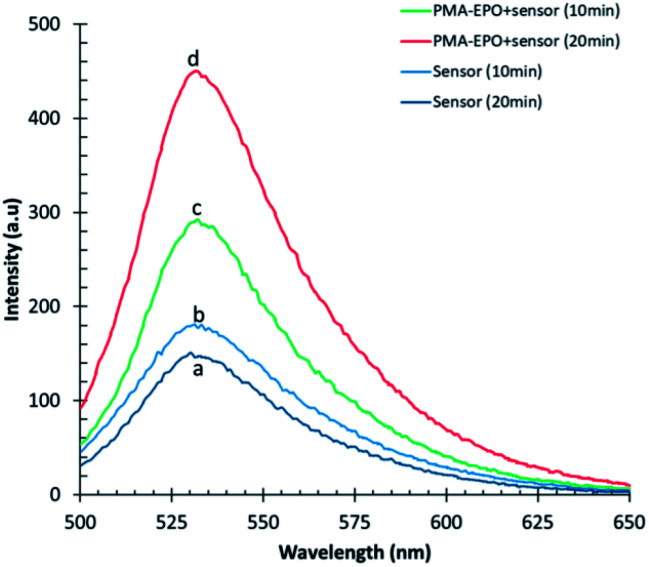
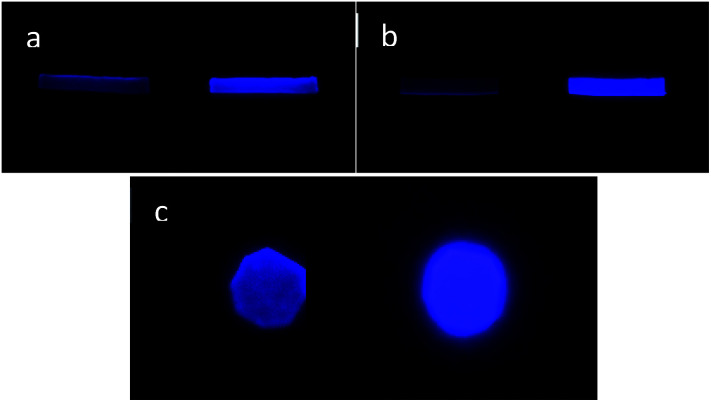
Controlled generation of singlet oxygen is very important due to its involvement in scheduled cellular maintenance processes and therapeutic potential. As a consequence, precise manipulation of singlet oxygen release rates under mild conditions, is crucial. In this work, a cross-linked polyacrylate, and a polydimethylsiloxane elastomer incorporating anthracene-endoperoxide modules with chain extensions at the 9,10-positions were synthesized. We now report that on mechanical agitation in cryogenic ball mill, fluorescence emission due to anthracene units in the PMA (polymethacrylate) polymer is enhanced, with a concomitant generation of singlet oxygen as proved by detection with a selective probe. The PDMS (polydimethylsiloxane) elastomer with the anthracene endoperoxide mechanophore, is also similarly sensitive to mechanical force.
This journal is © The Royal Society of Chemistry.
Conflict of interest statement
There are no conflicts to declare.
Figures
References
-
- Dougherty T. J. Kaufman J. E. Goldfarb A. Weishaupt K. R. Boyle D. Mittleman A. Cancer Res. 1978;38:2628–2635. doi: 10.1038/nrc1071. - DOI - PubMed
- Moan J. Peng Q. Anticancer Res. 2003;23:591–600. doi: 10.1038/nrc1071. - DOI - PubMed
- Dolmans D. E. J. G. J. Fukumura D. Jain R. K. Nat. Rev. Cancer. 2003;3:380–387. doi: 10.1038/nrc1071. - DOI - PubMed
-
- Huang Z. Technol. Cancer Res. Treat. 2005;4:283–293. doi: 10.1177/153303460500400308. - DOI - PMC - PubMed
- Bredell M. G. Besic E. Maake C. Walt H. J. Photochem. Photobiol., B. 2010;101:185–190. doi: 10.1177/153303460500400308. - DOI - PubMed
- Zeitouni N. C. Oseroff A. R. Shieh S. Mol. Immunol. 2003;39:1133–1136. doi: 10.1177/153303460500400308. - DOI - PubMed
- Stolik S. Delgado J. A. Perez A. Anasagasti L. J. Photochem. Photobiol., B. 2000;57:90–93. doi: 10.1177/153303460500400308. - DOI - PubMed
- Morton C. A. McKenna K. E. Rhodes L. E. Br. J. Dermatol. 2008;159:1245–1266. doi: 10.1177/153303460500400308. - DOI - PubMed
-
- Liu Y. Liu Y. Bu W. Cheng C. Zuo C. Xiao Q. Sun Y. Ni D. Zhang C. Liu J. Angew. Chem., Int. Ed. 2015;54:8105–8109. doi: 10.1039/C4AN01934B. - DOI - PubMed
- Xu J. Sun S. Li Q. Yue Y. Li Y. Shao S. Analyst. 2015;140:574–581. doi: 10.1039/C4AN01934B. - DOI - PubMed
- Wang S. Liu H. Mack J. Tian J. Zou B. Lu H. Li Z. Jiang J. Shen Z. Chem. Commun. 2015:13389–13392. doi: 10.1039/C4AN01934B. - DOI - PubMed
- Kiyose K. Hanaoka K. Oushiki D. Nakamura T. Kajimura M. Suematsu M. Nishimatsu H. Yamane T. Terai T. Hirata Y. J. Am. Chem. Soc. 2010;132:15846–15848. doi: 10.1039/C4AN01934B. - DOI - PubMed
- Zhang G. Palmer G. M. Dewhirst M. W. Fraser C. L. Nat. Mater. 2009;8:747–751. doi: 10.1039/C4AN01934B. - DOI - PMC - PubMed
- Pouyssegur J. Dayan F. Mazure N. M. Nature. 2006;441:437–443. doi: 10.1039/C4AN01934B. - DOI - PubMed
- Zheng X. Wang X. Mao H. Wu W. Liu B. Jiang X. Nat. Commun. 2015;6:5834. doi: 10.1039/C4AN01934B. - DOI - PubMed
- Gallagher W. Allen L. O'Shea C. Kenna T. Hall M. Gorman A. Killoran J. O'Shea D. Br. J. Cancer. 2005;92:1702–1710. doi: 10.1039/C4AN01934B. - DOI - PMC - PubMed
- Koukourakis M. I. Giatromanolaki A. Skarlatos J. Corti L. Blandamura S. Piazza M. Gatter K. C. Harris A. L. Cancer Res. 2001;61:1830–1832. doi: 10.1039/C4AN01934B. - DOI - PubMed
LinkOut - more resources
Full Text Sources
Research Materials
