


Genetic Variants of APOL1 Are Major Determinants of Kidney Failure in People of African Ancestry With HIV
- PMID: 35497797
- PMCID: PMC9039486
- DOI: 10.1016/j.ekir.2022.01.1054
Genetic Variants of APOL1 Are Major Determinants of Kidney Failure in People of African Ancestry With HIV
Erratum in
-
Corrigendum to "Genetic Variants of APOL1 Are Major Determinants of Kidney Failure in People of African Ancestry With HIV" [Kidney International Reports Volume 7, Issue 4, April 2022, Pages 786-796].Kidney Int Rep. 2024 Oct 11;9(12):3604. doi: 10.1016/j.ekir.2024.10.011. eCollection 2024 Dec. Kidney Int Rep. 2024. PMID: 39698367 Free PMC article.
Abstract
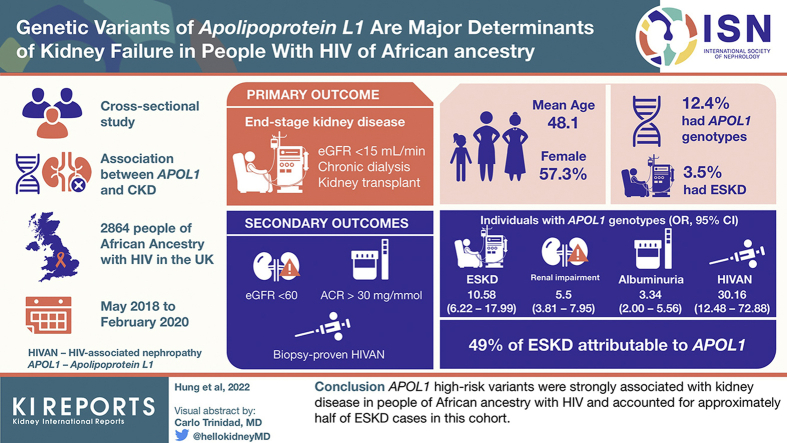
Introduction: Variants of the APOL1 gene are associated with chronic kidney disease (CKD) in people of African ancestry, although evidence for their impact in people with HIV are sparse.
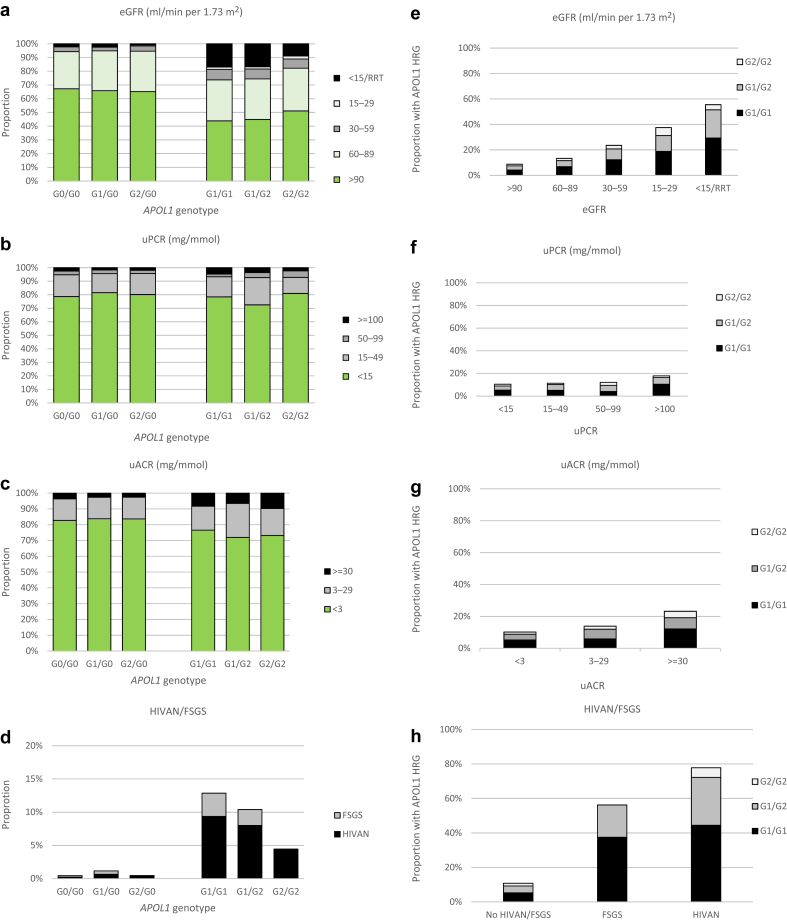
Methods: We conducted a cross-sectional study investigating the association between APOL1 renal risk alleles and kidney disease in people of African ancestry with HIV in the UK. The primary outcome was end-stage kidney disease (ESKD; estimated glomerular filtration rate [eGFR] of <15 ml/min per 1.73 m2, chronic dialysis, or having received a kidney transplant). The secondary outcomes included renal impairment (eGFR <60 ml/min per 1.73 m2), albuminuria (albumin-to-creatinine ratio [ACR] >30 mg/mmol), and biopsy-proven HIV-associated nephropathy (HIVAN). Multivariable logistic regression was used to estimate the associations between APOL1 high-risk genotypes (G1/G1, G1/G2, G2/G2) and kidney disease outcomes.
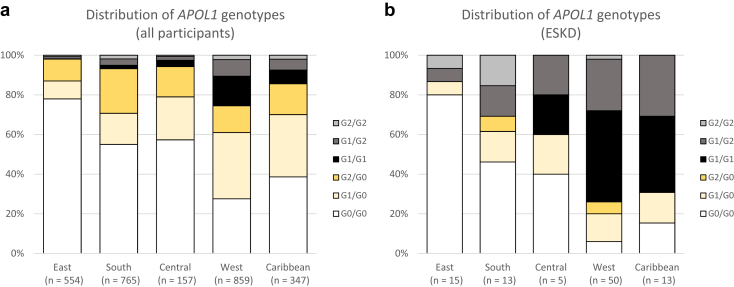
Results: A total of 2864 participants (mean age 48.1 [SD 10.3], 57.3% female) were genotyped, of whom, 354 (12.4%) had APOL1 high-risk genotypes, and 99 (3.5%) had ESKD. After adjusting for demographic, HIV, and renal risk factors, individuals with APOL1 high-risk genotypes were at increased odds of ESKD (odds ratio [OR] 10.58, 95% CI 6.22-17.99), renal impairment (OR 5.50, 95% CI 3.81-7.95), albuminuria (OR 3.34, 95% CI 2.00-5.56), and HIVAN (OR 30.16, 95% CI 12.48-72.88). An estimated 49% of ESKD was attributable to APOL1 high-risk genotypes.
Conclusion: APOL1 high-risk genotypes were strongly associated with kidney disease in people of African ancestry with HIV and accounted for approximately half of ESKD cases in this cohort.
Keywords: APOL1; Africa; HIV; HIVAN; diaspora; kidney.
© 2022 International Society of Nephrology. Published by Elsevier Inc.
Figures
References
-
- US Census Bureau QuickFacts: United States. US Census Bureau. Accessed May 12, 2021. https://www.census.gov/quickfacts/fact/table/US/PST045219
-
- Levey A.S., Coresh J., Balk E., et al. National Kidney Foundation practice guidelines for chronic kidney disease: evaluation, classification, and stratification [published correction appears in Ann Intern Med. 2003 Oct 7;139(7):605] Ann Intern Med. 2003;139:137–147. doi: 10.7326/0003-4819-139-2-200307150-00013. - DOI - PubMed
Grants and funding
LinkOut - more resources
Full Text Sources
Medical
Research Materials
Miscellaneous
