


Varicose Veins and Risk of Venous Thromboembolic Diseases: A Two-Sample-Based Mendelian Randomization Study
- PMID: 35498031
- PMCID: PMC9047357
- DOI: 10.3389/fcvm.2022.849027
Varicose Veins and Risk of Venous Thromboembolic Diseases: A Two-Sample-Based Mendelian Randomization Study
Abstract
Background: Varicose veins are found to be associated with increased risk of venous thromboembolism (VTE) in many observational studies, but whether varicose veins are causally associated with VTE remains unclear. Therefore, we used a series of Mendelian randomization (MR) methods to investigate that association.
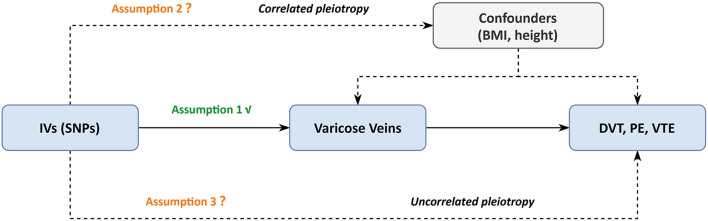
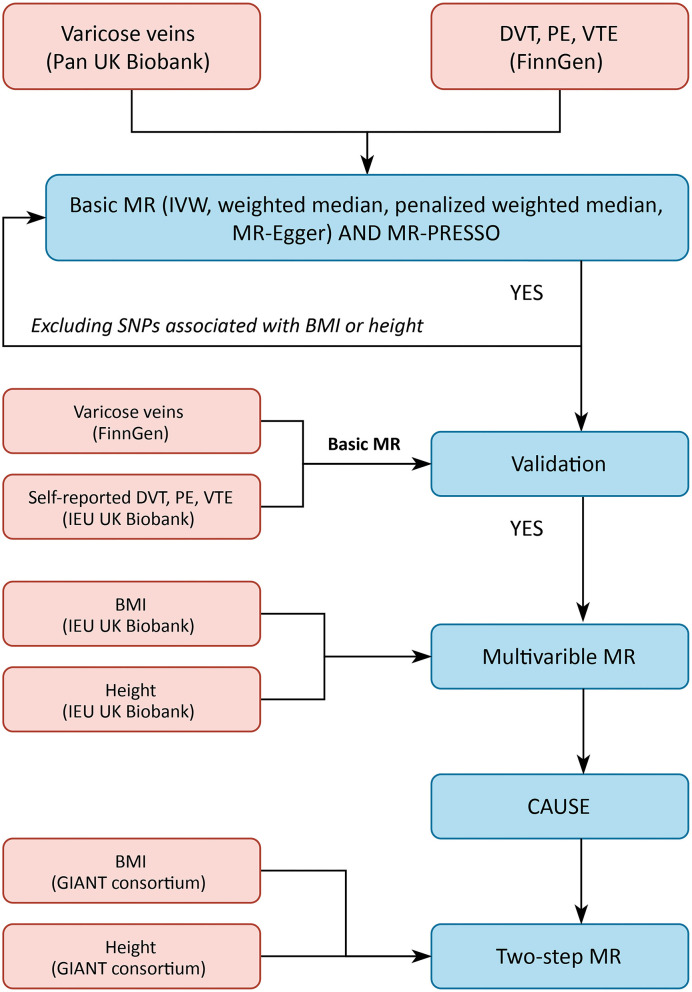
Methods: 23 independent single-nucleotide polymorphisms (SNPs) for varicose veins were obtained from the Pan UK Biobank analysis. The outcomes datasets for deep vein thrombosis (DVT), pulmonary embolism (PE) and venous thromboembolism (VTE) were obtained from the FinnGen study. Before analysis, body mass index (BMI) and height were included as confounders in our MR model. Basic MR [inverse-variance weighted (IVW), weight-median, penalized weighted-median and MR-Egger methods] and MR-PRESSO were performed against each outcome using the whole SNPs and SNPs after excluding those associated with confounders. If causal associations were suggested for any outcome, a basic MR validation analysis, a multivariable MR analysis with BMI and height, a Causal Analysis Using Summary Effect estimates (CAUSE), and a two-step MR analysis with BMI and height, would follow.
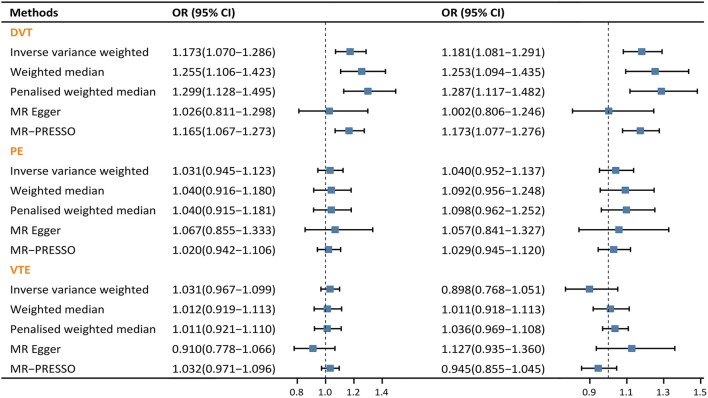
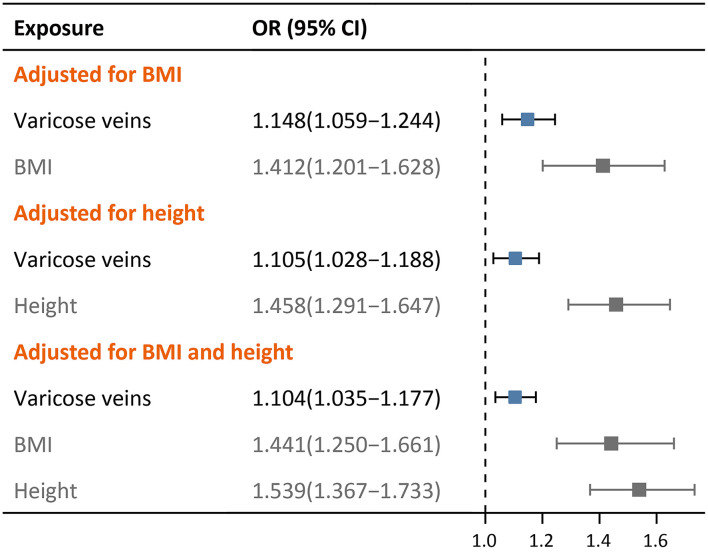
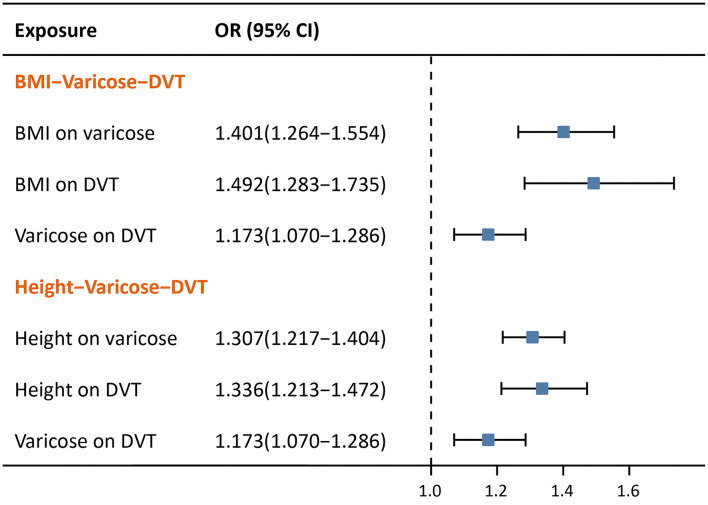
Results: Using 21 qualified SNPs, the IVW method (OR: 1.173, 95% CI: 1.070-1.286, p < 0.001, FDR = 0.002), the weighted median method (OR: 1.255, 95% CI: 1.106-1.423, p < 0.001, FDR = 0.001), the penalized weighted median method (OR: 1.299, 95% CI: 1.128-1.495, p < 0.001, FDR = 0.001) and the MR-PRESSO (OR: 1.165, 95% CI: 1.067-1.273, p = 0.003, FDR = 0.009) suggested potential causal effect of varicose veins on DVT, but no cause effect was found for PE and VTE. Excluding SNPs associated with confounders yielded similar results. The causal association with DVT was validated using a self-reported DVT cohort (IVW, OR: 1.107, 95% CI: 1.041-1.178, p = 0.001). The causal association maintained after adjustment for height (OR = 1.105, 95% CI: 1.028-1.188, p = 0.007), BMI (OR = 1.148, 95% CI: 1.059-1.244, p < 0.001) and them both (OR = 1.104, 95% CI: 1.035-1.177, p = 0.003). The causal association also survived the strict CAUSE (p = 0.018). Finally, in two-step MR, height and BMI were found to have causal effects on both varicose veins and DVT.
Conclusion: Genetically predicted varicose veins may have a causal effect on DVT and may be one of the mediators of obesity and taller height that predispose to DVT.
Keywords: Mendelian randomization; deep vein thrombosis; pulmonary embolism; varicose veins; venous thromboembolism.
Copyright © 2022 Li, Chen, Gui, Wu, Miao, Gao, Diao and Li.
Conflict of interest statement
The authors declare that the research was conducted in the absence of any commercial or financial relationships that could be construed as a potential conflict of interest.
Figures
References
Grants and funding
LinkOut - more resources
Full Text Sources
