Review
. 2022 Apr 20:2022:9299574.
doi: 10.1155/2022/9299574. eCollection 2022.

Oxidative Stress and Ginsenosides: An Update on the Molecular Mechanisms

Affiliations
Review

Oxidative Stress and Ginsenosides: An Update on the Molecular Mechanisms

Bo He et al. Oxid Med Cell Longev. .

Abstract

Ginsenosides are a class of active components extracted from ginseng plants (such as Panax ginseng, Panax quinquefolium, and Panax notoginseng). Ginsenosides have significant protective effects on the nervous system, cardiovascular system, and immune system, so they have been widely used in the treatment of related diseases. Entry of a variety of endogenous or exogenous harmful substances into the body can lead to an imbalance between the antioxidant defense system and reactive oxygen species, thus producing toxic effects on a variety of tissues and cells. In addition, oxidative stress can alter multiple signaling pathways, including the Keap1/Nrf2/ARE, PI3K/AKT, Wnt/β-catenin, and NF-κB pathways. With the deepening of research in this field, various ginsenoside monomers have been reported to exert antioxidant effects through multiple signaling pathways and thus have good application prospects. This article summarized the research advancements regarding the antioxidative effects and related mechanisms of ginsenosides, providing a theoretical basis for experimental research on and clinical treatment with ginsenosides.


Conflict of interest statement

The authors declare no conflict of interest.

Figures
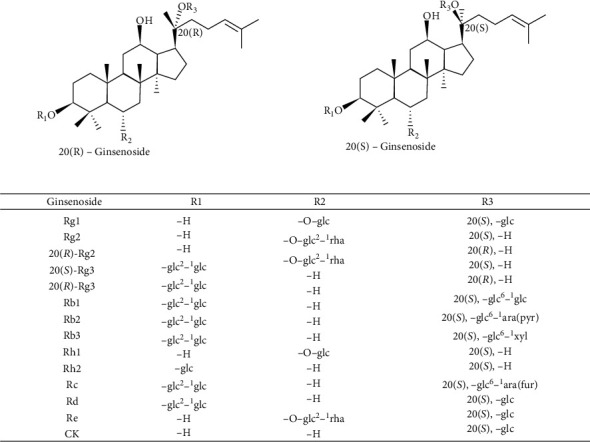
Figure 1
Figure 1
Structures of main ginsenosides. The figure shows the molecular structure of 20(R)-ginsenosides and 20(S)-ginsenosides. The main difference between them that is R1, R2, and R3 form a glycoside position (glc: β-d-glucopyranoside; ara (pyr): arabinopyranoside; ara (fur): furanoside; xyl: xylose group; rha: rhamnose).
Figure 2
Figure 2
Schematic diagram of multiple damaged organelles induced by oxidative stress. The figure shows that oxidative stress can cause apoptosis and the changes of mitochondria, GA, and ER after oxidative stress. Oxidative stress can lead to abnormal mitochondrial fusion division, dysfunction of the endoplasmic reticulum, imbalance of Golgi Ca2+ homeostasis, and Golgi fragmentation.
Figure 3
Figure 3
The schematic overview of major signaling pathways induced by oxidative stress. The overproduction of ROS leads to the imbalance of oxidation/antioxidants, which causes various signaling pathways to regulate the process of oxidative stress. Activation of Keap1/Nrf2/ARE and PI3K/Akt signaling pathways can induce the expression of antioxidants and play an antioxidative stress role. In addition, mTOR, Wnt/β-catenin, and NF-κB signaling pathways are also involved in the process of oxidative stress, and inhibition of these signaling pathways may play a protective role against oxidative stress.

References

    1. Shi Z. Y., Zeng J. Z., Wong A. S. T. Chemical structures and pharmacological profiles of ginseng saponins. Molecules . 2019;24(13):p. 2443. doi: 10.3390/molecules24132443. - DOI - PMC - PubMed
    1. Metwaly A. M., Lianlian Z., Luqi H., Deqiang D. Black ginseng and its saponins: preparation, phytochemistry and pharmacological effects. Molecules . 2019;24(10):p. 1856. doi: 10.3390/molecules24101856. - DOI - PMC - PubMed
    1. Yu S. E., Mwesige B., Yi Y. S., Yoo B. C. Ginsenosides: the need to move forward from bench to clinical trials. Journal of Ginseng Research . 2019;43(3):361–367. doi: 10.1016/j.jgr.2018.09.001. - DOI - PMC - PubMed
    1. He Y., Hu Z., Li A., et al. Recent advances in biotransformation of saponins. Molecules . 2019;24(13):p. 2365. doi: 10.3390/molecules24132365. - DOI - PMC - PubMed
    1. Kim Y. J., Zhang D., Yang D. C. Biosynthesis and biotechnological production of ginsenosides. Biotechnology Advances . 2015;33(6):717–735. doi: 10.1016/j.biotechadv.2015.03.001. - DOI - PubMed

MeSH terms

LinkOut - more resources
