


Prevalence and Self-Perceived Experiences With the Use of Hormonal Contraceptives Among Competitive Female Cross-Country Skiers and Biathletes in Norway: The FENDURA Project
- PMID: 35498528
- PMCID: PMC9047044
- DOI: 10.3389/fspor.2022.873222
Prevalence and Self-Perceived Experiences With the Use of Hormonal Contraceptives Among Competitive Female Cross-Country Skiers and Biathletes in Norway: The FENDURA Project
Abstract
Purpose: To investigate the prevalence of hormonal contraceptive (HC) use by female cross-country (XC) skiers and biathletes competing at a national and/or international level, their reasons for HC use, and to compare negative symptoms related to the HC-/menstrual cycle in HC users and non-HC users. Additionally, to characterize the self-perceived influence of HC use on training and performance.
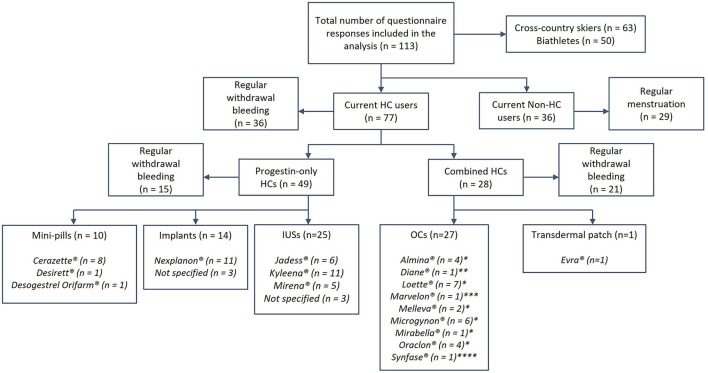
Methods: A total of 113 Norwegian competitive XC skiers and biathletes completed an online questionnaire including both closed and open-ended questions. The questions were designed to assess the type of HC, reasons for use, self-reported negative symptoms related to HC-/menstrual cycle, as well as athletes' experiences regarding how HC use affects training and performance.
Results: In total, 68% of all the athletes used HC, with 64 and 36% of them using a progestin-only and combined type HC, respectively. Non-contraceptive reasons for HC use were reported by 51% of the progestin-only HC users vs. 75% of the combined HC users (P = 0.039), with reduction of negative menstrual-related symptoms as the most common reason. Of the athletes reporting regular withdrawal bleedings in connection to HC use, 80% of the progestin-only and 86% of combined HC users experienced negative menstrual-related symptoms, which was comparable to the non-HC group (86%). The majority (81%) of HC users experienced solely positive, or no effect, of HC use on training and performance, with no differences between progestin-only and combined HC users (P = 0.942).
Conclusions: In total, 68% of the XC skiers and biathletes used HC, with the highest proportion (64%) using a progestin-only HC. Many athletes used HC to manipulate their menstrual cycle due to perceived negative menstrual-related symptoms that interfered with their training sessions and/or competitions.
Keywords: combined hormonal contraceptives; endurance; female athletes; hormonal contraceptives; progestin-only hormonal contraceptives.
Copyright © 2022 Engseth, Andersson, Solli, Morseth, Thomassen, Noordhof, Sandbakk and Welde.
Conflict of interest statement
The authors declare that the research was conducted in the absence of any commercial or financial relationships that could be construed as a potential conflict of interest.
Figures
References
-
- Armour M., Parry K. A., Steel K., Smith C. A. (2020). Australian female athlete perceptions of the challenges associated with training and competing when menstrual symptoms are present. Int. J. Sports Sci. Coach. 15, 316–323. 10.1177/1747954120916073 - DOI
LinkOut - more resources
Full Text Sources
