. 2020 Mar 9;10(17):10082-10096.
doi: 10.1039/d0ra00877j. eCollection 2020 Mar 6.

A novel CoFe2O4@Cr-MIL-101/Y zeolite ternary nanocomposite as a magnetically separable sonocatalyst for efficient sonodegradation of organic dye contaminants from water

Affiliations

A novel CoFe2O4@Cr-MIL-101/Y zeolite ternary nanocomposite as a magnetically separable sonocatalyst for efficient sonodegradation of organic dye contaminants from water

Meysam Sadeghi et al. RSC Adv. .

Abstract

In this research, a novel magnetic sonocatalyst nanocomposite, CoFe2O4@Cr-MIL-101/Y zeolite, has been successfully fabricated employing a simple hydrothermal method. The as-prepared catalyst was thoroughly identified using Fourier transform infrared spectroscopy (FTIR), X-ray diffraction (XRD), field emission scanning electron microscopy (FESEM), energy dispersive X-ray spectroscopy (EDS), EDS elemental dot-mapping, transmission electron microscopy (TEM), atomic force microscopy (AFM), vibrating sample magnetometer (VSM), and nitrogen Brunauer-Emmett-Teller (N2-BET) analyses. The procured CoFe2O4@Cr-MIL-101/Y nanocomposite was then assessed for the decomposition of three types of organic dyes namely methylene blue (MB), rhodamine B (RhB) and methyl orange (MO) from water solution using ultrasound irradiation and subsequently monitored via UV-Vis absorption technique. The sonodecomposition reactions of organic dyes were accomplished in the presence of the H2O2 solution as a green oxidizing agent. Furthermore, the influence of various experimental independent factors such as irradiation time, process type, initial dye concentration, catalyst dosage, H2O2 concentration, scavenger type, and catalyst regeneration on the decomposition of MB, RhB and MO were surveyed. Additionally, a first order kinetic model was applied to investigate the sonodecomposition reactions of dye contaminants. The rate constant (k) and half-life (t 1/2) data were gained as 0.0675 min-1 and 10.2666 min, respectively, for the decomposition of MB in the US/H2O2/CoFe2O4@Cr-MIL-101/Y system. Besides, evaluating the attained results, the distinctive performance of ˙OH as the radical scavenger originating from H2O2 throughout the sonodecomposition process is vividly approved.


Conflict of interest statement

There are no conflicts to declare.

Figures

Fig. 1
Fig. 1. FTIR spectra of the as-synthesized (a) raw Y zeolite, (b) Cr-MIL-101/Y, (c) CoFe2O4@Cr-MIL-101/Y, (d) raw CoFe2O4, and (e) raw Cr-MIL-101.
Fig. 2
Fig. 2. XRD patterns of the as-synthesized (a) raw Y zeolite, (b) Cr-MIL-101/Y, (c) CoFe2O4@Cr-MIL-101/Y, (d) raw CoFe2O4, and (e) raw Cr-MIL-101.
Fig. 3
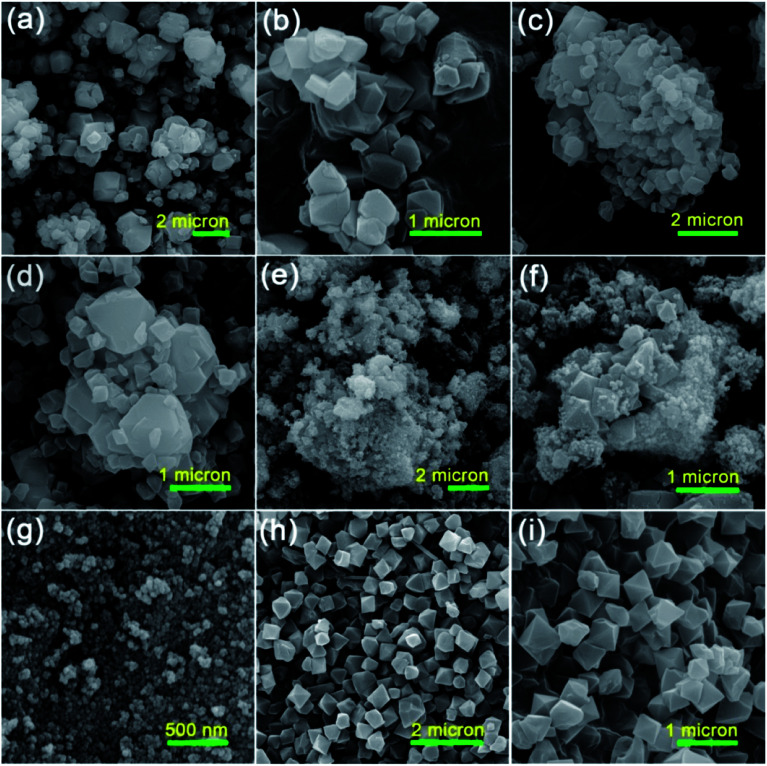
Fig. 3. FESEM images of the as-synthesized (a and b) raw Y zeolite, (c and d) Cr-MIL-101/Y, (e and f) CoFe2O4@Cr-MIL-101/Y, (g) raw CoFe2O4, (h and i) raw Cr-MIL-101 with different resolutions.
Fig. 4
Fig. 4. EDS analyses of the as-synthesized (a) raw Y zeolite, (b) CoFe2O4@Cr-MIL-101/Y, (c) raw CoFe2O4, (d) raw Cr-MIL-101, and (e) FESEM image affiliated to the EDS dot-mappings of the as-synthesized CoFe2O4@Cr-MIL-101/Y.
Fig. 5
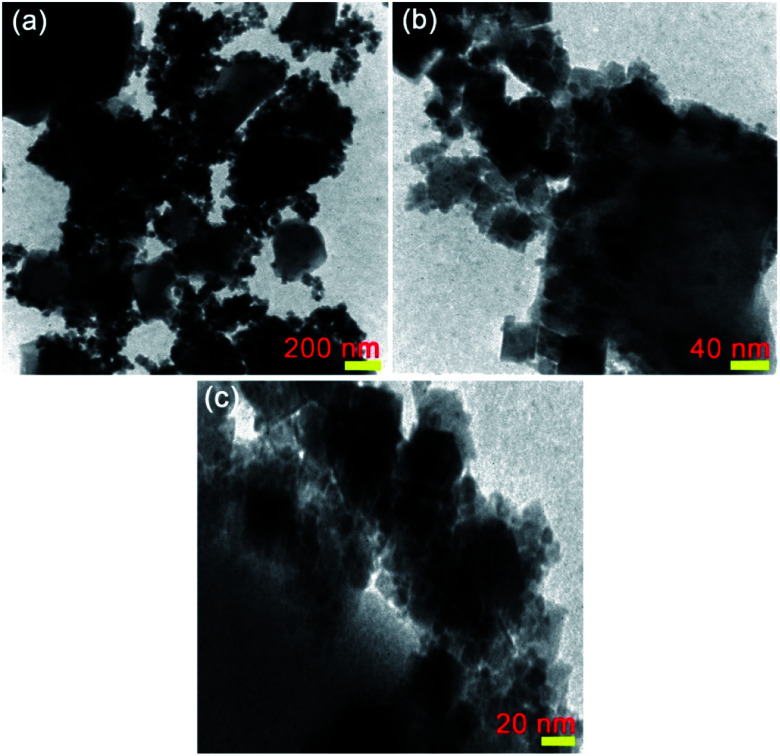
Fig. 5. TEM images of the as-synthesized (a–c) CoFe2O4@Cr-MIL-101/Y with different resolutions.
Fig. 6
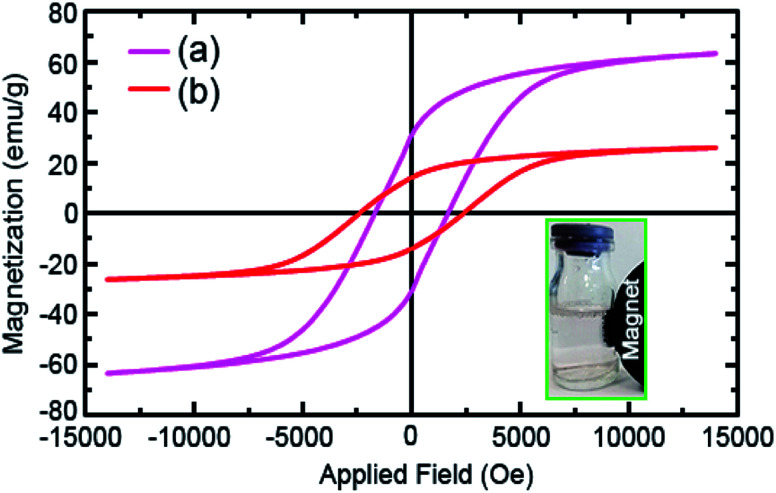
Fig. 6. VSM curves of the as-synthesized (a) raw CoFe2O4 and (b) CoFe2O4@Cr-MIL-101/Y.
Fig. 7
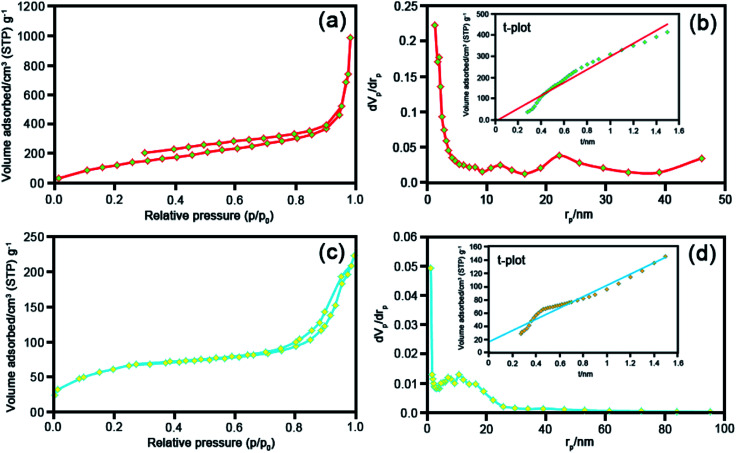
Fig. 7. BET analyses, BJH and t plots of the as-synthesized (a) and (b) raw Y zeolite, (c) and (d) CoFe2O4@Cr-MIL-101/Y.
Fig. 8
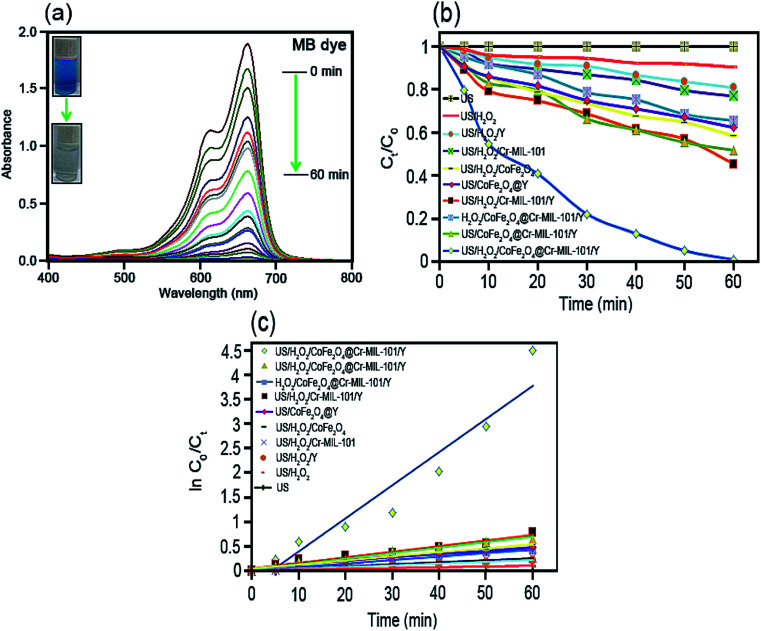
Fig. 8. UV-Vis absorption spectra of the sonodecomposition process of MB dye over the CoFe2O4@Cr-MIL-101/Y catalyst nanocomposite as a function of the irradiation time (a and b), the first order kinetic plot (ln(C0/Ct)) against the irradiation time (c) (optimized experimental conditions; [MB dye]o: 25 mg L−1 (50 mL), [H2O2]: 40 mmol L−1 (2 mL), [catalyst dosage]: 0.5 g L−1, pH: 7 and temperature: 25 ± 1 °C).
Fig. 9
Fig. 9. UV-Vis absorption spectra of (a) RhB and (b) MO. (c) Decomposition efficiency% of MO and RhB dyes as a function of the irradiation time over the CoFe2O4@Cr-MIL-101/Y catalyst nanocomposite (optimized experimental conditions; [dye]o: 25 mg L−1 (50 mL), [H2O2]: 40 mmol L−1 (2 mL), [catalyst dosage]: 0.5 g L−1, pH: 7, and temperature: 25 ± 1 °C).
Fig. 10
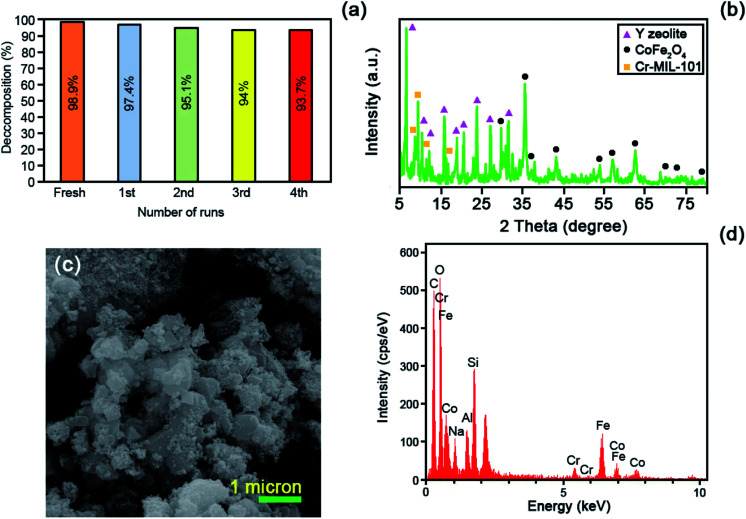
Fig. 10. (a) The regeneration plot, (b) XRD (c) FESEM, and (d) EDS analyses of the recovered CoFe2O4/Y@Cr-MIL-101 on the sonodecomposition process of MB after four runs (optimized experimental conditions; irradiation time: 60 min, [MB]o: 25 mg L−1 (50 mL), [H2O2]: 40 mmol L−1 (2 mL), [catalyst dosage]: 0.5 g L−1, pH: 7 and temperature: 25 ± 1 °C).
Fig. 11
Fig. 11. A plausible mechanism for the sonodecomposition process of dye contaminants utilizing the US/H2O2/CoFe2O4@Cr-MIL-101/Y system from water solution.

References

    1. Liu X. Guan Y. Ma Z. Zhou H. Langmuir. 2004;20:10278–10282. doi: 10.1021/la0491908. - DOI - PubMed
    1. Gupta V. K. Suhas J. Environ. Manage. 2009;90:2313–2342. doi: 10.1016/j.jenvman.2008.11.017. - DOI - PubMed
    1. Rai H. S. Bhattacharyya M. S. Singh J. Bansal T. K. Vats P. Banerjee U. C. Crit. Rev. Environ. Sci. Technol. 2005;35:219–238. doi: 10.1080/10643380590917932. - DOI
    1. Sadettin S. Dönmez G. Process Biochem. 2006;41:836–841. doi: 10.1016/j.procbio.2005.10.031. - DOI
    1. Brüschweiler B. J. Merlot C. Regul. Toxicol. Pharmacol. 2017;88:214–226. doi: 10.1016/j.yrtph.2017.06.012. - DOI - PubMed