


Cross-talk between HIF and PD-1/PD-L1 pathways in carcinogenesis and therapy
- PMID: 35499071
- PMCID: PMC9057611
- DOI: 10.1172/JCI159473
Cross-talk between HIF and PD-1/PD-L1 pathways in carcinogenesis and therapy
Abstract
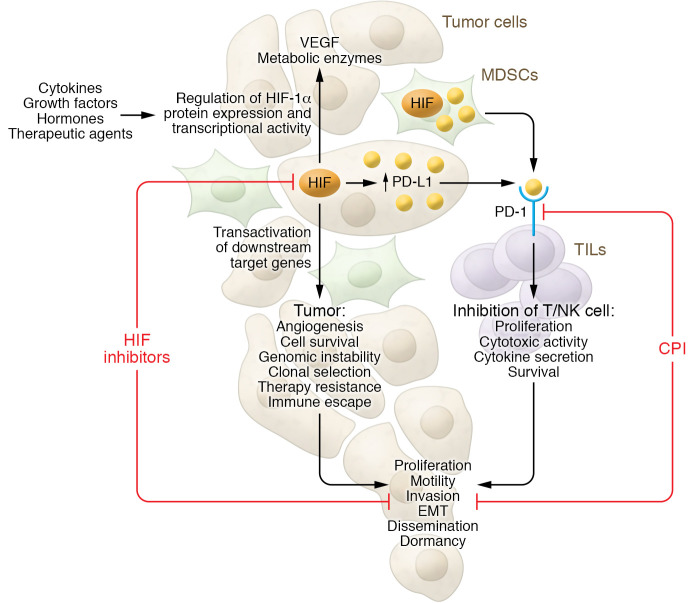
Tumor-associated hypoxia plays an important role in carcinogenesis and metastasis. The expression, activation, and stabilization of hypoxia-inducible transcription factors (HIFs) support malignant cell survival, proliferation, plasticity, and motility. Hypoxia also upregulates the expression of programmed cell death ligand 1 (PD-L1) in malignant and immune regulatory cells. Therefore, the combination of HIF inhibitors and checkpoint inhibitors (CPIs) is promising for boosting antitumor immunity and diminishing malignant cell plasticity and therapy resistance. In this issue of the JCI, Salman et al. report the development of a specific agent that inhibited HIF-1/2-mediated gene expression in tumor cells and suppressed tumor growth. Bailey, Liu, et al. in this issue demonstrate that targeting HIF-1α abrogated PD-L1-mediated immune evasion by suppressing PD-L1 expression on malignant and myeloid regulatory cells, causing tumor rejection. These findings suggest that targeting the HIF/PD-L1 axis with specific HIF inhibitors should improve the safety and efficacy of CPIs for cancer therapy.
Conflict of interest statement
Figures
Comment on
-
Targeting HIF-1α abrogates PD-L1-mediated immune evasion in tumor microenvironment but promotes tolerance in normal tissues.J Clin Invest. 2022 May 2;132(9):e150846. doi: 10.1172/JCI150846. J Clin Invest. 2022. PMID: 35239514 Free PMC article.
-
HIF inhibitor 32-134D eradicates murine hepatocellular carcinoma in combination with anti-PD1 therapy.J Clin Invest. 2022 May 2;132(9):e156774. doi: 10.1172/JCI156774. J Clin Invest. 2022. PMID: 35499076 Free PMC article.
References
Publication types
MeSH terms
Substances
Grants and funding
LinkOut - more resources
Full Text Sources
Other Literature Sources
Medical
Research Materials
