


Recent Estimates and Predictions of 5-Year Survival in Patients with Gastric Cancer: A Model-Based Period Analysis
- PMID: 35499497
- PMCID: PMC9067041
- DOI: 10.1177/10732748221099227
Recent Estimates and Predictions of 5-Year Survival in Patients with Gastric Cancer: A Model-Based Period Analysis
Abstract
Background: The overall incidence and mortality of gastric cancer have steadily declined in the United States over the past few decades, but it is still a serious disease burden for patients. Therefore, it is of great significance to evaluate the latest survival rate of gastric cancer.
Methods: Based on the Surveillance, Epidemiology, and End Results database, this study analyzed the age-standardized relative survival rates and survival trends of gastric cancer cases in 2007-2011 and 2012-2016 using period analysis, and the survival rate 2017-2021 was predicted using a generalized linear model based on the period analysis.
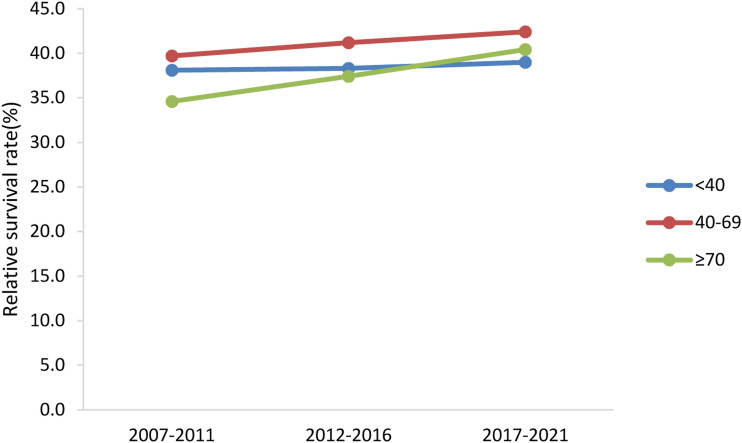
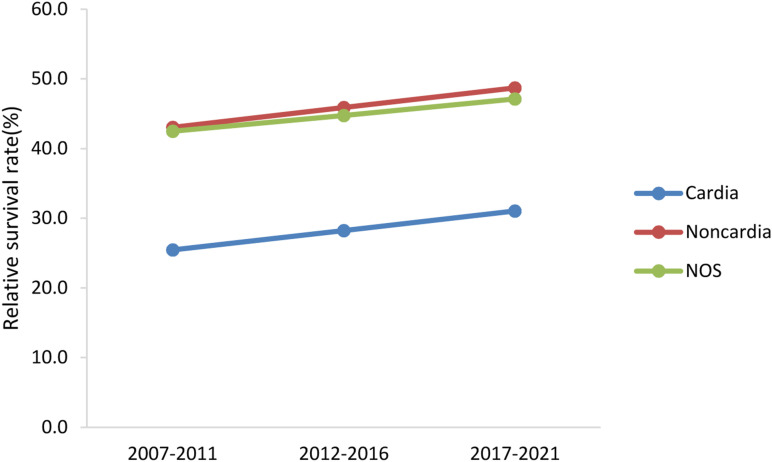
Results: During 2007-2016, the 5-year relative survival rate of patients with gastric cancer continued to rise, and the same trend was observed in 2017-2021. The 5-year overall age-standardized relative survival rates in 2007-2011, 2012-2016, and 2017-2021 were 38.3%, 40.6%, and 42.9%, respectively. However, despite these favorable trends, the overall relative survival of patients with gastric cancer remains at a low level. There were significant differences in the relative survival rates of patients with gastric cancer in terms of age, sex, race, primary site, stage, and socioeconomic status. Notably, the survival rate of patients with distant-stage gastric cancer remains very low (10%).
Conclusion: We found that the survival rate of patients with gastric cancer showed different degrees of improvement in each subgroup. However, the overall relative survival rate of patients with gastric cancer remains low. Analyzing the changes of patients with gastric cancer in the last 10 years will be helpful in predicting the changing trend of cancer in the future. It also provides a scientific basis for relevant departments to formulate effective tumor prevention and control measures.
Keywords: gastric cancer; period analysis; prediction; surveillance, epidemiology, and end results; survival rate.
Conflict of interest statement
Figures





References
-
- Sung H, Ferlay J, Siegel RL, et al. Global cancer statistics 2020: GLOBOCAN estimates of incidence and mortality Worldwide for 36 cancers in 185 Countries. CA Cancer J Clin. 2021;71(3):209-249. - PubMed
-
- Allemani C, Matsuda T, Di Carlo V, et al. Global surveillance of trends in cancer survival 2000–14 (CONCORD-3): analysis of individual records for 37 513 025 patients diagnosed with one of 18 cancers from 322 population-based registries in 71 countries. Lancet. 2018;391(10125):1023-1075. - PMC - PubMed
-
- Jiang X, Wang L, Cheng Y, Tang H, Chen T. Assessment of long-term survival of cancer patients using cancer registry data from eastern China: period analysis is superior to traditional methods. Int J Cancer. 2020;147(4):996-1005. - PubMed
-
- Brenner H, Hakulinen T. Up-to-date and precise estimates of cancer patient survival: model-based period analysis. Am J Epidemiol. 2006;164(7):689-696. - PubMed
MeSH terms
LinkOut - more resources
Full Text Sources
Medical
Miscellaneous
