


Circulating C-Peptide Levels in Living Children and Young People and Pancreatic β-Cell Loss in Pancreas Donors Across Type 1 Diabetes Disease Duration
- PMID: 35499624
- PMCID: PMC9233242
- DOI: 10.2337/db22-0097
Circulating C-Peptide Levels in Living Children and Young People and Pancreatic β-Cell Loss in Pancreas Donors Across Type 1 Diabetes Disease Duration
Abstract
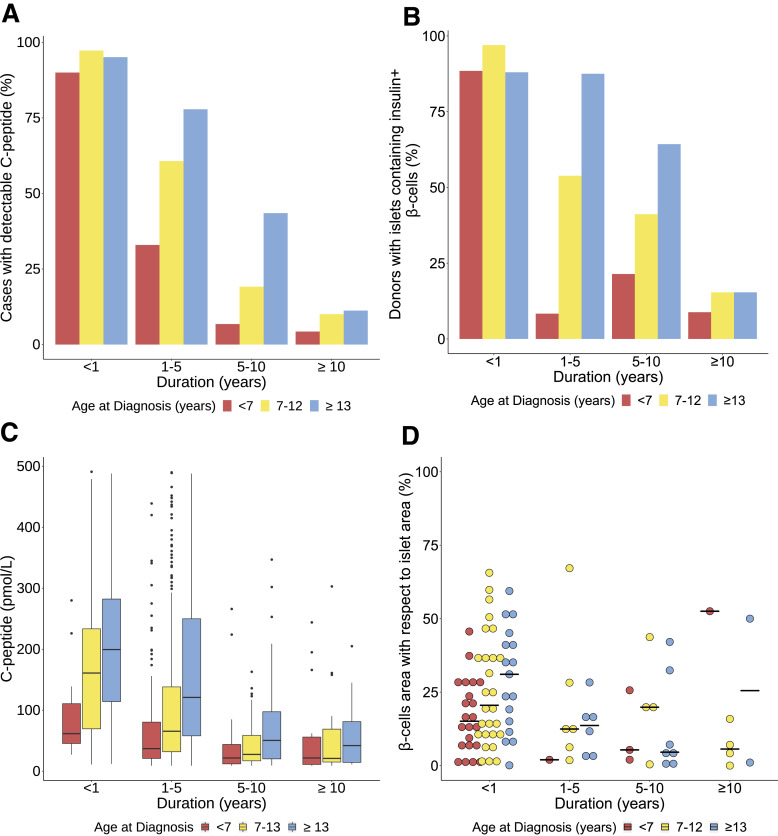
C-peptide declines in type 1 diabetes, although many long-duration patients retain low, but detectable levels. Histological analyses confirm that β-cells can remain following type 1 diabetes onset. We explored the trends observed in C-peptide decline in the UK Genetic Resource Investigating Diabetes (UK GRID) cohort (N = 4,079), with β-cell loss in pancreas donors from the network for Pancreatic Organ donors with Diabetes (nPOD) biobank and the Exeter Archival Diabetes Biobank (EADB) (combined N = 235), stratified by recently reported age at diagnosis endotypes (<7, 7-12, ≥13 years) across increasing diabetes durations. The proportion of individuals with detectable C-peptide declined beyond the first year after diagnosis, but this was most marked in the youngest age group (<1-year duration: age <7 years: 18 of 20 [90%], 7-12 years: 107 of 110 [97%], ≥13 years: 58 of 61 [95%] vs. 1-5 years postdiagnosis: <7 years: 172 of 522 [33%], 7-12 years: 604 of 995 [61%], ≥13 years: 225 of 289 [78%]). A similar profile was observed in β-cell loss, with those diagnosed at younger ages experiencing more rapid loss of islets containing insulin-positive (insulin+) β-cells <1 year postdiagnosis: age <7 years: 23 of 26 (88%), 7-12 years: 32 of 33 (97%), ≥13 years: 22 of 25 (88%) vs. 1-5 years postdiagnosis: <7 years: 1 of 12 (8.3%), 7-12 years: 7 of 13 (54%), ≥13 years: 7 of 8 (88%). These data should be considered in the planning and interpretation of intervention trials designed to promote β-cell retention and function.
© 2022 by the American Diabetes Association.
Figures
References
-
- Davis AK, DuBose SN, Haller MJ, et al. Prevalence of detectable C-peptide according to age at diagnosis and duration of type 1 diabetes. Diabetes Care 2015;38:476–481 - PubMed
Publication types
MeSH terms
Substances
Associated data
Grants and funding
LinkOut - more resources
Full Text Sources
Medical
