. 2023 May;85(4):1498-1513.
doi: 10.1007/s00248-022-02025-5. Epub 2022 May 2.

Social Interaction is Unnecessary for Hindgut Microbiome Transmission in Honey Bees: The Effect of Diet and Social Exposure on Tissue-Specific Microbiome Assembly

Affiliations

Social Interaction is Unnecessary for Hindgut Microbiome Transmission in Honey Bees: The Effect of Diet and Social Exposure on Tissue-Specific Microbiome Assembly

Kirk E Anderson et al. Microb Ecol. 2023 May.

Abstract

Honey bees are a model for host-microbial interactions with experimental designs evolving towards conventionalized worker bees. Research on gut microbiome transmission and assembly has examined only a fraction of factors associated with the colony and hive environment. Here, we studied the effects of diet and social isolation on tissue-specific bacterial and fungal colonization of the midgut and two key hindgut regions. We found that both treatment factors significantly influenced early hindgut colonization explaining similar proportions of microbiome variation. In agreement with previous work, social interaction with older workers was unnecessary for core hindgut bacterial transmission. Exposure to natural eclosion and fresh stored pollen resulted in gut bacterial communities that were taxonomically and structurally equivalent to those produced in the natural colony setting. Stressed diets of no pollen or autoclaved pollen in social isolation resulted in decreased fungal abundance and bacterial diversity, and atypical microbiome structure and tissue-specific variation of functionally important core bacteria. Without exposure to the active hive environment, the abundance and strain diversity of keystone ileum species Gilliamella apicola was markedly reduced. These changes were associated with significantly larger ileum microbiotas suggesting that extended exposure to the active hive environment plays an antibiotic role in hindgut microbiome establishment. We conclude that core hindgut microbiome transmission is facultative horizontal with 5 of 6 core hindgut species readily acquired from the built hive structure and natural diet. Our findings contribute novel insights into factors influencing assembly and maintenance of honey bee gut microbiota and facilitate future experimental designs.

Keywords: Beebread; Fungi; Gut bacteria; Hive environment; Honey bee; Microbiota; Mycobiota; Pollen; Sociality.


Conflict of interest statement

The authors have no relevant financial or non-financial interests to disclose.

Figures
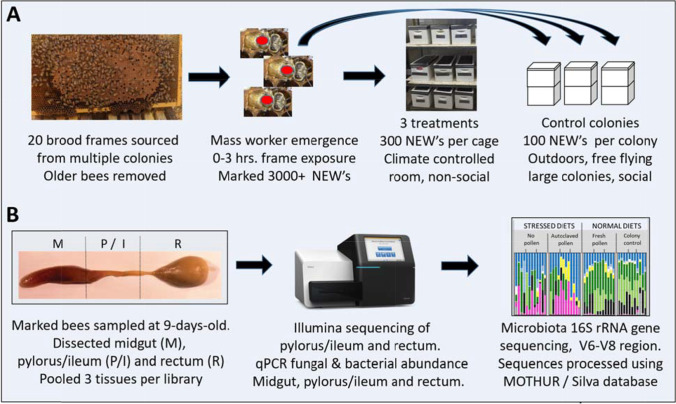
Fig. 1
Fig. 1
Summary of experimental approach. (A) Highlights the marked bee assay and treatment/control conditions. Newly emerged bees (NEW’s) were collected from a climate controlled room and marked with a dot of paint on their thorax. The three treatments were fresh pollen, autoclaved pollen, and no pollen, all applied in social isolation in a climate controlled room. All treatment cages were provided autoclaved sucrose syrup and water ad libitum. Control colonies contained over 10,000 established (older) workers and were exposed to the pollination environment. (B) Illustration of tissue dissection and molecular analyses. The pylorus and ileum (P/I) were dissected, sequenced and analyzed as a unit
Fig. 2
Fig. 2
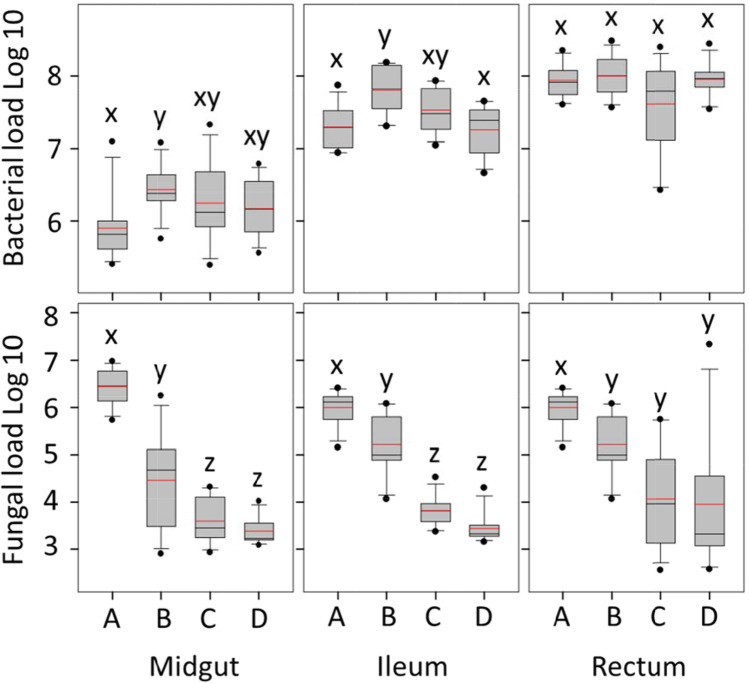
Bacterial and fungal load differ by social context and diet throughout the gut. On the x-axis, A is the positive control; large colonies exhibiting a typical age structure, and exposed to the pollination environment. Treatment B is fresh stored pollen (beebread), C is autoclaved corbicular pollen, and D is no pollen (negative control). Treatments B, C, and D lack the colony context, and each consist of three replicate cages containing 300 newly emerged bees and wax combs containing each diet treatment (Fig. 1). Y-axis values were determined by bactquant and fungiquant and are cell number for bacteria, rRNA copy number for fungi. Within each panel, distributions (boxplots) with the same lower case letter (x, y or z) do not differ significantly based on a Wilcoxon test (p < 0.05)
Fig. 3
Fig. 3
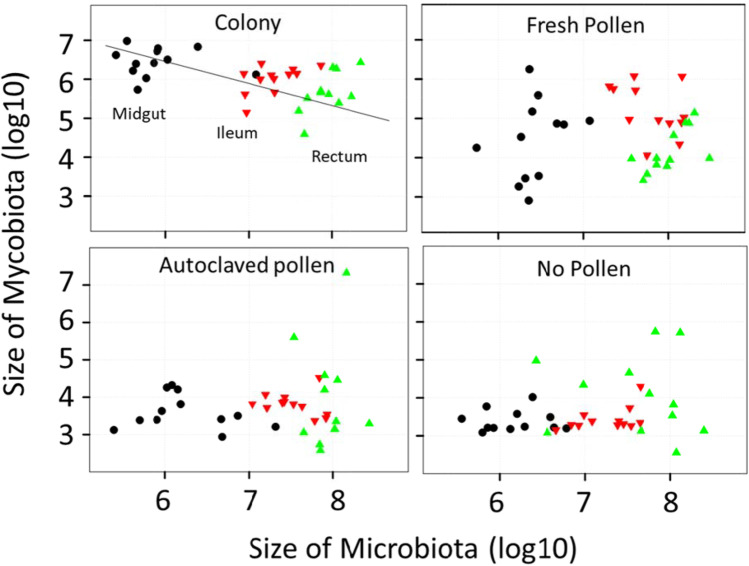
Throughout the alimentary tract, the presence of fungi (the mycobiome) or fungal associated factors was correlated with the structure of the bacterial microbiome. In our positive control, colony reared bees, there is a positive association of microbiota and mycobiota size, but considering the alimentary tract as a unit, fungal load decreases concurrent with increasing bacterial load (Rsq = 0.25, F = 11.4503, p = 0.002). This pattern shifted significantly when workers were detached from the active hive environment and provided various diet treatments. Values are from Fig. 2
Fig. 4
Fig. 4
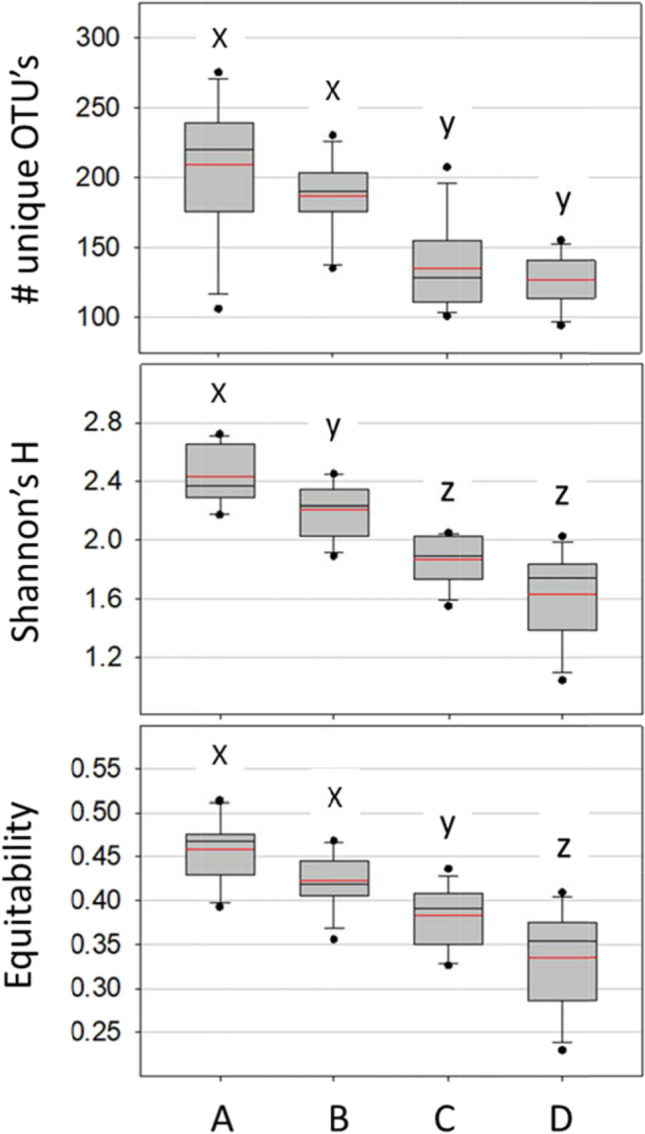
Diversity of combined hindgut tissues (ileum/pylorus and rectum) based on unique bacterial OTUs (top panel), Shannon’s H, and Equitability, a measure of evenness. The treatments on the x-axis are colony control (A), fresh pollen (B), autoclaved pollen (C), and no pollen (D). Within each panel, distributions (boxplots) with the same lower case letter (x, y or z) do not differ significantly based on a t-test (p < 0.05)
Fig. 5
Fig. 5
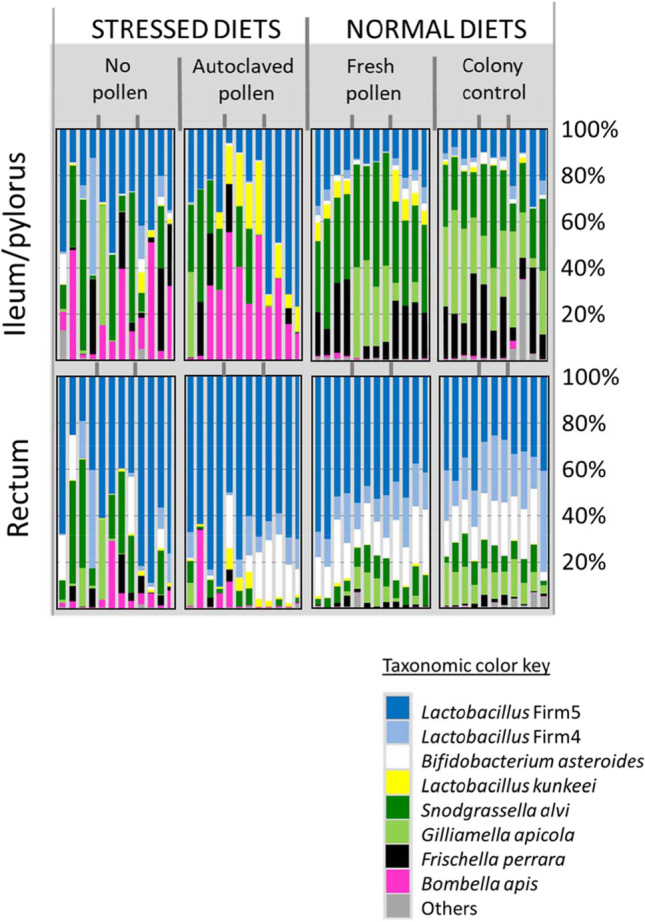
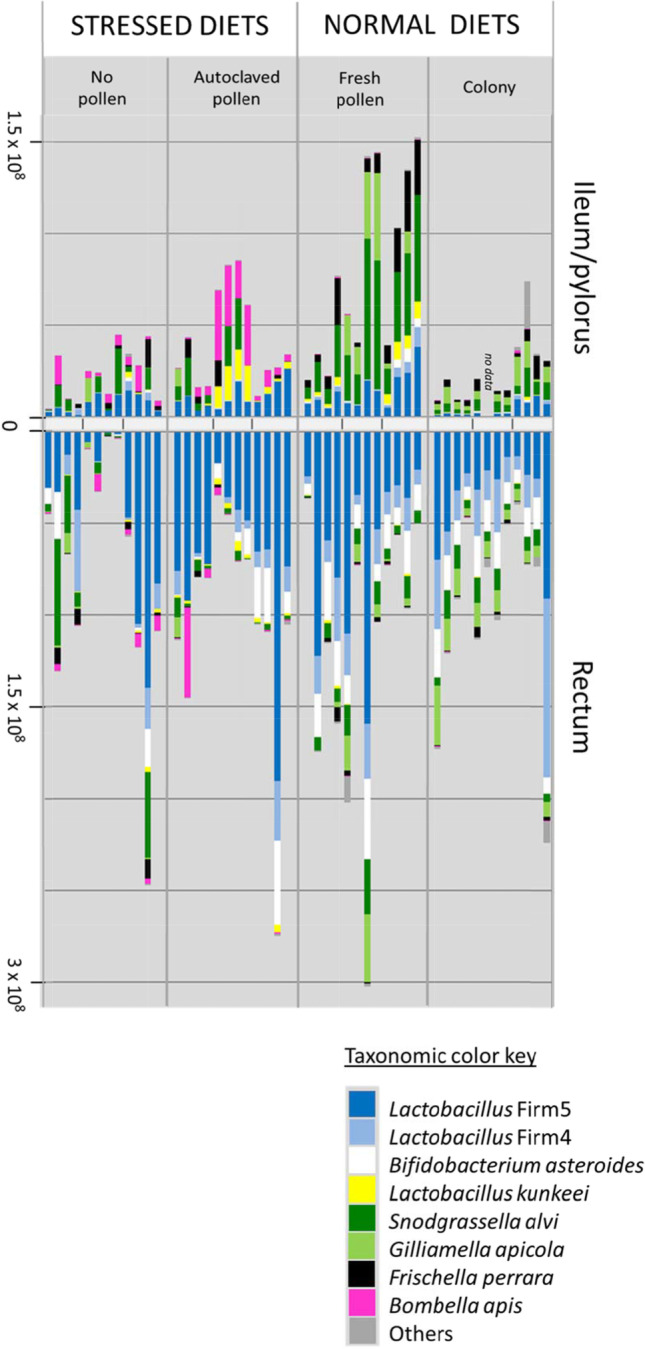
Bar charts representing the relative abundance of bacterial OTUs from two hindgut tissues and three treatment conditions plus a control, each composed of three replicate cages or colonies marked by grey dividers at the top and center of the diagram. Each bar is a single Illumina library, representing the combined tissues of three workers. We sequenced four libraries per replicate. The colony control is a natural colony environment. Diet treatments lack the colony context. The vertically oriented ileum and rectum microbiotas correspond to the same worker individuals. Note replicate variation
Fig. 6
Fig. 6
Hindgut Microbiota of 9-Day-old workers reared in large functional colonies or in social isolation with different diet treatments and a control. Bar charts represent the Bactquant normalized abundance of bacterial OTUs from two hindgut tissues (ileum/pylorus and rectum). Colony is the positive control; a natural outdoor colony environment. The three diet treatments lack the colony context. Each bar is a single Illumina library, representing the combined tissues of three workers. We sequenced four libraries per cage or colony replicate. The x-axis is centered at zero and increases in absolute value moving in either direction
Fig. 7
Fig. 7
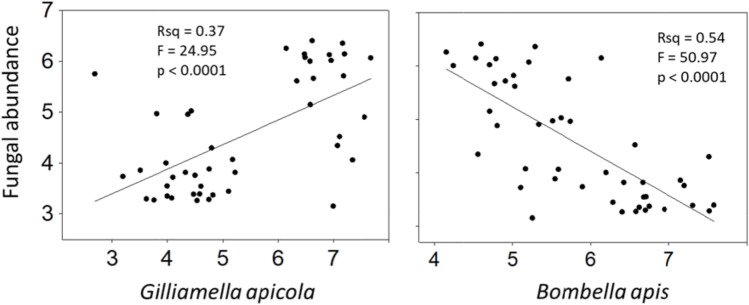
The significant relationship of fungal abundance with two different bacteria in the worker ileum. Trend line represents Pearson’s correlations of log transformed abundance measures. Axes are displayed as (log 10) exponents. Fungi are 18S rRNA copy number, and bacteria represent cell counts, normalized by genome-specific copy number

References

    1. Kwong WK, Medina LA, Koch H, et al. Dynamic microbiome evolution in social bees. Sci Adv. 2017;3:e1600513. doi: 10.1126/sciadv.1600513. - DOI - PMC - PubMed
    1. Engel P, Martinson VG, Moran NA. Functional diversity within the simple gut microbiota of the honey bee. Proc Natl Acad Sci U S A. 2012;109:11002–11007. doi: 10.1073/pnas.1202970109. - DOI - PMC - PubMed
    1. Anderson KE, Ricigliano VA, Mott BM et al (2018) The Queen Gut Refines with Age: Longevity Phenotypes in a Social Insect Model. bioRxiv:1–16. 10.1101/297507 - PMC - PubMed
    1. Zheng H, Powell JE, Steele MI, et al. Honeybee gut microbiota promotes host weight gain via bacterial metabolism and hormonal signaling. Proc Natl Acad Sci U S A. 2017;114:4775–4780. doi: 10.1073/pnas.1701819114. - DOI - PMC - PubMed
    1. Zheng H, Steele MI, Leonard SP, et al. Honey bees as models for gut microbiota research. Lab Anim (NY) 2018;47:317–325. doi: 10.1038/s41684-018-0173-x. - DOI - PMC - PubMed

LinkOut - more resources