Review
. 2022 May;39(5):1011-1025.
doi: 10.1007/s10815-022-02438-8. Epub 2022 May 2.

Mammalian cumulus-oocyte complex communication: a dialog through long and short distance messaging

Affiliations
Review

Mammalian cumulus-oocyte complex communication: a dialog through long and short distance messaging

Mathilde Marchais et al. J Assist Reprod Genet. 2022 May.

Abstract

Communications are crucial to ovarian follicle development and to ovulation, and while both folliculogenesis and oogenesis are distinct processes, they share highly interdependent signaling pathways. Signals from distant organs such as the brain must be processed and compartments within the follicle have to be synchronized. The hypothalamic-pituitary-gonadal (HPG) axis relies on long-distance signalling analogous to wireless communication by which data is disseminated in the environment and cells equipped with the appropriate receptors receive and interpret the messages. In contrast, direct cell-to-cell transfer of molecules is a very targeted, short distance messaging system. Numerous signalling pathways have been identified and proven to be essential for the production of a developmentally competent egg. The development of the cumulus-oocyte complex relies largely on short distance communications or direct transfer type via extensions of corona radiata cells through the zona pellucida. The type of information transmitted through these transzonal projections is still largely uncharacterized. This review provides an overview of current understanding of the mechanisms by which the gamete receives and transmits information within the follicle. Moreover, it highlights the fact that in addition to the well-known systemic long-distance based communications from the HPG axis, these mechanisms acting more locally should also be considered as important targets for controlling/optimizing oocyte quality.

Keywords: Cellular communication; Cumulus-oocyte complex; Folliculogenesis; Signal transduction; Transzonal projections.


Conflict of interest statement

The authors confirm that there are no known conflicts of interest associated with this publication and there has been no significant financial support for this work that could have influenced its outcome.

Figures
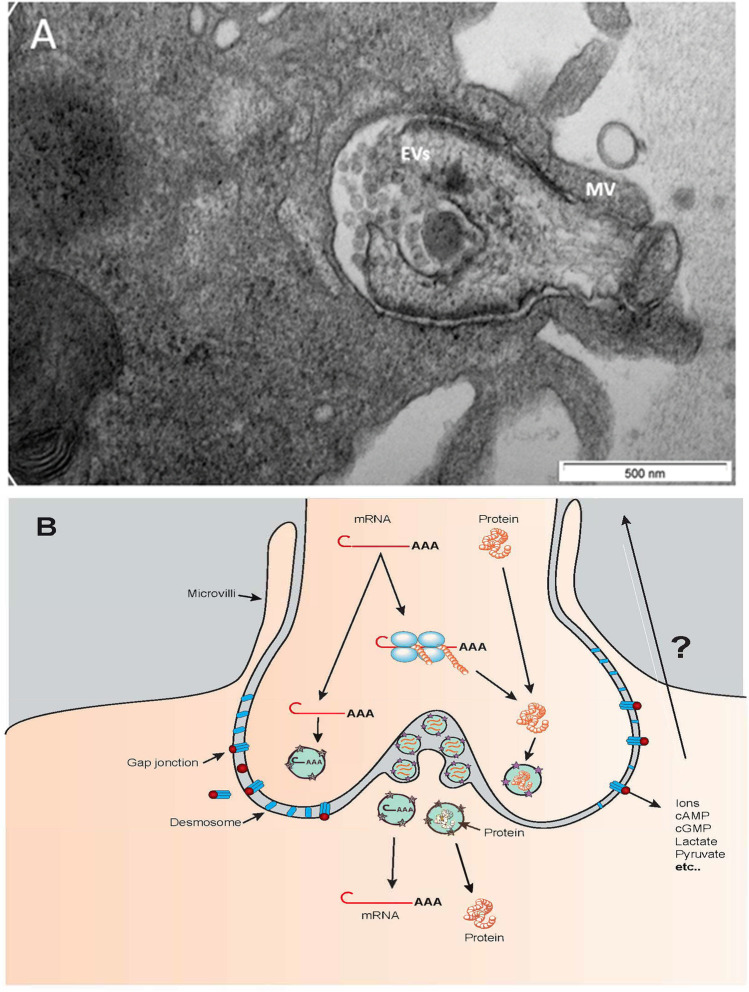
Fig. 1
Fig. 1
A Electron microscopy image of a bovine TZP terminus, the bulged portion held in place by microvilli (MV). Numerous extracellular vesicles (EVs, spheres about 50 nm in diameter) are visible. The projection terminus contains electron-dense structures. B Schematic representation of material movement through a TZP terminus. Transcripts (mRNA) could be transferred to the oocyte or translated polyribosomes, and proteins could be transferred. Small molecules could be transferred through gap junctions
Fig. 2
Fig. 2
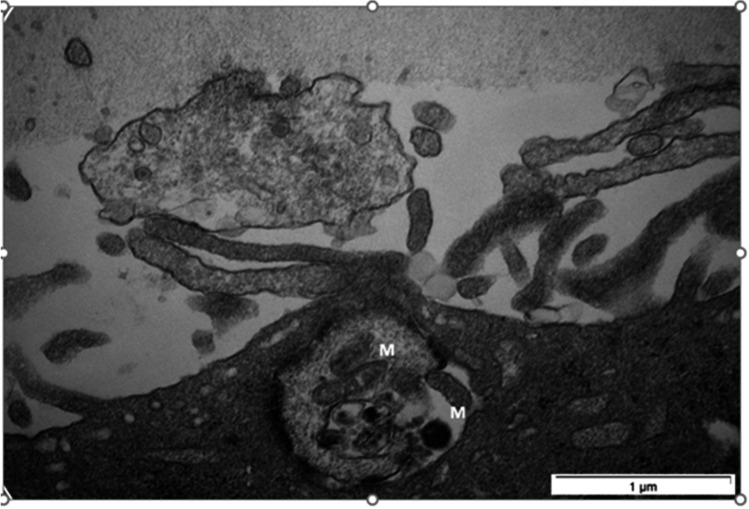
Electron microscopy image of a bovine TZP containing mitochondria (M)
Fig. 3
Fig. 3
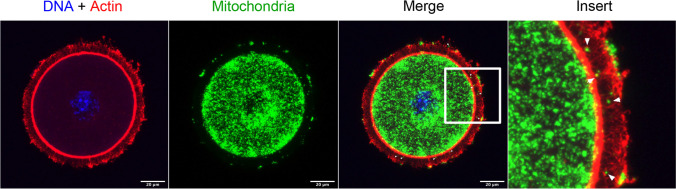
Mitochondria distribution in cumulus-oocyte complexes (COCs) in transgenic mice expressing mitochondrial-targeted red fluorescent protein. Immunofluorescence confocal images showed the presence of mitochondria throughout the cytoplasm with an accumulation at the cytoplasmic end of the oocyte, adjacent to the edge of the zona pellucida but also around the nucleus. Some points are found in the zona pellucida and at the periphery of cumulus cells. DNA material was stained with Hoechst 33,342 dye (blue) and actin with SiR-actin (red). Scale bar = 20 μ m
Fig. 4
Fig. 4
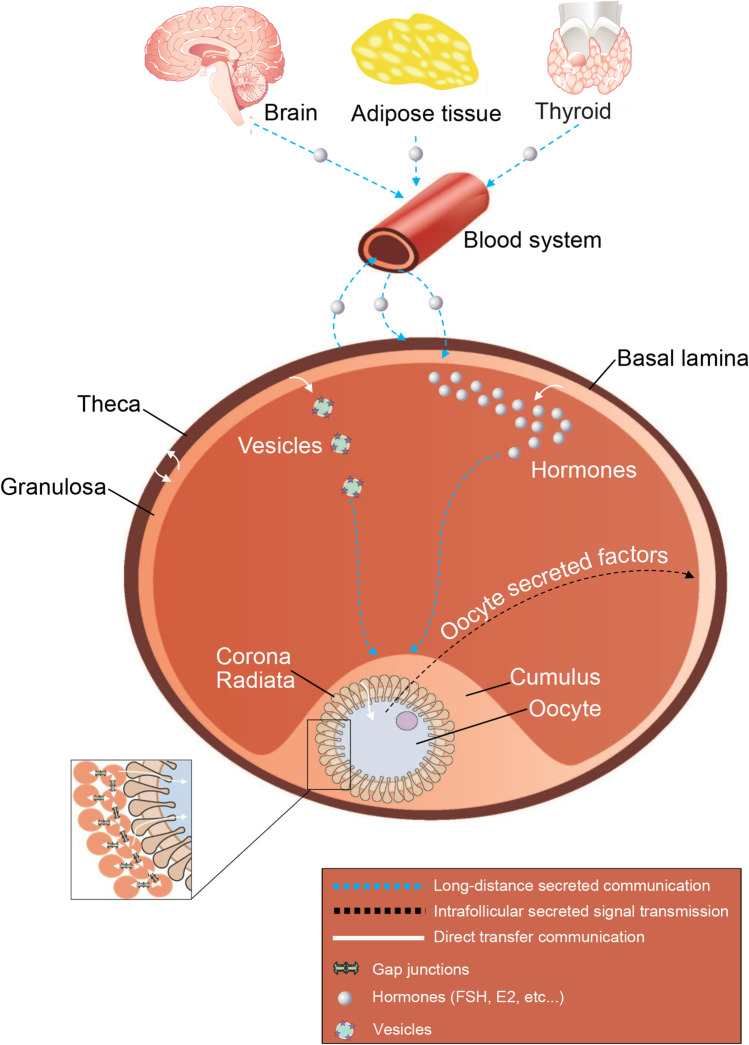
Schematic representation of the long-distance (wireless) and direct communications involved in managing folliculogenesis and oogenesis in mammals. Organs such as brain or thyroid send hormones to the follicle via the bloodstream. By binding to the somatic cell receptor of the follicle, the hormone enables its activation and the stimulation of its dependant signaling pathways. This endocrine signaling on the functions and the development of the follicle cells and the oocyte, without direct transmission by physical contact, constitutes a long-distance systemic (wireless) inward signaling route (represented by blue-dotted line). Moreover, by secreting extracellular vesicles containing miRNA, proteins and RNA, components involved in various pathway which are closely related to follicular growth and maturation, granulosa cells are another instance of secreted signaling into the local environment. The oocyte also actively communicates with its surrounding cells, using secreted factors (represented by dark dotted line), which therefore actively regulate the functions of the granulosa cells and the cumulus cells, related to growth and differentiation of somatic cells. Although much of the dialogue required for folliculogenesis and oogenesis occurs through secreted (wireless) communications, some inputs go through direct communications (represented by white arrows). This direct communication implies a direct transmission via physical contact. These direct material transfers occur between granulosa cells using gap junctions and between the oocyte and its surrounding cells using TZPs and gap junctions

References

    1. Palma GA, Argañaraz ME, Barrera AD, Rodler D, Mutto AÁ, Sinowatz F. Biology and Biotechnology of follicle development. ScientificWorldJournal. 2012;2012:1–14. doi: 10.1100/2012/938138. - DOI - PMC - PubMed
    1. Wassarman PM. Channels of communication in the ovary. Nat Cell Biol. 2002;4:S7–9. doi: 10.1038/ncb-nm-fertilityS7. - DOI - PubMed
    1. Luciano AM, Sirard M-A. Successful in vitro maturation of oocytes: a matter of follicular differentiation. Biol Reprod. 2018;98:162–169. doi: 10.1093/biolre/iox149. - DOI - PubMed
    1. Gershon E, Plaks V, Dekel N. Gap junctions in the ovary: expression, localization and function. Mol Cell Endocrinol. 2008;282:18–25. doi: 10.1016/j.mce.2007.11.001. - DOI - PubMed
    1. Macaulay AD, Gilbert I, Caballero J, Barreto R, Fournier E, Tossou P, et al. The gametic synapse: RNA transfer to the bovine oocyte. Biol Reprod. 2014;91:90. doi: 10.1095/biolreprod.114.119867. - DOI - PubMed

LinkOut - more resources