


Community and Provider Perspectives on Molecular HIV Surveillance and Cluster Detection and Response for HIV Prevention: Qualitative Findings From King County, Washington
- PMID: 35500058
- PMCID: PMC9062191
- DOI: 10.1097/JNC.0000000000000308
Community and Provider Perspectives on Molecular HIV Surveillance and Cluster Detection and Response for HIV Prevention: Qualitative Findings From King County, Washington
Abstract
Responding quickly to HIV outbreaks is one of four pillars of the U.S. Ending the HIV Epidemic (EHE) initiative. Inclusion of cluster detection and response in the fourth pillar of EHE has led to public discussion concerning bioethical implications of cluster detection and response and molecular HIV surveillance (MHS) among public health authorities, researchers, and community members. This study reports on findings from a qualitative analysis of interviews with community members and providers regarding their knowledge and perspectives of MHS. We identified five key themes: (a) context matters, (b) making sense of MHS, (c) messaging, equity, and resource prioritization, (d) operationalizing confidentiality, and (e) stigma, vulnerability, and power. Inclusion of community perspectives in generating innovative approaches that address bioethical concerns related to the use of MHS data is integral to ensure that widely accessible information about the use of these data is available to a diversity of community members and providers.
Copyright © 2021 Association of Nurses in AIDS Care.
Conflict of interest statement
Disclosures
The authors report no real or perceived vested interests related to this article that could be construed as a conflict of interest.
Figures
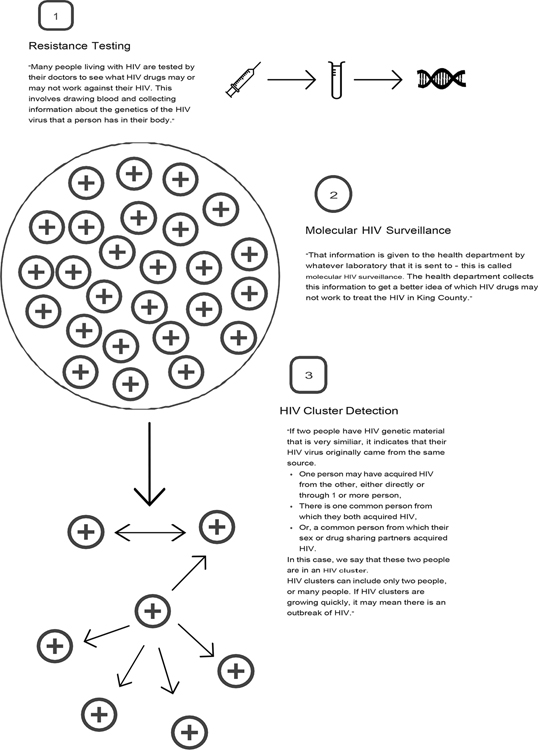
References
-
- Alpren C, Dawson EL, John B, Cranston K, Panneer N, Dawn Fukuda H, Roosevelt R, Klevens M, Bryant J, Peters P, Lyss SB., Switzer WM., Burrage A, Murray A, Agnew-Brune C, Stiles T, McClung P, Campbell EM, Breen C, Randall LM, … Buchacz K (2020). Opioid use fueling HIV transmission in an urban setting: An outbreak of HIV infection among people who inject drugs-Massachusetts, 2015–2018. American Journal of Public Health, 110(1), 37–44. 10.2105/AJPH.2019.305366 - DOI - PMC - PubMed
-
- Braun V, & Clarke V (2006). Using thematic analysis in psychology. Qualitative Research in Psychology, 3(2), 77–101. 10.1191/1478088706qp063oa - DOI
-
- Campbell EM, Jia H, Shankar A, Hanson D, Luo W, Masciotra S, Owen SM, Oster AM, Galang RR, Spiller MW, Blosser SJ, Switzer WM (2017). Detailed transmission network analysis of a large opiate-driven outbreak of HIV infection in the United States. Journal of Infectious Diseases, 216(9), 1053–1062. 10.1093/infdis/jix307 - DOI - PMC - PubMed
-
- Cho J, & Trent A (2006). Validity in qualitative research revisited. Qualitative Research, 6(3), 319–340. 10.1177/1468794106065006 - DOI
-
- Dawson L, Benbow N, Fletcher FE, Kassaye S, Killelea A, Latham SR, Lee LM, Leitner T, LIttle SJ, Mehta SR, Martinez O, Minalga B, Poon A, Rennie S, Sugarman J, Sweeney P, Torian LV, Wertheim JO (2020). Addressing ethical challenges in US-based HIV phylogenetic research. The Journal of Infectious Diseases. 10.1093/infdis/jiaa107 - DOI - PMC - PubMed
Publication types
MeSH terms
Grants and funding
LinkOut - more resources
Full Text Sources
Medical
