


Lung function six months after severe COVID-19: Does time, in fact, heal all wounds?
- PMID: 35500646
- PMCID: PMC9042802
- DOI: 10.1016/j.bjid.2022.102352
Lung function six months after severe COVID-19: Does time, in fact, heal all wounds?
Abstract
Background: COVID-19 has been associated with persistent symptoms and functional changes, especially in those surviving severe disease.
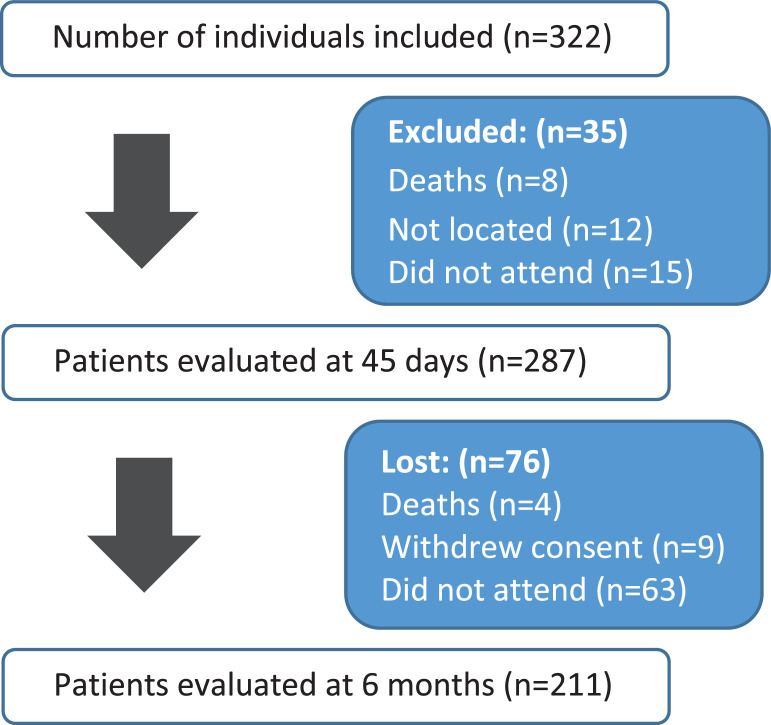
Methods: We conducted a prospective multicenter study in patients with severe COVID-19 to determine respiratory sequelae. Patients were stratified into two groups: ward admission (WA) and intensive care unit (ICU) admission. In each follow-up visit, the patients where inquired about cough and dyspnea, and performed spirometry, lung volumes, carbon monoxide diffusion capacity (DLCO), 6-minute walk test (6MWT), and respiratory muscle strength (MIP and MEP). Results of pulmonary function tests at 45 days and 6 months after hospital admission were compared using paired analysis.
Results: 211 patients were included, 112 in WA and 99 in ICU. Dyspnea persisted in 64.7% in the WA and 66.7% in the ICU group after 6 months. Lung function measures showed significant improvement between 45 days and 6 months, both in WA and ICU groups in VC, FVC, FEV1, total lung capacity, and 6MW distance measures. The improvement in the proportions of the altered functional parameters was significant in the ICU group for VC (44.2% 45 d; 20.8% 6 m; p = 0,014), FVC (47.6% 45 d; 28% 6 m; p = 0,003), FEV1 (45.1% 45 d; 28% 6 m; p = 0,044), DLCO (33.8% 45 d; 7.7% 6 m; p < 0,0001).
Conclusion: Six months follow-up of patients with the severe forms of COVID-19 showed significant improvement in the lung function measures compared to 45 days post hospital discharge. The difference was more evident in those requiring ICU admission.
Keywords: COVID-19; Follow-up; Lung function; Post-COVID condition.
Copyright © 2022 Sociedade Brasileira de Infectologia. Published by Elsevier España, S.L.U. All rights reserved.
Conflict of interest statement
Conflicts of interest The authors declare no conflicts of interest.
Figures
References
-
- Razak F, Katz GM, Cheung AM, Herridge MS, Slutsky AS, Allen U, et al. Understanding the post COVID-19 condition (long COVID) and the expected burden for Ontario. Science briefs of the Ontario COVID-19 science advisory table. 2021;2(44).
Publication types
MeSH terms
LinkOut - more resources
Full Text Sources
Medical
