Review
. 2022 Sep;23(9):533-546.
doi: 10.1038/s41576-022-00478-5. Epub 2022 May 2.

The human genetic epidemiology of COVID-19

Affiliations
Review

The human genetic epidemiology of COVID-19

Mari E K Niemi et al. Nat Rev Genet. 2022 Sep.

Abstract

Human genetics can inform the biology and epidemiology of coronavirus disease 2019 (COVID-19) by pinpointing causal mechanisms that explain why some individuals become more severely affected by the disease upon infection by the severe acute respiratory syndrome coronavirus 2 (SARS-CoV-2) virus. Large-scale genetic association studies, encompassing both rare and common genetic variants, have used different study designs and multiple disease phenotype definitions to identify several genomic regions associated with COVID-19. Along with a multitude of follow-up studies, these findings have increased our understanding of disease aetiology and provided routes for management of COVID-19. Important emergent opportunities include the clinical translatability of genetic risk prediction, the repurposing of existing drugs, exploration of variable host effects of different viral strains, study of inter-individual variability in vaccination response and understanding the long-term consequences of SARS-CoV-2 infection. Beyond the current pandemic, these transferrable opportunities are likely to affect the study of many infectious diseases.


Conflict of interest statement

M.E.K.N. is an employee of Novartis. M.J.D. and A.G. declare no competing interests.

Figures
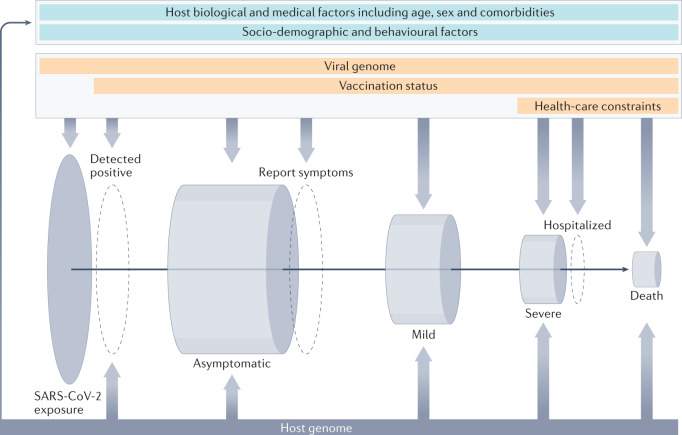
Fig. 1
Fig. 1. Schematic of the disease progression trajectory for individuals exposed to SARS-CoV-2.
The black horizontal arrow shows the progression through different stages of coronavirus disease 2019 (COVID-19), and the decreasing cylinder sizes represent that only a subset of individuals at each stage progress to more-advanced disease states. The true stages of the disease do not always correspond to what is captured in most COVID-19 studies. For example, many asymptomatic individuals are not captured. Thus, the dashed ellipses represent ‘checkpoints’ that one needs to cross to be identified with a certain COVID-19-related phenotype and be included in most COVID-19 studies. Environmental and external factors (shown above the cylinders) influence not only the checkpoints but also the underlying chance and speed of transition between various stages of the disease. Each factor can influence various stages of disease progression, and some (for example, socio-demographic factors) affect each step in the progression from severe acute respiratory syndrome coronavirus 2 (SARS-CoV-2) exposure to death. On the bottom, we represent the impact of the host genome. The host genome affects each phase of disease progression either by acting directly on infection susceptibility and disease severity or via environmental factors.
Fig. 2
Fig. 2. Genetic association patterns in the chromosome 3p21.31 region from COVID-19 HGI meta-analysis.
a,b | Locuszoom plots of the 3p21.31 locus for coronavirus disease 2019 (COVID-19) hospitalization (panel a) and reported infection (as a proxy for susceptibility to infection) (panel b) from the COVID-19 Host Genetics Initiative (HGI) release 6. Points are coloured based on r2 linkage disequilibrium (LD) values to each lead variant, and the purple diamond represents the lead variant. c | Local LD structure of the region. The heatmap represents r2 values among the significantly associated variants (plotted region is highlighted with background shading in panels a and b). The Neanderthal-derived 49.4 kb haplotype region with high LD is highlighted in darker grey background shading. The region displays patterns of long regions in strong LD and harbours within it several genes (annotated below panel b). Identifying the causal variants by statistical means in regions of long LD is challenging, as the lack of recombination events can lead to multiple variants having similar evidence for association in the locus. Causal variants at this risk-associated locus may have relevance for different ancestries given the different global frequencies of introgressed Neanderthal alleles. More information about this locus can be found in Box 1. Figure and legend provided by M. Kanai (laboratory of M.J.D.).

References

    1. Hu B, Guo H, Zhou P, Shi Z-L. Characteristics of SARS-CoV-2 and COVID-19. Nat. Rev. Microbiol. 2021;19:141–154. doi: 10.1038/s41579-020-00459-7. - DOI - PMC - PubMed
    1. Hoffmann M, et al. SARS-CoV-2 cell entry depends on ACE2 and TMPRSS2 and is blocked by a clinically proven protease inhibitor. Cell. 2020;181:271–280.e8. doi: 10.1016/j.cell.2020.02.052. - DOI - PMC - PubMed
    1. Grant RA, et al. Circuits between infected macrophages and T cells in SARS-CoV-2 pneumonia. Nature. 2021;590:635–641. doi: 10.1038/s41586-020-03148-w. - DOI - PMC - PubMed
    1. Zhou S, et al. A Neanderthal OAS1 isoform protects individuals of European ancestry against COVID-19 susceptibility and severity. Nat. Med. 2021;27:659–667. doi: 10.1038/s41591-021-01281-1. - DOI - PubMed
    1. Asano T, et al. X-linked recessive TLR7 deficiency in ~1% of men under 60 years old with life-threatening COVID-19. Sci. Immunol. 2021;6:eabl4348. doi: 10.1126/sciimmunol.abl4348. - DOI - PMC - PubMed

Publication types
