


Clinical impact of primary tumor sidedness and sex on unresectable post-recurrence survival in resected pathological stage II-III colorectal cancers: a nationwide multicenter retrospective study
- PMID: 35501727
- PMCID: PMC9063292
- DOI: 10.1186/s12885-022-09615-z
Clinical impact of primary tumor sidedness and sex on unresectable post-recurrence survival in resected pathological stage II-III colorectal cancers: a nationwide multicenter retrospective study
Abstract
Background: Several studies have demonstrated that right-sided tumors have poorer prognosis than left-sided tumors in patients with unresectable colorectal cancer (CRC). The predictive ability of the tumor sidedness in CRC treated with chemotherapy in each sex is unclear.
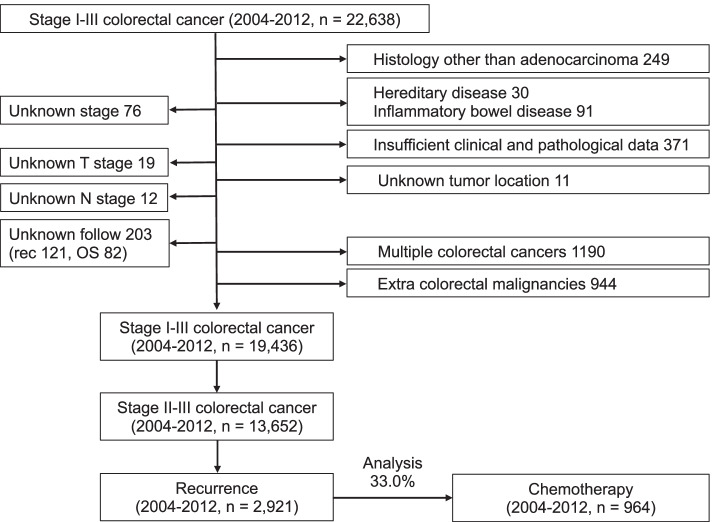
Methods: Subjects were 964 unresectable recurrent patients treated with chemotherapy with stage II-III CRC after curative resection between 2004 and 2012. Post-recurrence cancer-specific survival (CSS) for each sex was examined.
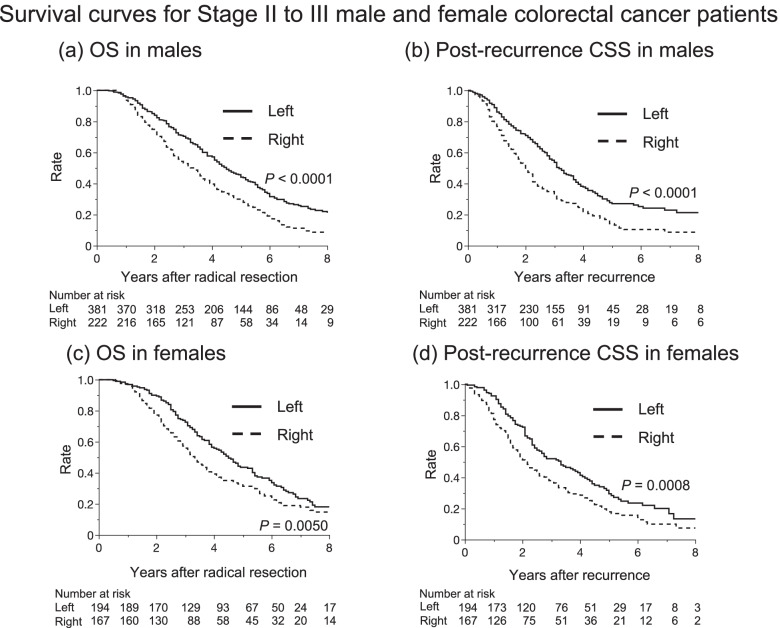
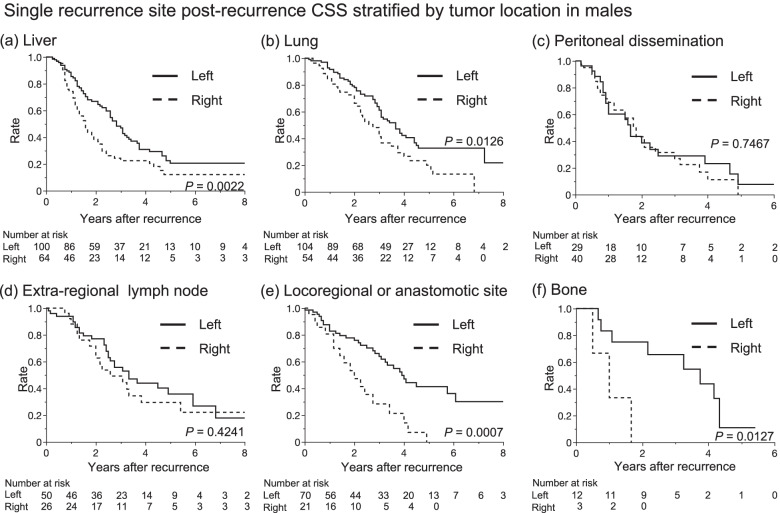
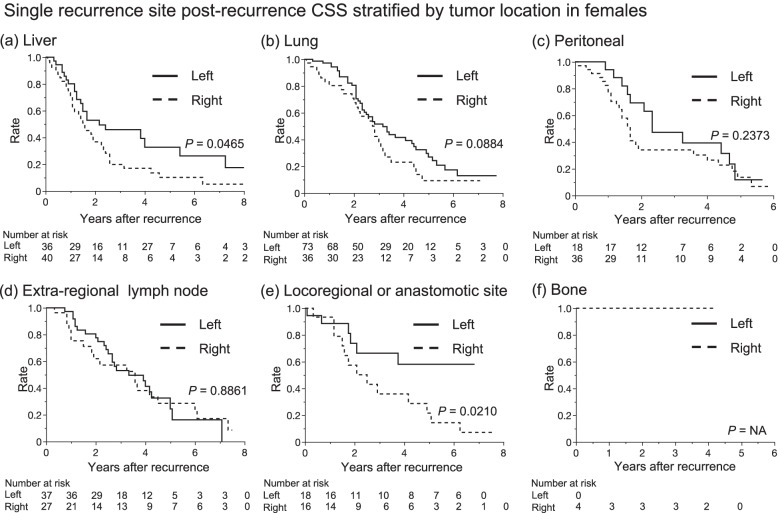
Results: Patients were 603 males (222 right-side tumors (cecum to transverse colon) and 381 left-sided tumors (descending colon to rectum)), and 361 females (167 right-side tumors and 194 left-sided tumors). Right-sided tumors developed peritoneal recurrences in males and females. Left-sided tumors were associated with locoregional recurrences in males and with lung recurrences in females. Right-sided tumors were associated with shorter post-recurrence CSS in both sexes. In males, multivariate analyses showed that right-sided tumors were associated with shorter post-recurrence CSS (HR: 1.53, P < 0.0001) together with the presence of regional lymph node metastasis histopathological type of other than differentiated adenocarcinoma, the recurrence of liver only, the recurrence of peritoneal dissemination only, and relapse-free interval less than one-year. In females, multivariate analyses showed that right-sided tumors were associated with shorter post-recurrence CSS (HR: 1.50, P = 0.0019) together with advanced depth of invasion, the presence of regional lymph node metastasis, and recurrence of liver only.
Conclusions: Primary tumor sidedness in both sexes in unresectable recurrent CRC patients treated with chemotherapy may have prognostic implications for post-recurrence CSS.
Keywords: Chemoradiotherapy; Colorectal cancer; Outcome; Primary tumor location; Prognostic marker.
© 2022. The Author(s).
Conflict of interest statement
The authors declare that they have no competing interests.
Figures
Similar articles
-
Prognostic impact of primary tumor location in Stage III colorectal cancer-right-sided colon versus left-sided colon versus rectum: a nationwide multicenter retrospective study.J Gastroenterol. 2020 Oct;55(10):958-968. doi: 10.1007/s00535-020-01706-7. Epub 2020 Jul 10. J Gastroenterol. 2020. PMID: 32651860
-
Prognostic impact of primary tumour location after curative resection in Stage I-III colorectal cancer: a single-centre retrospective study.Jpn J Clin Oncol. 2024 Jul 7;54(7):753-760. doi: 10.1093/jjco/hyae035. Jpn J Clin Oncol. 2024. PMID: 38535894
-
Prognostic Value of Primary Tumor Sidedness for Unresectable Stage IV Colorectal Cancer: A Retrospective Study.Ann Surg Oncol. 2019 May;26(5):1358-1365. doi: 10.1245/s10434-019-07209-x. Epub 2019 Feb 4. Ann Surg Oncol. 2019. PMID: 30719633
-
The primary tumor location impacts survival outcome of colorectal liver metastases after hepatic resection: A systematic review and meta-analysis.Eur J Surg Oncol. 2019 Aug;45(8):1349-1356. doi: 10.1016/j.ejso.2019.04.017. Epub 2019 Apr 25. Eur J Surg Oncol. 2019. PMID: 31054852
-
Prognostic value of primary tumor location in colorectal cancer: an updated meta-analysis.Clin Exp Med. 2023 Dec;23(8):4369-4383. doi: 10.1007/s10238-023-01120-2. Epub 2023 Jul 5. Clin Exp Med. 2023. PMID: 37405571 Review.
Cited by
-
Primary Tumor Sidedness Associated with Clinical Characteristics and Postoperative Outcomes in Colon Cancer Patients: A Propensity Score Matching Analysis.J Clin Med. 2024 Jun 22;13(13):3654. doi: 10.3390/jcm13133654. J Clin Med. 2024. PMID: 38999219 Free PMC article.
-
Development and validation of a novel risk score to predict overall survival following surgical clearance of bilobar colorectal liver metastases.BJS Open. 2023 Sep 5;7(5):zrad085. doi: 10.1093/bjsopen/zrad085. BJS Open. 2023. PMID: 37738617 Free PMC article.
-
Recent Trends in Biosensing and Diagnostic Methods for Novel Cancer Biomarkers.Biosensors (Basel). 2023 Mar 18;13(3):398. doi: 10.3390/bios13030398. Biosensors (Basel). 2023. PMID: 36979610 Free PMC article. Review.
References
Publication types
MeSH terms
Grants and funding
LinkOut - more resources
Full Text Sources
Medical
