


Predictive value of circulating NMR metabolic biomarkers for type 2 diabetes risk in the UK Biobank study
- PMID: 35501852
- PMCID: PMC9063288
- DOI: 10.1186/s12916-022-02354-9
Predictive value of circulating NMR metabolic biomarkers for type 2 diabetes risk in the UK Biobank study
Abstract
Background: Effective targeted prevention of type 2 diabetes (T2D) depends on accurate prediction of disease risk. We assessed the role of metabolomic profiling in improving T2D risk prediction beyond conventional risk factors.
Methods: Nuclear magnetic resonance (NMR) metabolomic profiling was undertaken on baseline plasma samples in 65,684 UK Biobank participants without diabetes and not taking lipid-lowering medication. Among a subset of 50,519 participants with data available on all relevant co-variates (sociodemographic characteristics, parental history of diabetes, lifestyle-including dietary-factors, anthropometric measures and fasting time), Cox regression yielded adjusted hazard ratios for the associations of 143 individual metabolic biomarkers (including lipids, lipoproteins, fatty acids, amino acids, ketone bodies and other low molecular weight metabolic biomarkers) and 11 metabolic biomarker principal components (PCs) (accounting for 90% of the total variance in individual biomarkers) with incident T2D. These 11 PCs were added to established models for T2D risk prediction among the full study population, and measures of risk discrimination (c-statistic) and reclassification (continuous net reclassification improvement [NRI], integrated discrimination index [IDI]) were assessed.
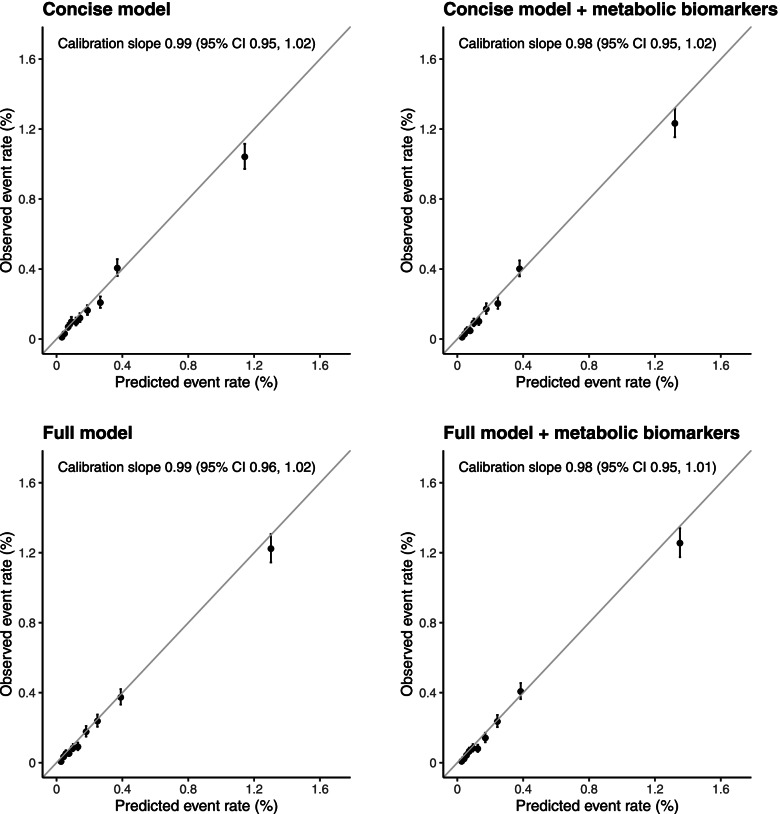
Results: During median 11.9 (IQR 11.1-12.6) years' follow-up, after accounting for multiple testing, 90 metabolic biomarkers showed independent associations with T2D risk among 50,519 participants (1211 incident T2D cases) and 76 showed associations after additional adjustment for HbA1c (false discovery rate controlled p < 0.01). Overall, 8 metabolic biomarker PCs were independently associated with T2D. Among the full study population of 65,684 participants, of whom 1719 developed T2D, addition of PCs to an established risk prediction model, including age, sex, parental history of diabetes, body mass index and HbA1c, improved T2D risk prediction as assessed by the c-statistic (increased from 0.802 [95% CI 0.791-0.812] to 0.830 [0.822-0.841]), continuous NRI (0.44 [0.38-0.49]) and relative (15.0% [10.5-20.4%]) and absolute (1.5 [1.0-1.9]) IDI. More modest improvements were observed when metabolic biomarker PCs were added to a more comprehensive established T2D risk prediction model additionally including waist circumference, blood pressure and plasma lipid concentrations (c-statistic, 0.829 [0.819-0.838] to 0.837 [0.831-0.848]; continuous NRI, 0.22 [0.17-0.28]; relative IDI, 6.3% [4.1-9.8%]; absolute IDI, 0.7 [0.4-1.1]).
Conclusions: When added to conventional risk factors, circulating NMR-based metabolic biomarkers modestly enhanced T2D risk prediction.
Keywords: Biomarkers; Diabetes; Metabolomics; Risk prediction.
© 2022. The Author(s).
Conflict of interest statement
The authors declare that they have no competing interests.
Figures

References
-
- Gillies CL, Abrams KR, Lambert PC, Cooper NJ, Sutton AJ, Hsu RT, et al. Pharmacological and lifestyle interventions to prevent or delay type 2 diabetes in people with impaired glucose tolerance: systematic review and meta-analysis. BMJ. 2007;334(7588):299. doi: 10.1136/bmj.39063.689375.55. - DOI - PMC - PubMed
-
- Gong Q, Zhang P, Wang J, Ma J, An Y, Chen Y, et al. Morbidity and mortality after lifestyle intervention for people with impaired glucose tolerance: 30-year results of the Da Qing diabetes prevention outcome study. Lancet Diabetes Endocrinol. 2019;7(6):452–461. doi: 10.1016/S2213-8587(19)30093-2. - DOI - PMC - PubMed
Publication types
MeSH terms
Substances
Grants and funding
LinkOut - more resources
Full Text Sources
Medical
