


The pyruvate decarboxylase activity of IpdC is a limitation for isobutanol production by Klebsiella pneumoniae
- PMID: 35501883
- PMCID: PMC9063327
- DOI: 10.1186/s13068-022-02144-8
The pyruvate decarboxylase activity of IpdC is a limitation for isobutanol production by Klebsiella pneumoniae
Abstract
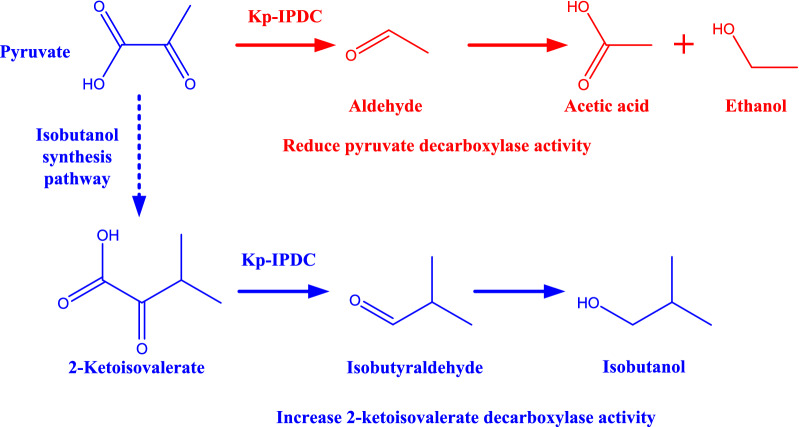
Background: Klebsiella pneumoniae contains an endogenous isobutanol synthesis pathway. The ipdC gene annotated as an indole-3-pyruvate decarboxylase (Kp-IpdC), was identified to catalyze the formation of isobutyraldehyde from 2-ketoisovalerate.
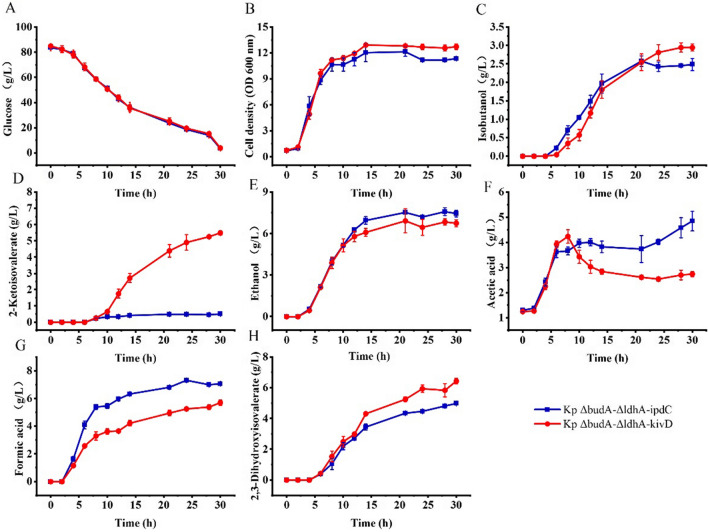
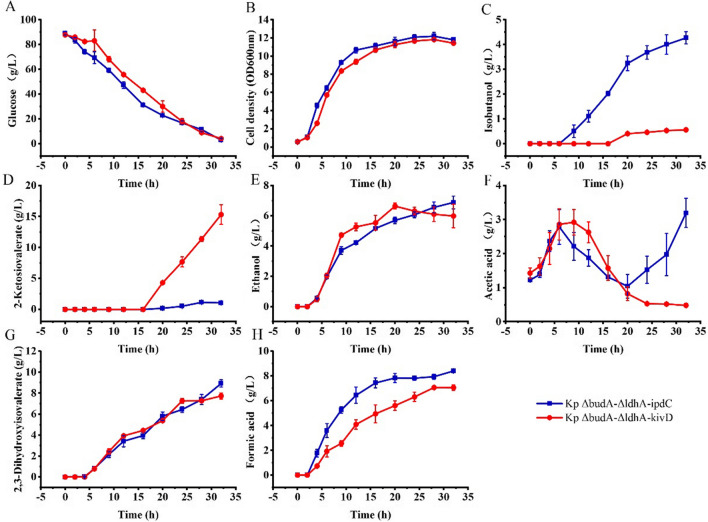
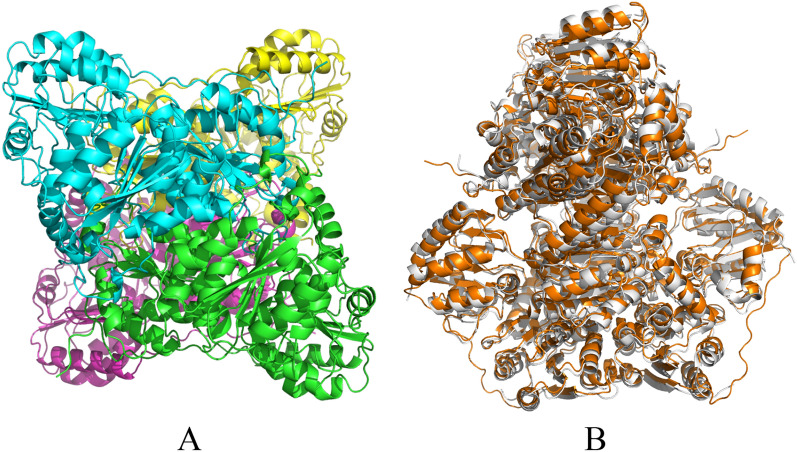
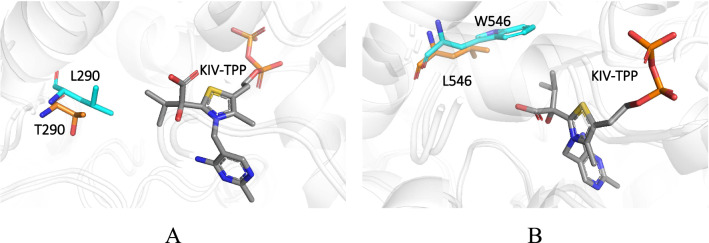
Results: Compared with 2-ketoisovalerate decarboxylase from Lactococcus lactis (KivD), a decarboxylase commonly used in artificial isobutanol synthesis pathways, Kp-IpdC has an 2.8-fold lower Km for 2-ketoisovalerate, leading to higher isobutanol production without induction. However, expression of ipdC by IPTG induction resulted in a low isobutanol titer. In vitro enzymatic reactions showed that Kp-IpdC exhibits promiscuous pyruvate decarboxylase activity, which adversely consume the available pyruvate precursor for isobutanol synthesis. To address this, we have engineered Kp-IpdC to reduce pyruvate decarboxylase activity. From computational modeling, we identified 10 amino acid residues surrounding the active site for mutagenesis. Ten designs consisting of eight single-point mutants and two double-point mutants were selected for exploration. Mutants L546W and T290L that showed only 5.1% and 22.1% of catalytic efficiency on pyruvate compared to Kp-IpdC, were then expressed in K. pneumoniae for in vivo testing. Isobutanol production by K. pneumoniae T290L was 25% higher than that of the control strain, and a final titer of 5.5 g/L isobutanol was obtained with a substrate conversion ratio of 0.16 mol/mol glucose.
Conclusions: This research provides a new way to improve the efficiency of the biological route of isobutanol production.
Keywords: 2-Ketoisovalerate decarboxylase; Indole-3-pyruvate decarboxylase; Isobutanol; Klebsiella pneumoniae.
© 2022. The Author(s).
Conflict of interest statement
Authors declare that they have no conflict of interest.
Figures


References
-
- Reis CER, Rajendran A, Hu B. New technologies in value addition to the thin stillage from corn-to-ethanol process. Rev Environ Sci Biotechnol. 2017;16:175–206. doi: 10.1007/s11157-017-9421-6. - DOI
-
- Tao L, Tan EC, McCormick R, Zhang M, Aden A, He X, Zigler BT. Techno-economic analysis and life-cycle assessment of cellulosic isobutanol and comparison with cellulosic ethanol and n-butanol. Biofuel Bioprod Biorefin. 2014;8:30–48. doi: 10.1002/bbb.1431. - DOI
-
- Raju NP, Rao BA. Performance and Emission characteristics of an indirect injection (IDI) diesel engine fuelled with Pongamia methyl ester (PME) and isobutanol as an additive. Int J Eng Res Technol. 2015;4:415–419.
-
- Karabektas M, Hosoz M. Performance and emission characteristics of a diesel engine using isobutanol-diesel fuel blends. Renew Energy. 2009;34:1554–1559. doi: 10.1016/j.renene.2008.11.003. - DOI