


Evaluation of Apixaban safety and effectiveness in morbidly obese patients with atrial fibrillation: a retrospective cohort study
- PMID: 35501916
- PMCID: PMC9063081
- DOI: 10.1186/s12959-022-00379-x
Evaluation of Apixaban safety and effectiveness in morbidly obese patients with atrial fibrillation: a retrospective cohort study
Abstract
Background: The benefit of apixaban to reduce stroke risk in morbidly obese patients with nonvalvular atrial fibrillation (AF) is still undetermined. The International Society of Thrombosis and Hemostasis recommends avoiding the use of direct oral anticoagulants (DOAC)s in morbidly obese patients (body mass index > 40 or weight > 120 kg) because of limited clinical data. This exploratory study aims to evaluate the effectiveness and safety of using apixaban in morbidly obese (body mass index (BMI) ≥ 40) patients with AF.
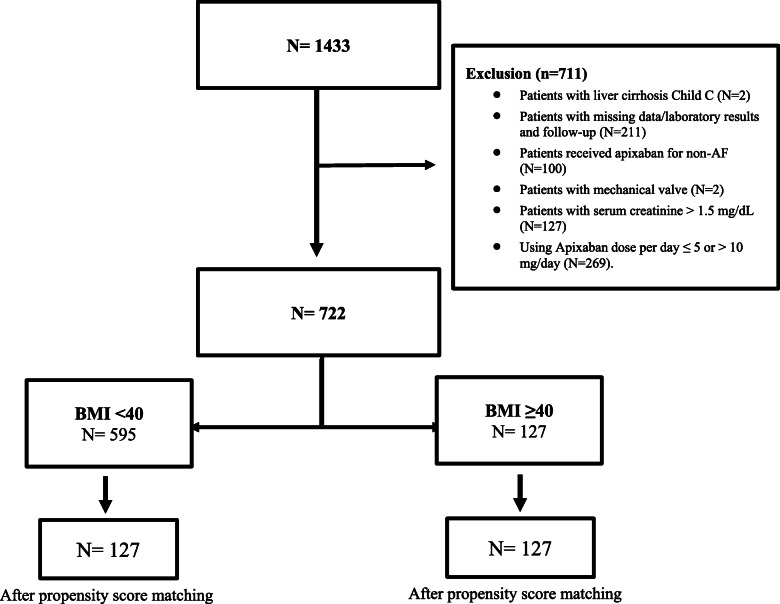
Methods: An exploratory retrospective cohort study was conducted at a single-center, including adult patients with non-valvular AF using apixaban between 01/01/2016 and 31/12/2019. Patients were excluded if they were known to have liver cirrhosis Child-Pugh C, mechanical valve, serum creatinine > 1.5 mg/dL, follow up < 3 months, or using apixaban with a dose of ≤5 or > 10 mg/day. Included patients were categorized into two groups based on their BMI (BMI<40 Vs. BMI ≥ 40). The primary outcome was all thrombotic events, while the secondary outcomes were major and minor bleeding after apixaban initiation. Propensity score (PS) matching was used (1:1 ratio) based on the patient's age, gender, and HAS-BLED score.
Results: A total of 722 patients were eligible; 254 patients were included after propensity score matching based on the selected criteria. The prevalence of all thrombotic events was similar between the two groups in the first year of apixaban initiation (OR (95%CI): 0.58 (0.13, 2.5), p-value = 0.46). In addition, the odds of developing major and minor bleeding were not statistically significant between the two groups (OR (95%CI): 0.39 (0.07, 2.03), p-value = 0.26 and OR (95%CI): 1.27 (0.56, 2.84), p-value = 0.40), respectively).
Conclusion: This exploratory study showed similar effectiveness and safety of apixaban use in both morbid and non-morbid obese patients with non-valvular AF. However, a larger randomized controlled trial with a longer follow-up period needs to confirm our findings.
Keywords: Apixaban; Atrial fibrillation; BMI ≥ 40; Bleeding; Morbidly obese; Thrombosis.
© 2022. The Author(s).
Conflict of interest statement
No author has a conflict of interest in this study.
Figures
References
-
- January CT, Wann LS, Calkins H, Chen LY, Cigarroa JE, Cleveland JC, et al. 2019 AHA/ACC/HRS focused update of the 2014 AHA/ACC/HRS guideline for the Management of Patients with Atrial Fibrillation: a report of the American College of Cardiology/American Heart Association task force on clinical practice guidelines and the Heart Rhythm Society in collaboration with the Society of Thoracic Surgeons. Circulation. 2019;140(2):e125–e151. doi: 10.1161/CIR.0000000000000665. - DOI - PubMed
-
- Hindricks G, Potpara T, Dagres N, Arbelo E, Bax JJ, Blomström-Lundqvist C, et al. 2020 ESC guidelines for the diagnosis and management of atrial fibrillation developed in collaboration with the European Association for Cardio-Thoracic Surgery (EACTS). Eur Heart J. 2021;42(5):373–498. 10.1093/eurheartj/ehaa612. - PubMed
-
- Ruff CT, Giugliano RP, Braunwald E, Hoffman EB, Deenadayalu N, Ezekowitz MD, Camm AJ, Weitz JI, Lewis BS, Parkhomenko A, Yamashita T, Antman EM. Comparison of the efficacy and safety of new oral anticoagulants with warfarin in patients with atrial fibrillation: a meta-analysis of randomised trials. Lancet. 2014;383(9921):955–962. doi: 10.1016/S0140-6736(13)62343-0. - DOI - PubMed
-
- de Souza Lima Bitar Y, Neto MG, JAL F, Pereira LV, KSO T, Akrami KM, et al. Comparison of the New Oral Anticoagulants and Warfarin in Patients with Atrial Fibrillation and Valvular Heart Disease: Systematic Review and Meta-Analysis. Drugs R D. 2019;19:117–126. doi: 10.1007/s40268-019-0274-z. - DOI - PMC - PubMed
LinkOut - more resources
Full Text Sources
