


The two-process model of sleep regulation: Beginnings and outlook
- PMID: 35502706
- PMCID: PMC9540767
- DOI: 10.1111/jsr.13598
The two-process model of sleep regulation: Beginnings and outlook
Abstract
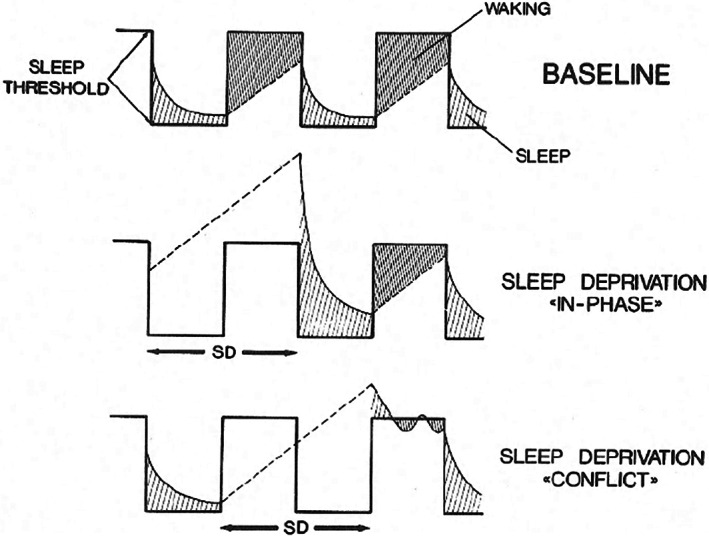
The two-process model serves as a major conceptual framework in sleep science. Although dating back more than four decades, it has not lost its relevance for research today. Retracing its origins, I describe how animal experiments aimed at exploring the oscillators driving the circadian sleep-wake rhythm led to the recognition of gradients of sleep states within the daily sleep period. Advances in signal analysis revealed that the level of slow-wave activity in non-rapid eye movement sleep electroencephalogram is high at the beginning of the 12-light period and then declines. After sleep deprivation, the level of slow-wave activity is enhanced. By scheduling recovery sleep to the animal's activity period, the conflict between the sleep-wake-dependent and the circadian influence resulted in a two-stage recovery pattern. These experiments provided the basis for the first version of the two-process model. Sleep deprivation experiments in humans showed that the decline of slow-wave activity during sleep is exponential. The two-process model posits that a sleep-wake-dependent homeostatic process (Process S) interacts with a process controlled by the circadian pacemaker (Process C). At present, homeostatic and circadian facets of sleep regulation are being investigated at the synaptic level as well as in the transcriptome and proteome domains. The notion of sleep has been extended from a global phenomenon to local representations, while the master circadian pacemaker has been supplemented by multiple peripheral oscillators. The original interpretation that the emergence of sleep may be viewed as an escape from the rigid control imposed by the circadian pacemaker is still upheld.
Keywords: circadian pacemaker; circadian sleep-wake rhythm; forced desynchrony; homeostatic process; sleep regulation; two-process model.
© 2022 The Author. Journal of Sleep Research published by John Wiley & Sons Ltd on behalf of European Sleep Research Society.
Conflict of interest statement
The authors declare no conflict of interest.
Figures
References
-
- Achermann, P. , & Borbély, A. A. (2017). Sleep homeostasis and models of sleep regulation. In Kryger M., Roth T., & Dement W. C. (Eds.), Principles and practice of sleep medicine (pp. 377–387). Elsevier Saunders.
-
- Blum, I. D. , Keles, M. F. , Baz, E.‐S. , Han, E. , Park, K. , Luu, S. , Issa, H., Brown, M., Ho, M. C.W., Tabuchi, M., Liu, S., & Wu, M. N. (2021). Astroglial calcium signaling encodes sleep need in drosophila. Current biology: CB, 31(1), 150–162.e157. 10.1016/j.cub.2020.10.012 - DOI - PMC - PubMed
-
- Borbély, A. (2019). Mehr als Schlaf. Erinnerungen und Erkundungen eines Schlafforschers. Tredition, Hamburg.
Publication types
MeSH terms
LinkOut - more resources
Full Text Sources
