


Integrating blue: How do we make nationally determined contributions work for both blue carbon and local coastal communities?
- PMID: 35503201
- PMCID: PMC9063623
- DOI: 10.1007/s13280-022-01723-1
Integrating blue: How do we make nationally determined contributions work for both blue carbon and local coastal communities?
Abstract
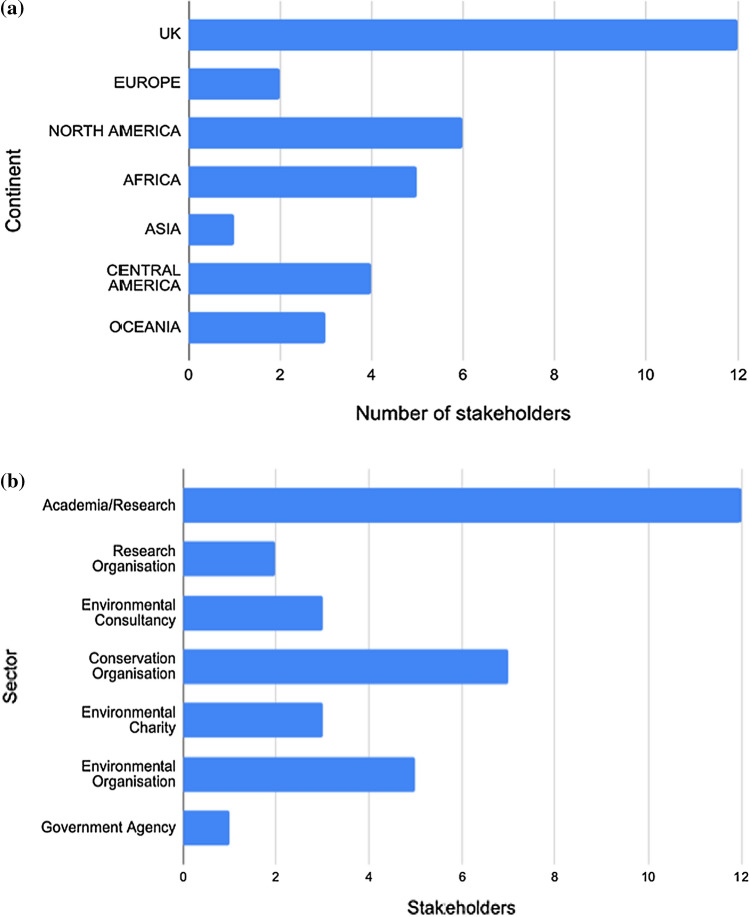
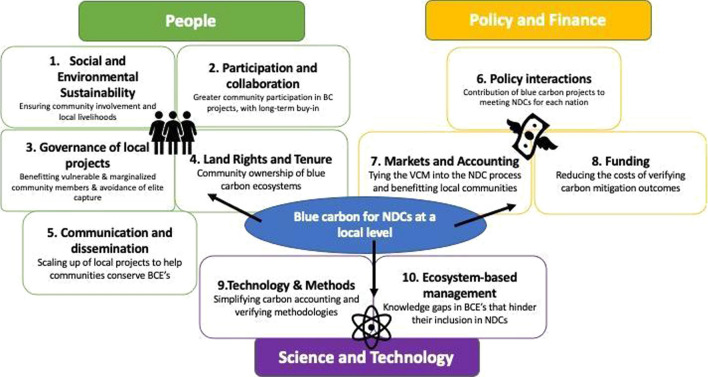
Blue Carbon Ecosystems (BCEs) help mitigate and adapt to climate change but their integration into policy, such as Nationally Determined Contributions (NDCs), remains underdeveloped. Most BCE conservation requires community engagement, hence community-scale projects must be nested within the implementation of NDCs without compromising livelihoods or social justice. Thirty-three experts, drawn from academia, project development and policy, each developed ten key questions for consideration on how to achieve this. These questions were distilled into ten themes, ranked in order of importance, giving three broad categories of people, policy & finance, and science & technology. Critical considerations for success include the need for genuine participation by communities, inclusive project governance, integration of local work into national policies and practices, sustaining livelihoods and income (for example through the voluntary carbon market and/or national Payment for Ecosystem Services and other types of financial compensation schemes) and simplification of carbon accounting and verification methodologies to lower barriers to entry.
Keywords: Blue carbon; Conservation; Local livelihoods; NDCs; Nature-based solutions; Sustainability.
© 2022. The Author(s).
Figures


References
-
- Association for Coastal Ecosystem Services. 2021. Mikoko Pamoja Project. https://www.aces-org.co.uk/mikoko-pamoja-project/. Accessed 12 May 2021
-
- Badola R, Barthwal S, Hussain SA. Attitudes of local communities towards conservation of mangrove forests: A case study from the east coast of India. Estuarine, Coastal and Shelf Science. 2012;96:188–196. doi: 10.1016/j.ecss.2011.11.016. - DOI
-
- Banjade, M.R., N. Liswanti, T. Herawati, and E. Mwangi. 2017. Governing mangroves: Unique challenges for managing Indonesia’s coastal forests. Bogor, Indonesia: CIFOR; Washington, DC: USAID Tenure and Global Climate Change Program (Report)
-
- Barnaud C, Van Paassen A. Equity, power games, and legitimacy: Dilemmas of participatory natural resource management. Ecology and Society. 2013;18:21. doi: 10.5751/ES-05459-180221. - DOI
-
- Beeston, M., L. Cuyvers, and J. Vermilye. 2020. Blue carbon: Mind the gap. Gallifrey Foundation, Geneva, Switzerland (Report)
MeSH terms
Substances
Grants and funding
LinkOut - more resources
Full Text Sources
