


Robust fetoscopic mosaicking from deep learned flow fields
- PMID: 35503395
- PMCID: PMC9124660
- DOI: 10.1007/s11548-022-02623-1
Robust fetoscopic mosaicking from deep learned flow fields
Erratum in
-
Correction to: Robust fetoscopic mosaicking from deep learned flow fields.Int J Comput Assist Radiol Surg. 2024 Jan;19(1):181. doi: 10.1007/s11548-023-03018-6. Int J Comput Assist Radiol Surg. 2024. PMID: 37787940 Free PMC article. No abstract available.
Abstract
Purpose: Fetoscopic laser photocoagulation is a minimally invasive procedure to treat twin-to-twin transfusion syndrome during pregnancy by stopping irregular blood flow in the placenta. Building an image mosaic of the placenta and its network of vessels could assist surgeons to navigate in the challenging fetoscopic environment during the procedure.
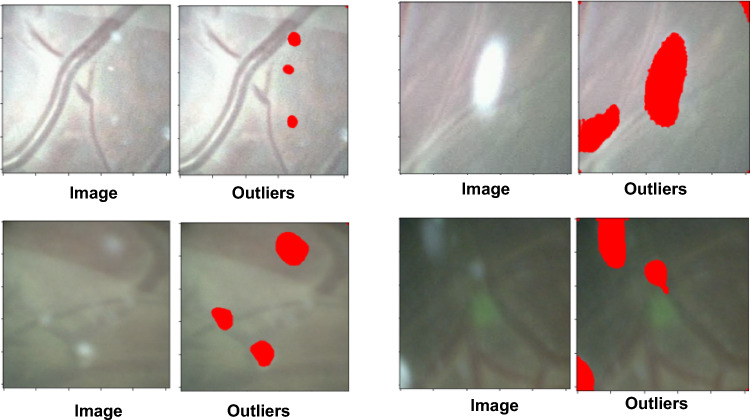
Methodology: We propose a fetoscopic mosaicking approach by combining deep learning-based optical flow with robust estimation for filtering inconsistent motions that occurs due to floating particles and specularities. While the current state of the art for fetoscopic mosaicking relies on clearly visible vessels for registration, our approach overcomes this limitation by considering the motion of all consistent pixels within consecutive frames. We also overcome the challenges in applying off-the-shelf optical flow to fetoscopic mosaicking through the use of robust estimation and local refinement.
Results: We compare our proposed method against the state-of-the-art vessel-based and optical flow-based image registration methods, and robust estimation alternatives. We also compare our proposed pipeline using different optical flow and robust estimation alternatives.
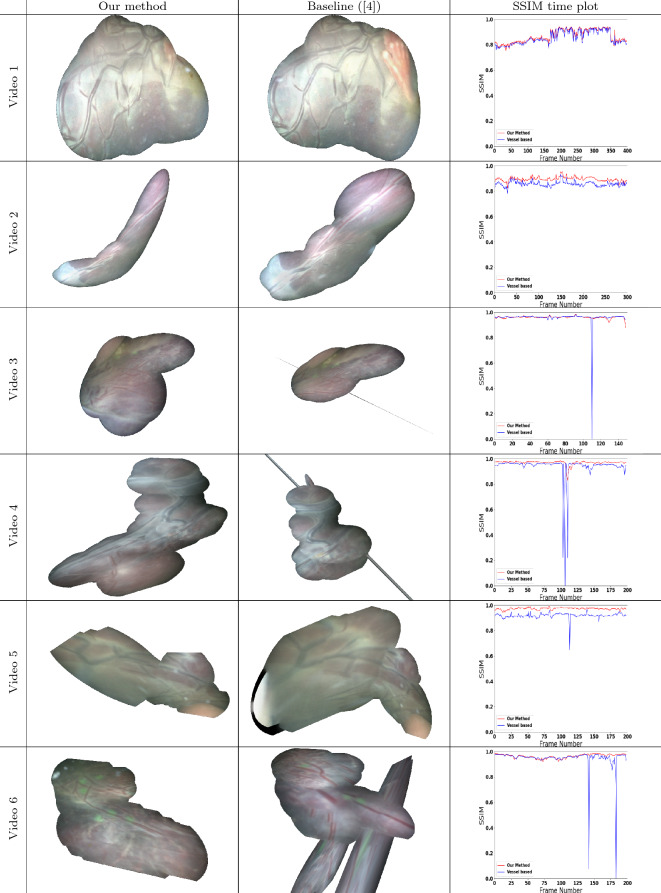
Conclusions: Through analysis of our results, we show that our method outperforms both the vessel-based state of the art and LK, noticeably when vessels are either poorly visible or too thin to be reliably identified. Our approach is thus able to build consistent placental vessel mosaics in challenging cases where currently available alternatives fail.
Keywords: Fetoscopy; Optical flow; Twin-to-twin transfusion syndrome; Video mosaicking.
© 2022. The Author(s).
Conflict of interest statement
The authors declare that they have no conflict of interest.
Figures



References
-
- Aubry M, Maturana D, Efros AA, Russell BC, Sivic J (2014) Seeing 3D chairs: Exemplar part-based 2d-3d alignment using a large dataset of cad models. In: IEEE conference on computer vision and pattern recognition
-
- Bano S, Casella A, Vasconcelos F, Moccia S, Attilakos G, Wimalasundera R, David A, Paladini D, Deprest J, Mattos L, Stoyanov D (2021) FetReg: Placental vessel segmentation and registration in fetoscopy challenge dataset
-
- Bano S, Vasconcelos F, Amo MT, Dwyer G, Gruijthuijsen C, Deprest J, Ourselin S, Vander Poorten E, Vercauteren T, Stoyanov D (2019) Deep sequential mosaicking of fetoscopic videos. In: International conference on medical image computing and computer-assisted intervention, pp 311–319. Springer
-
- Bano S, Vasconcelos F, Shepherd LM, Vander Poorten E, Vercauteren T, Ourselin S, David AL, Deprest J, Stoyanov D (2020) Deep placental vessel segmentation for fetoscopic mosaicking. In: Martel AL, Abolmaesumi P, Stoyanov D, Mateus D, Zuluaga MA, Zhou SK, Racoceanu D, Joskowicz L (eds) Medical image computing and computer assisted intervention – MICCAI 2020. Springer International Publishing, Cham, pp 763–773
MeSH terms
Grants and funding
LinkOut - more resources
Full Text Sources
