


Assessing the effect of the COVID-19 pandemic, shift to online learning, and social media use on the mental health of college students in the Philippines: A mixed-method study protocol
- PMID: 35503779
- PMCID: PMC9064082
- DOI: 10.1371/journal.pone.0267555
Assessing the effect of the COVID-19 pandemic, shift to online learning, and social media use on the mental health of college students in the Philippines: A mixed-method study protocol
Abstract
Introduction: The COVID-19 pandemic declared by the WHO has affected many countries rendering everyday lives halted. In the Philippines, the lockdown quarantine protocols have shifted the traditional college classes to online. The abrupt transition to online classes may bring psychological effects to college students due to continuous isolation and lack of interaction with fellow students and teachers. Our study aims to assess Filipino college students' mental health status and to estimate the effect of the COVID-19 pandemic, the shift to online learning, and social media use on mental health. In addition, facilitators or stressors that modified the mental health status of the college students during the COVID-19 pandemic, quarantine, and subsequent shift to online learning will be investigated.
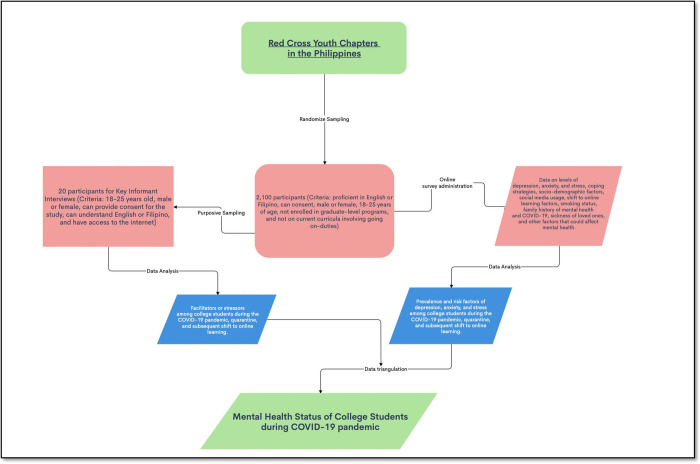
Methods and analysis: Mixed-method study design will be used, which will involve: (1) an online survey to 2,100 college students across the Philippines; and (2) randomly selected 20-40 key informant interviews (KIIs). Online self-administered questionnaire (SAQ) including Depression, Anxiety, and Stress Scale (DASS-21) and Brief-COPE will be used. Moreover, socio-demographic factors, social media usage, shift to online learning factors, family history of mental health and COVID-19, and other factors that could affect mental health will also be included in the SAQ. KIIs will explore factors affecting the student's mental health, behaviors, coping mechanism, current stressors, and other emotional reactions to these stressors. Associations between mental health outcomes and possible risk factors will be estimated using generalized linear models, while a thematic approach will be made for the findings from the KIIs. Results of the study will then be triangulated and summarized.
Ethics and dissemination: Our study has been approved by the University of the Philippines Manila Research Ethics Board (UPMREB 2021-099-01). The results will be actively disseminated through conference presentations, peer-reviewed journals, social media, print and broadcast media, and various stakeholder activities.
Conflict of interest statement
The authors have declared that no competing interests exist.
Figures
References
-
- Gazette O. Memorandum from the Executive Secretary On Community Quarantine Over the Entire Luzon and Further Guidelines for the Management of the Coronavirus Disease 2019 (COVID-19) Situation Manila, Philippines: Office of the President, Malacanang; 2020. [updated March 16, 2020; cited 2020]. Available from: https://www.officialgazette.gov.ph/2020/03/16/memorandum-from-the-execut...
Publication types
MeSH terms
LinkOut - more resources
Full Text Sources
Medical
