Case Reports
. 2022 Oct;46(8):101932.
doi: 10.1016/j.clinre.2022.101932. Epub 2022 Apr 30.

Covid19 vaccination-associated portal vein thrombosis-An interdisciplinary clinical challenge

Affiliations
Case Reports

Covid19 vaccination-associated portal vein thrombosis-An interdisciplinary clinical challenge

Niklas Bogovic et al. Clin Res Hepatol Gastroenterol. 2022 Oct.

Abstract

Despite one of the largest vaccination campaigns in human history, the COVID-19 pandemic has not been yet defeated. More than 10 billion doses of COVID-19 vaccine have been administered worldwide. AstraZeneca's Vaxzevria (ChAdOx1 nCoV-19 / AZD1222) was approved as the first viral vector-based vaccine in the EU on 29 January 2021. Thromboembolic events are a rare complication of vaccination with ChAdOx1 nCoV-19 in the context of, now known as vaccine-induced immune thrombotic thrombocytopenia (VITT), with an incidence of 1.5-3 in 100,000 vaccinations. VITT is clinically as well as pathophysiologically comparable to heparin-induced thrombocytopenia. Illustrated by a fulminant patient case, a multidisciplinary step-by-step guideline was developed for the recognition, diagnosis, and management of patients with severe acute portosplanchic venous thrombosis with mesenteric ischemia due to vaccine-induced immunogenic thrombotic thrombocytopenia.


Conflict of interest statement

Declaration of Competing Interest The authors declare that they have no known competing financial interests or personal relationships that could have appeared to influence the work reported in this paper.

Figures
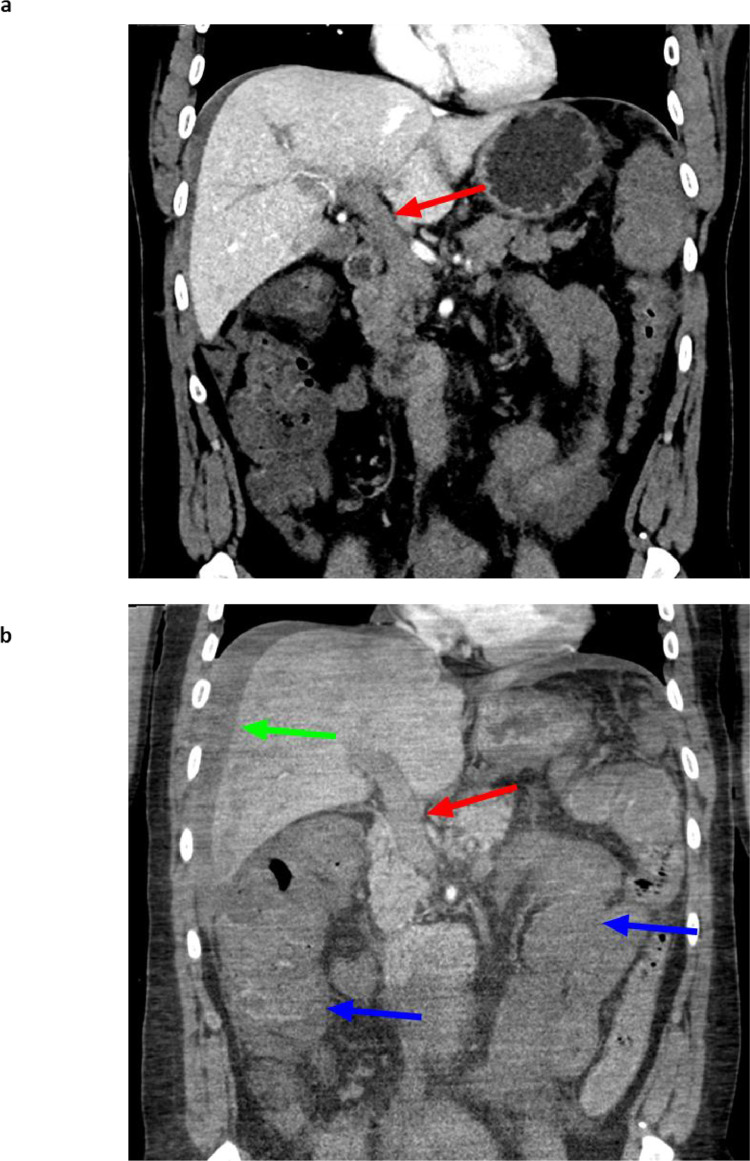
Fig 1
Fig. 1
Abdominal computer tomography examinations in portal-venous contrast phase (coronal images). a) Scan immediately after hospital admission showing complete portal vein thrombosis (red arrow). b) The repeated scan 16 hours later shows a clear deterioration with increased ascites (green arrow), intestinal oedema (blue arrow) and progression of the thrombosis (red arrow).
Fig 2
Fig. 2
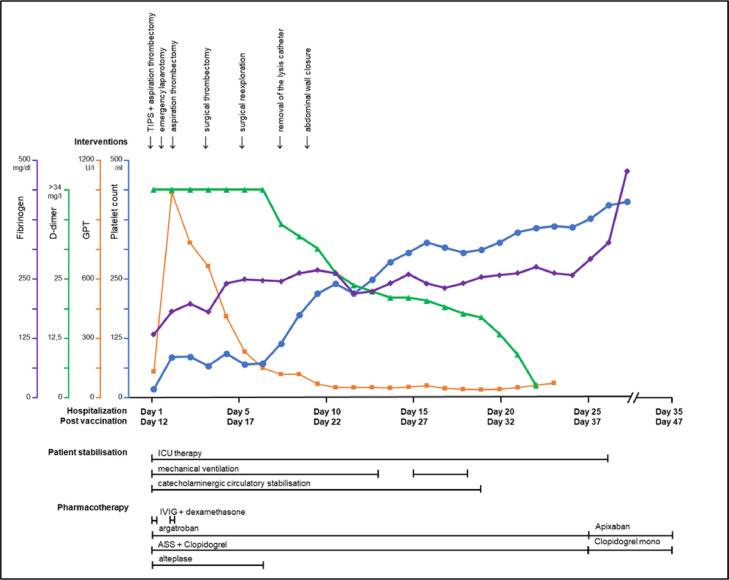
Overview of the patient's clinical course over time. The diagram shows the course of the levels of fibrinogen (purple), D-dimers (green), GPT (orange) and platelets (blue) in relation to the time after vaccination respectively after diagnosis of VITT-associated portal vein thrombosis. In addition, the durations of the pharmacological, interventional and surgical treatment measures are marked.
Fig 3
Fig. 3
Interventional therapeutic options in the treatment of VITT-associated portal vein thrombosis. a) Systematic illustration of interventional therapy options. Shown is a transjugular intrahepatic portosystemic (stent) shunt (TIPS) for reopening venous mesenteric flow and as angiographic access to the portal vein with the option of local drug thrombolysis or thrombectomy. In addition, a catheter inserted femorally into the AMS for indirect thrombolysis is drawn. b) X-ray fluoroscopy of angiographic TIPS implantation in a patient with thrombotic occlusion of portal vein and related splanchincus veins. c) CT-graphic follow-up after angiography (cf. Fig. 3b) with visible and perfused TIPS. In addition, bowel oedema is regressive compared to the previous scan in Fig. 1b. d) X-ray fluoroscopy of an angiographic insertion of a lysis catheter into the AMS via a femoral access. This can be used as an indirect route for pharmacological thrombolysis.
Fig 4
Fig. 4
Role of surgery in the treatment of VITT-associated portal vein thrombosis. a) Operative findings after emergency laparotomy due to an abdominal compartment, showing global venous ischaemia of the bowel. b) Systematic illustration of the surgical procedure of an open thrombectomy using a Fogarty catheter. Alternatively, a suction thrombectomy via the vascular access of the superior mesenteric vein is equally possible. c) Operative findings after restoration of venous mesenteric outflow by placement of a TIPS and surgical thrombectomy, showing a clearly recovered intestine. d) Duplex sonographic examination of liver perfusion showing adequate hepatopetal flow of the portal vein after TIPS insertion.
Fig 5
Fig. 5
Flow chart for the diagnostic and therapeutic procedure for VITT associated acute portal vein thrombosis.

References

    1. WHO - COVID-19 Tools (ACT) Accelerator; Available from: https://www.who.int/initiatives/act-accelerator.
    1. WHO Coronavirus (COVID-19) Dashboard; Available from: https://covid19.who.int/.
    1. MacIntyre CR, Veness B, Berger D, Hamad N, Bari N. Thrombosis with Thrombocytopenia Syndrome (TTS) following AstraZeneca ChAdOx1 nCoV-19 (AZD1222) COVID-19 vaccination - A risk-benefit analysis for people < 60 years in Australia. Vaccine. 2021;39(34):4784–4787. doi: 10.1016/j.vaccine.2021.07.013. - DOI - PMC - PubMed
    1. National Institute for Health and Care Excellence. Covid-19 rapid guideline: vaccine-induced immune thrombocytopenia and thrombosis (VITT): NICE guideline [NG200], 2021. - PubMed
    1. Greinacher A, Thiele T, Warkentin TE, Weisser K, Kyrle PA, Eichinger S. Thrombotic thrombocytopenia after ChAdOx1 nCov-19 vaccination. N Engl J Med. 2021;384(22):2092–2101. doi: 10.1056/NEJMoa2104840. - DOI - PMC - PubMed

Publication types