Effect of adolescent pregnancy on child mortality in 46 countries
- PMID: 35504693
- PMCID: PMC9066488
- DOI: 10.1136/bmjgh-2021-007681
Effect of adolescent pregnancy on child mortality in 46 countries
Abstract
Introduction: Adolescent pregnancy is a known health risk to mother and child. Statements and reports of health outcomes typically group mothers under 20 years old together. Few studies examined this risk at a finer age resolution, none of them comprehensively, and with differing results.
Methods: We analysed Demographic and Health Surveys data from 2004 to 2018 in sub-Saharan Africa (SSA) and South Asia, on firstborn children of mothers 25 years old or younger. We examined the association between maternal age and stillbirths, and neonatal mortality rate (NNMR), infant mortality rate (IMR) and under-5 mortality rate (U5MR), using mixed-effects logistic regression adjusting for major demographic variables and exploring the impact of maternal health-seeking.
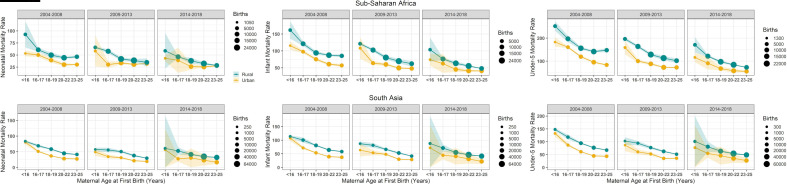
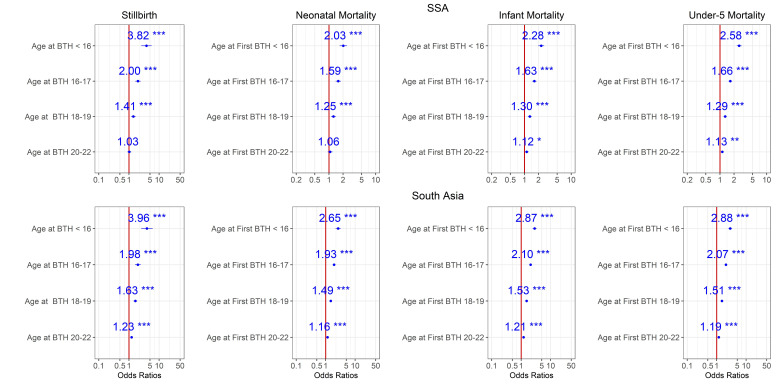
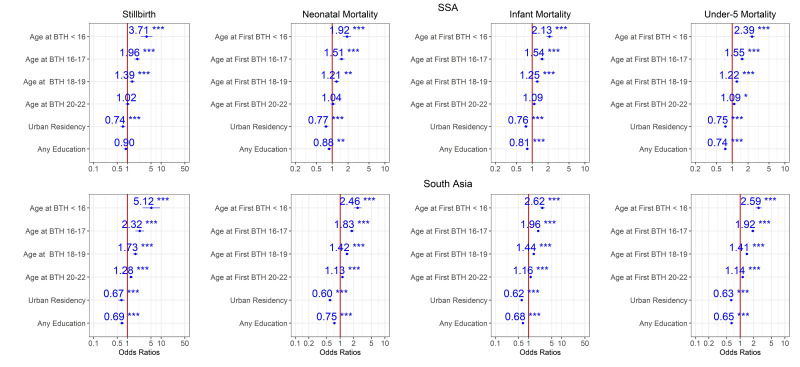
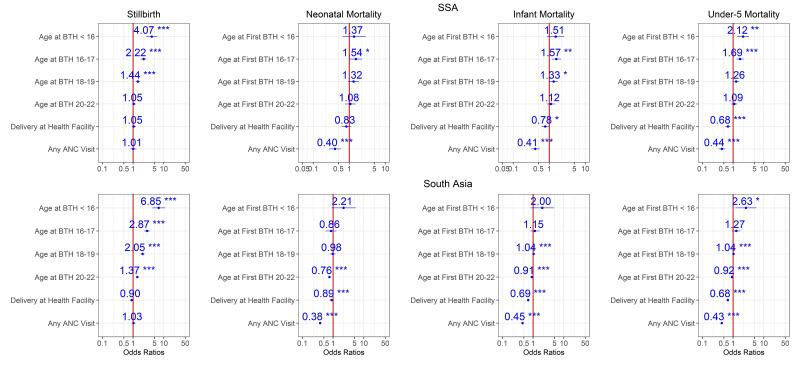
Results: In both regions and across all endpoints, mortality rates of children born to mothers aged <16 years, 16-17 years and 18-19 years at first birth were about 2-4 times, 1.5-2 times and 1.2-1.5 times higher, respectively, than among firstborn children of mothers aged 23-25. Absolute mortality rates declined over time, but the age gradient remained similar across time periods and regions. Adjusting for rural/urban residence and maternal education, in SSA in 2014-2018 having a <16-year-old mother was associated with ORs of 3.71 (95% CI: 2.50 to 5.51) for stillbirth, 1.92 (1.60-2.30) for NNMR, 2.13 (1.85-2.46) for IMR and 2.39 (2.13-2.68) for U5MR, compared with having a mother aged 23-25. In South Asia, in 2014-2018 ORs were 5.12 (2.85-9.20) for stillbirth, 2.46 (2.03-2.97) for NNMR, 2.62 (2.22-3.08) for IMR and 2.59 (2.22-3.03) for U5MR. Part of the effect on NNMR and IMR may be mediated by a lower maternal health-seeking rate.
Conclusions: Adolescent pregnancy is associated with dramatically worse child survival and mitigated by health-seeking behaviour, likely reflecting a combination of biological and social factors. Refining maternal age reporting will avoid masking the increased risk to children born to very young adolescent mothers. Collection of additional biological and social data may better reveal mediators of this relationship. Targeted intervention strategies to reduce unintended pregnancy at earlier ages may also improve child survival.
Keywords: child health; descriptive study; maternal health; public health.
© Author(s) (or their employer(s)) 2022. Re-use permitted under CC BY-NC. No commercial re-use. See rights and permissions. Published by BMJ.
Conflict of interest statement
Competing interests: None declared.
Figures
References
-
- WHO . Adolescent pregnancy-WHO. Available: https://www.who.int/news-room/fact-sheets/detail/adolescent-pregnancy [Accessed 03 Feb 2021].
-
- UNICEF . Early childbearing – UNICEF data. Available: https://data.unicef.org/topic/child-health/adolescent-health/#:~:text=Gl... [Accessed 03 Feb 2021].
Publication types
MeSH terms
LinkOut - more resources
Full Text Sources
Medical
Research Materials